The discovery of the Indian Spotted Neck Gecko (Cnemaspis salimalii) in the Western Ghats during 2023 represents an exceptional opportunity for 3D scientific visualization. This species, named in honor of ornithologist Salim Ali, exhibits unique coloration patterns that pose a technical challenge for photorealistic texturing. Below, we detail the workflow for digitally recreating this small lizard, from reference capture to integration into its natural habitat.
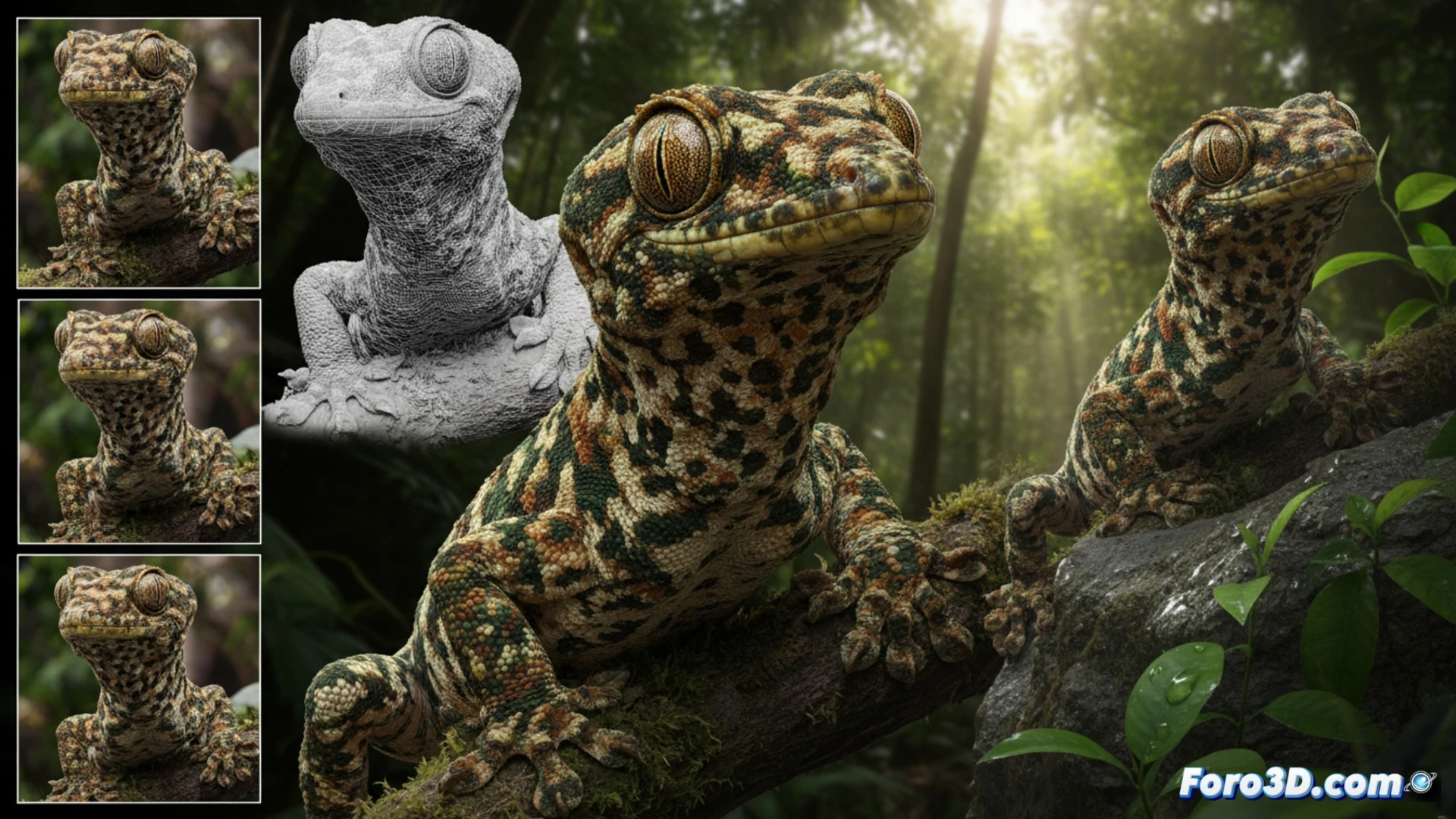
Technical workflow for modeling and texturing 🦎
Start the process in Blender or ZBrush using a base model of a lacertid from the genus Cnemaspis. The key lies in the topology of the head and neck, where the characteristic spots are concentrated. Sculpt the dorsal scales with a custom brush in ZBrush to achieve the keratinized microstructure. Export the model to Substance Painter for texturing. Generate a displacement map based on high-resolution photographs of type specimens. The coloration patterns require procedural masks that combine irregular dark brown spots on a light ochre background, replicating individual variations. Finish with a roughness map that differentiates the ventral areas (smoother) from the dorsal ones (rougher).
Ecosystem reconstruction and comparative analysis 🌿
For the digital reconstruction of the habitat in the Western Ghats, model the substrate of leaf litter and laterite rocks using photogrammetric scans. Light the scene with a filtered ambient light system (God Rays) to simulate the tropical forest canopy. Finally, compare your model with other species of the genus Cnemaspis in an interactive viewer. Adjust the morphology of the digital pads and tail length to highlight the ecological adaptations of C. salimalii. This approach not only documents the species but also allows researchers to study its anatomy without the need to manipulate live specimens.
What specific 3D modeling techniques for representing scales and coloration patterns in Cnemaspis salimalii allow biologists to better visualize its camouflage in the microhabitats of the Western Ghats?
(PS: fluid physics for simulating the ocean is like the sea: unpredictable and you always run out of RAM)