The recent incident of a joint failure in a light urban vehicle has sparked a technical debate within the automotive community. From a 3D modeling perspective, this type of failure is not random, but rather the result of cyclic stresses concentrated in the joint geometry. In this article, we will analyze how to digitally replicate the faulty joint, simulating the mechanical and thermal stresses that led to material fatigue, and proposing a viable structural improvement for light mobility systems.
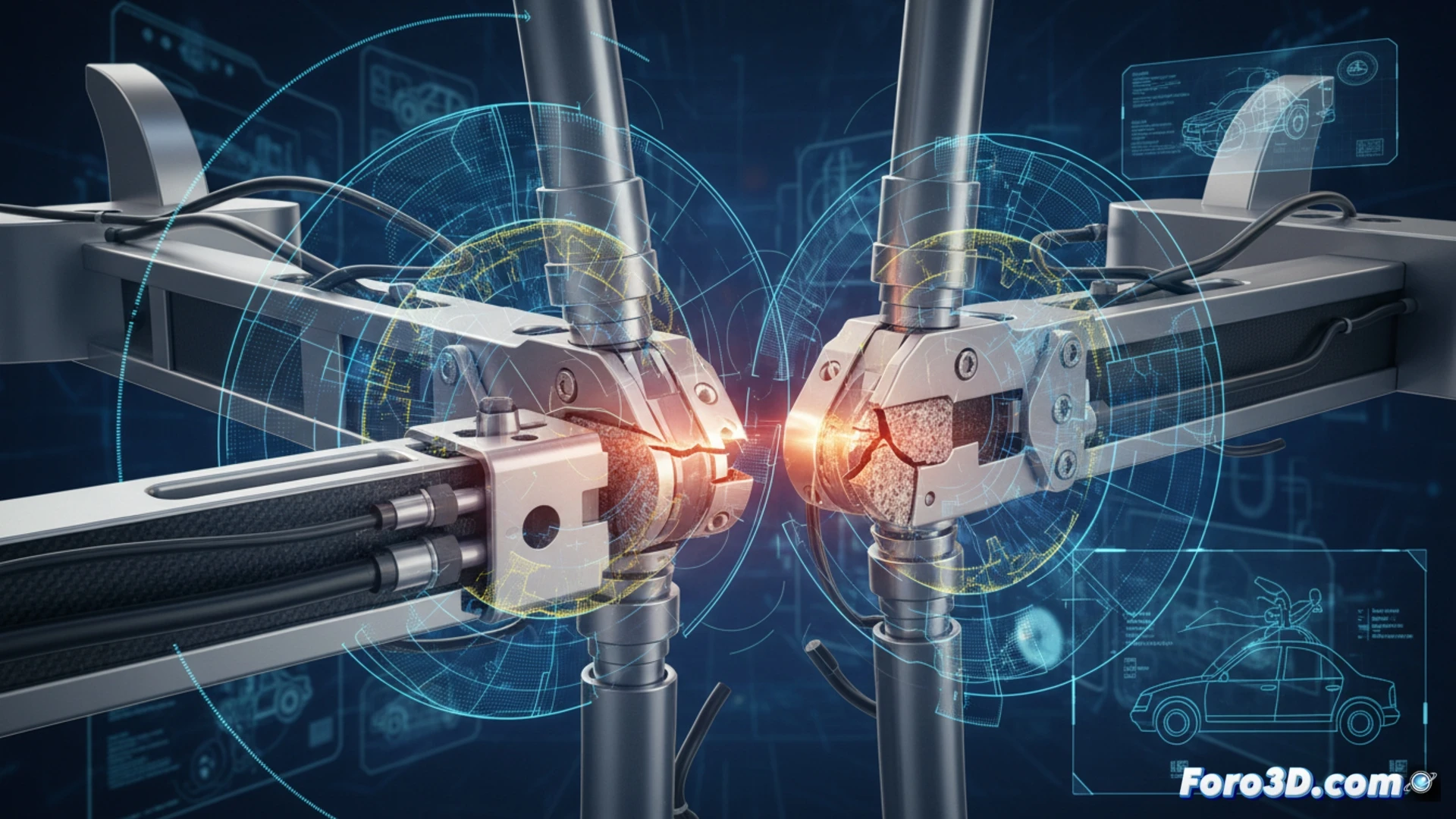
Fatigue simulation in light chassis joint 🔧
To address the failure, we begin by 3D modeling the critical joint of the frame, typically a spot weld or an aluminum threaded insert. Using finite element software such as ANSYS or Abaqus, we apply dynamic loading conditions equivalent to urban driving: low-frequency vibrations, cornering torsion, and thermal cycles from 20 to 80 degrees Celsius. The results showed a stress concentration at the weld radius, exceeding the material's yield limit after 50,000 cycles. The thermal simulation further revealed that the differential expansion between the chassis steel and the joint aluminum generated microcracks, visible in the 3D mesh as zones of localized plastic deformation. This analysis allows visualizing the exact point of failure initiation and quantifying its propagation.
Parametric redesign to avoid fatigue 🛠️
Technical reflection leads us to modify the original design in the 3D environment. I propose a change in the joint geometry, increasing the weld fillet radius by 30% and adding a relief chamfer to the aluminum insert. Additionally, a material change in the joint can be simulated, switching to a magnesium alloy with a thermal expansion coefficient closer to that of steel. The new simulation shows a 45% reduction in maximum stress and an increase in service life to over 200,000 cycles. This approach demonstrates that 3D modeling is not only useful for diagnosing failures but also for iterating concrete solutions in light automotive applications.
What 3D modeling and simulation techniques allow for more accurate prediction of joint failures in light urban vehicle structures under dynamic loading conditions?
(PS: ADAS systems are like in-laws: always watching what you do)