In 2024, an oceanographic expedition off the coast of New Zealand revealed a new species of abyssal fish to the world: the Bounty Eelpout, belonging to the family Zoarcidae. This organism, with an elongated body and gelatinous texture, has captured the attention of the scientific community not only for its biological uniqueness but also for the challenge its study poses. Inhabiting extreme depths makes obtaining intact specimens nearly impossible, turning 3D modeling into an indispensable tool for its analysis.
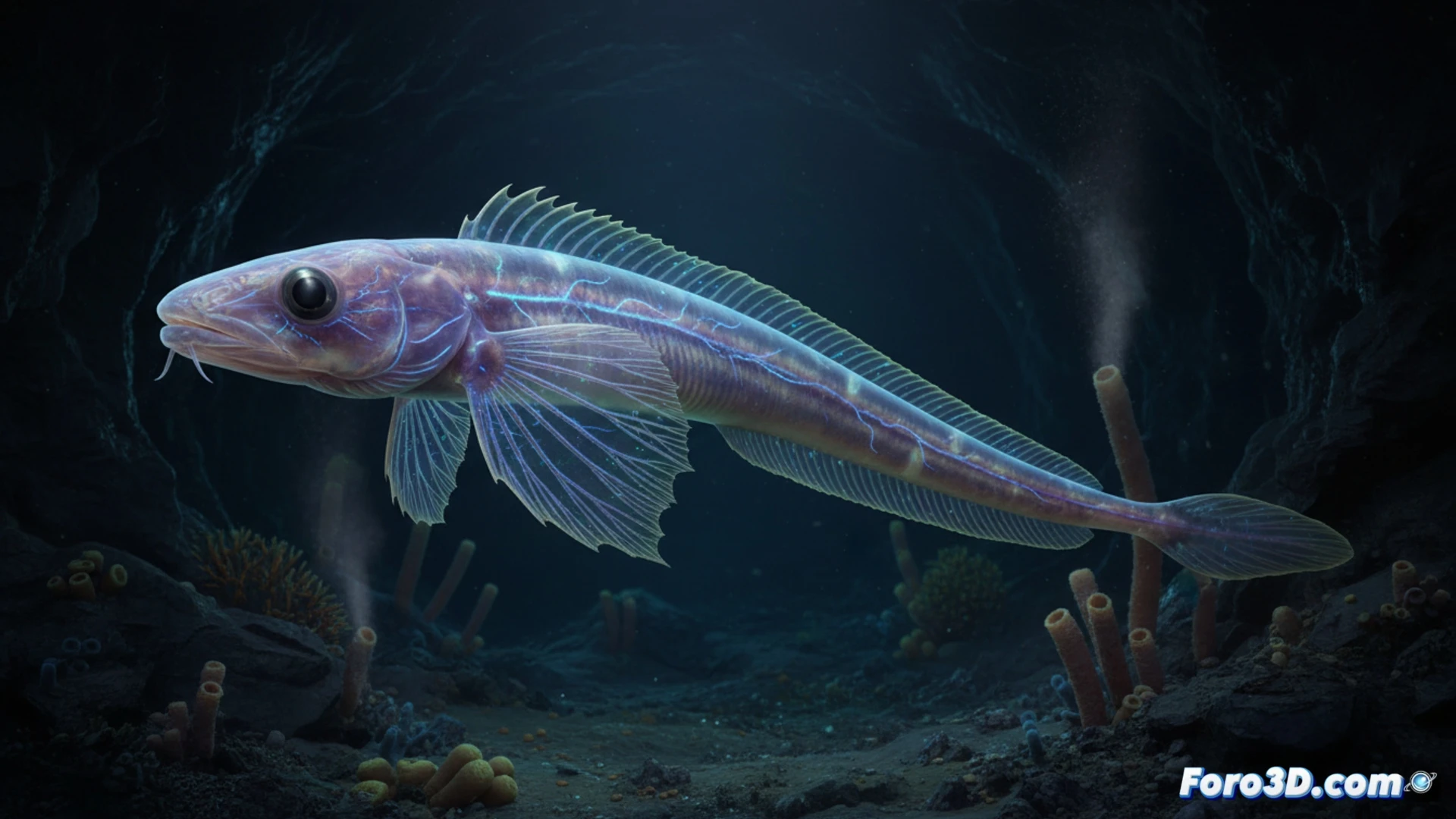
Anatomical reconstruction and habitat representation 🐟
For scientific visualization specialists, the Bounty Eelpout represents a fascinating case study. The modeling process begins with the digitization of the few collected specimens, using structured light scanners and photogrammetry. From this data, a polygonal mesh is built that captures the elongated morphology and semi-transparency of its skin. The real challenge lies in recreating the bathypelagic environment: a dark seabed, with soft sediments and cold currents, where lighting must simulate ambient bioluminescence. Tools like Blender or Houdini allow integrating these elements, generating a digital twin that researchers can rotate, virtually dissect, and share without risking the original specimen.
Scientific dissemination in the era of the digital twin 🌐
Beyond the laboratory, 3D visualization of this species democratizes knowledge. Virtual museums and educational platforms can host these interactive models, allowing anyone to explore the anatomy of the Bounty Eelpout from their home. This approach eliminates the need to preserve specimens in formaldehyde and reduces the impact of expeditions. In the end, the 3D model not only documents a discovery; it becomes the specimen itself for future generations of biologists and marine life enthusiasts.
What technical and methodological challenges does the transition from bathymetric data and underwater photographs to a photorealistic 3D model of the Bounty Eelpout present for its use in scientific visualization?
(PS: modeling manta rays is easy; the hard part is making them not look like floating plastic bags)