The botanical community has received a reminder that nature still holds colossal secrets. In 2024, the Drypetes oliveri, a 35-meter-tall tree in the Tambopata National Reserve, Peru, was officially identified. Its monumental size contrasts with the fact that it had evaded scientific classification for decades, a phenomenon that 3D visualization can now help understand and disseminate.
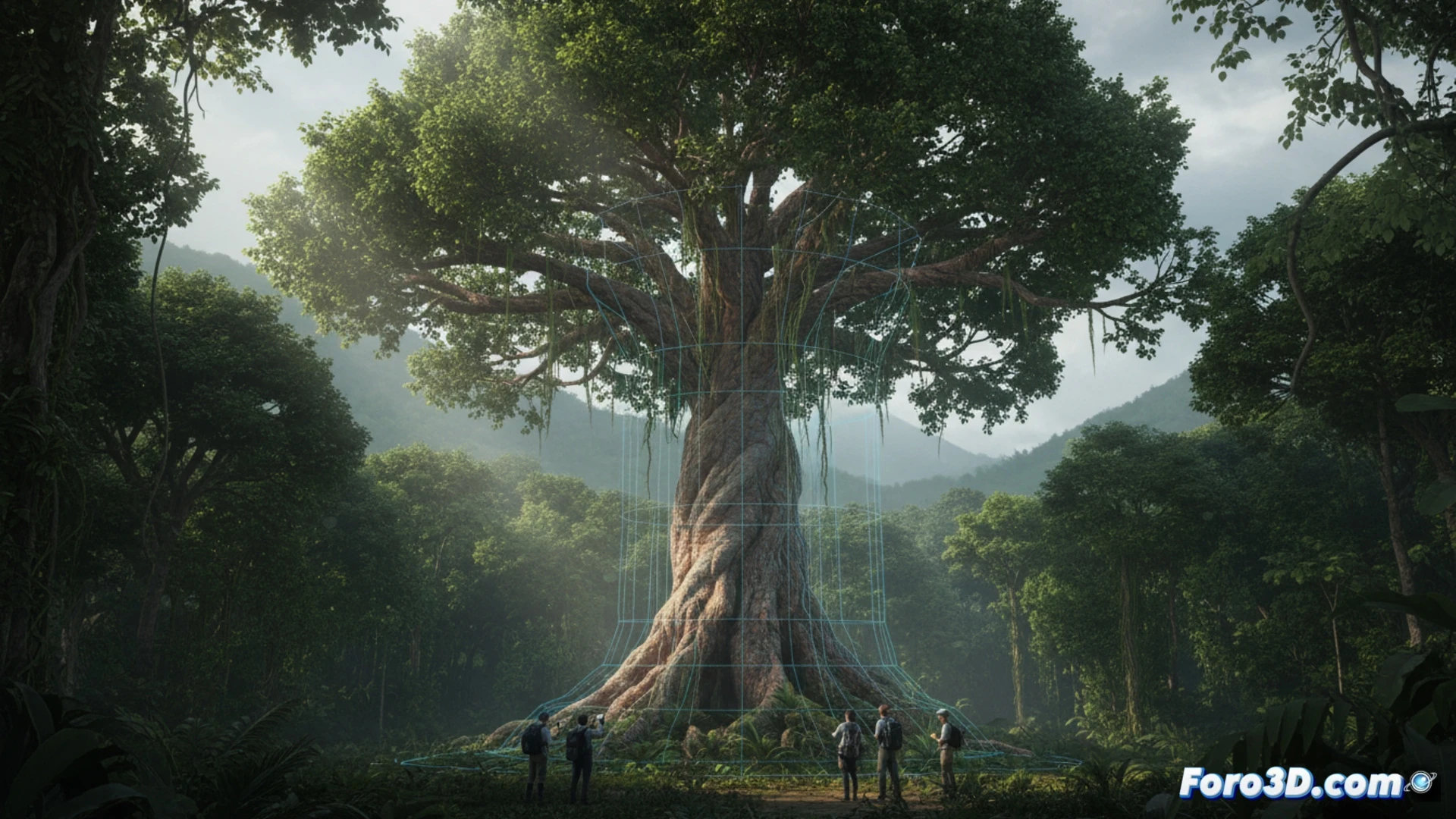
Digital canopy reconstruction and parametric scaling 🌿
For a scientific visualization project, the first challenge is scale. A photorealistic model of this tree requires a high-density polygonal mesh to capture the rough texture of its bark and the complexity of its branch system. The critical step is integrating a 1.70-meter human figure into the scene; this scaling resource, combined with an animation rig to simulate foliage movement with the wind, allows the viewer to appreciate the true magnitude of the specimen. Furthermore, reconstructing the Tambopata canopy using public LIDAR data would enable simulating light competition and this giant's interaction with the lower forest layers, generating a valuable dataset for ecological studies.
3D tools for conserving the invisible 🔍
The existence of the Drypetes oliveri raises an uncomfortable question: how many other giants go unnoticed beneath the canopy. 3D modeling serves not only for outreach but as an active conservation tool. A digital twin of this tree, textured with high-resolution images and precisely geolocated, can serve as a reference for park rangers and biologists, allowing them to monitor its phenological state without physically intervening in its habitat. It is technology applied to protecting what we have yet to discover.
How were photogrammetry techniques integrated with LiDAR scanning data to reconstruct the three-dimensional structure of the Drypetes oliveri and visualize its hidden biomass in the Tambopata canopy?
(PS: fluid physics for simulating the ocean is like the sea: unpredictable and you always run out of RAM)