The herpetological community has added a new gem to its catalog: the Cyrtodactylus rufford, or Thailand Slender-Toed Gecko, discovered in 2023 in the karst formations of northern Thailand. This nocturnal lizard features a pattern of dark transverse bands on a light brown background, a prehensile tail, and notably slender toes, direct adaptations to life in limestone rock crevices. For the 3D artist specializing in scientific visualization, this specimen presents a fascinating challenge: translating newly published taxonomic data into a photorealistic polygonal mesh that accurately reflects its unique morphology and cryptic behavior.
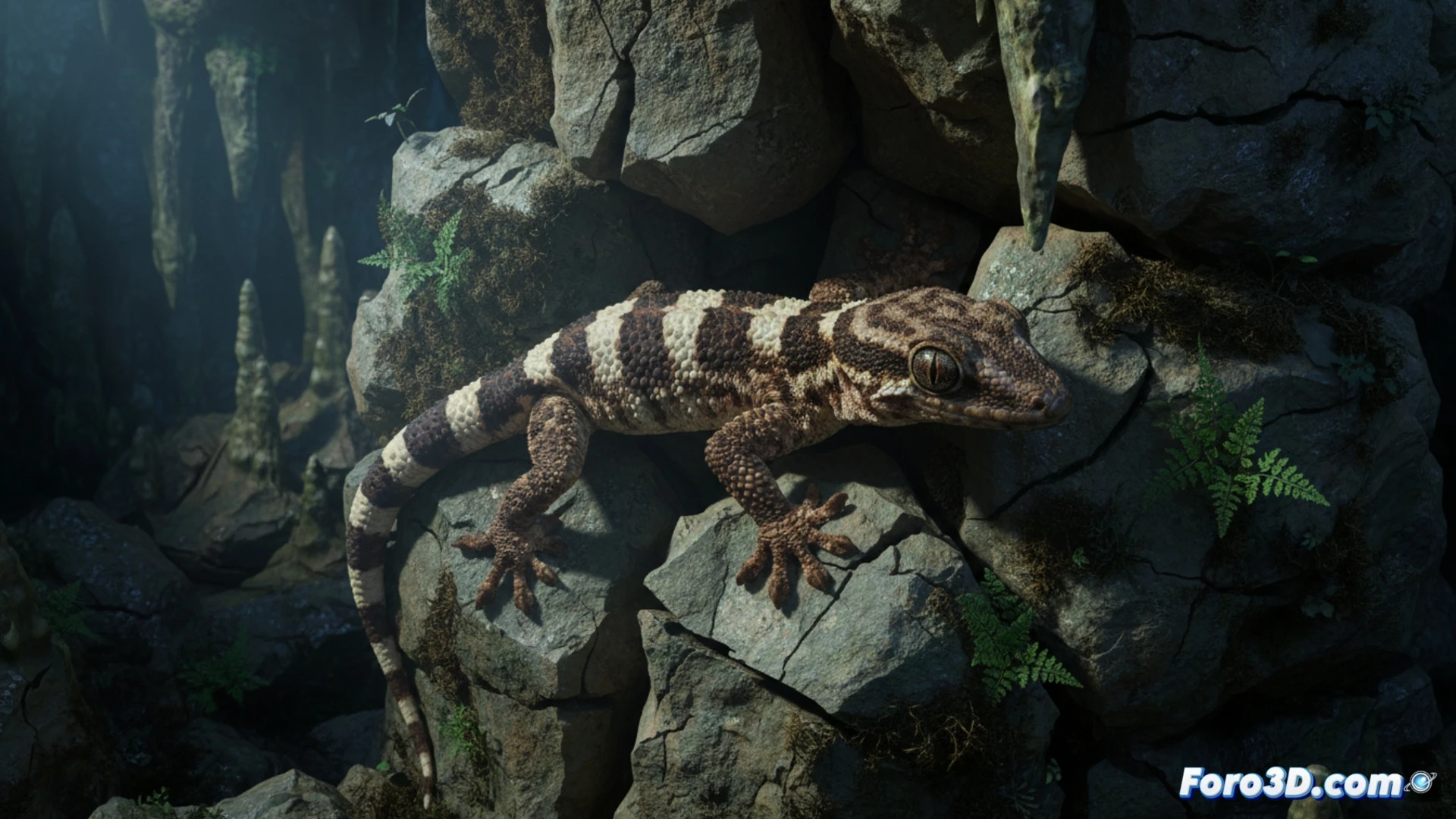
Technical pipeline for the anatomical reconstruction of Cyrtodactylus rufford 🦎
The process begins with studying the original publication, which details the dorsal scalation (keeled scales in 18-20 rows), the subdigital lamellae formula, and the unique head proportion (wider than long). In ZBrush, a generic lizard base is sculpted and then deformed to adjust cranial proportions and the tail, which in this species measures 1.3 times the body length. Texturing in Substance Painter must replicate the dark transverse bands (4-5 bands on the trunk) with irregular edges to simulate camouflage on limestone rock. Render lighting is key: being a nocturnal species, the scene should simulate moonlight filtered through the jungle canopy, with soft shadows revealing the granular texture of the skin. The final animation should show the gecko moving laterally across a karst cave wall, using its tail as a counterbalance, a behavior documented in field sightings.
The challenge of representing the newly discovered 🧬
Modeling a species described just a year ago involves working with limited reference material: only preserved holotypes and grainy night videos. Here, scientific visualization becomes a bridge between empirical observation and public understanding. Every scale, every band must be a visual hypothesis based on data, not artistic license. The true success of this project lies not in superficial realism, but in whether a herpetologist can identify the species from the 3D model, confirming that the toe geometry and banding pattern match the scientific diagnosis. That is the quality standard we aim for at Foro3D for this niche.
What photogrammetry and 3D scanning techniques were used to accurately capture the morphology of Cyrtodactylus rufford, and how do these data influence the validation of its new species within the Thai karst ecosystem?
(PS: modeling manta rays is easy; the hard part is making them not look like floating plastic bags)