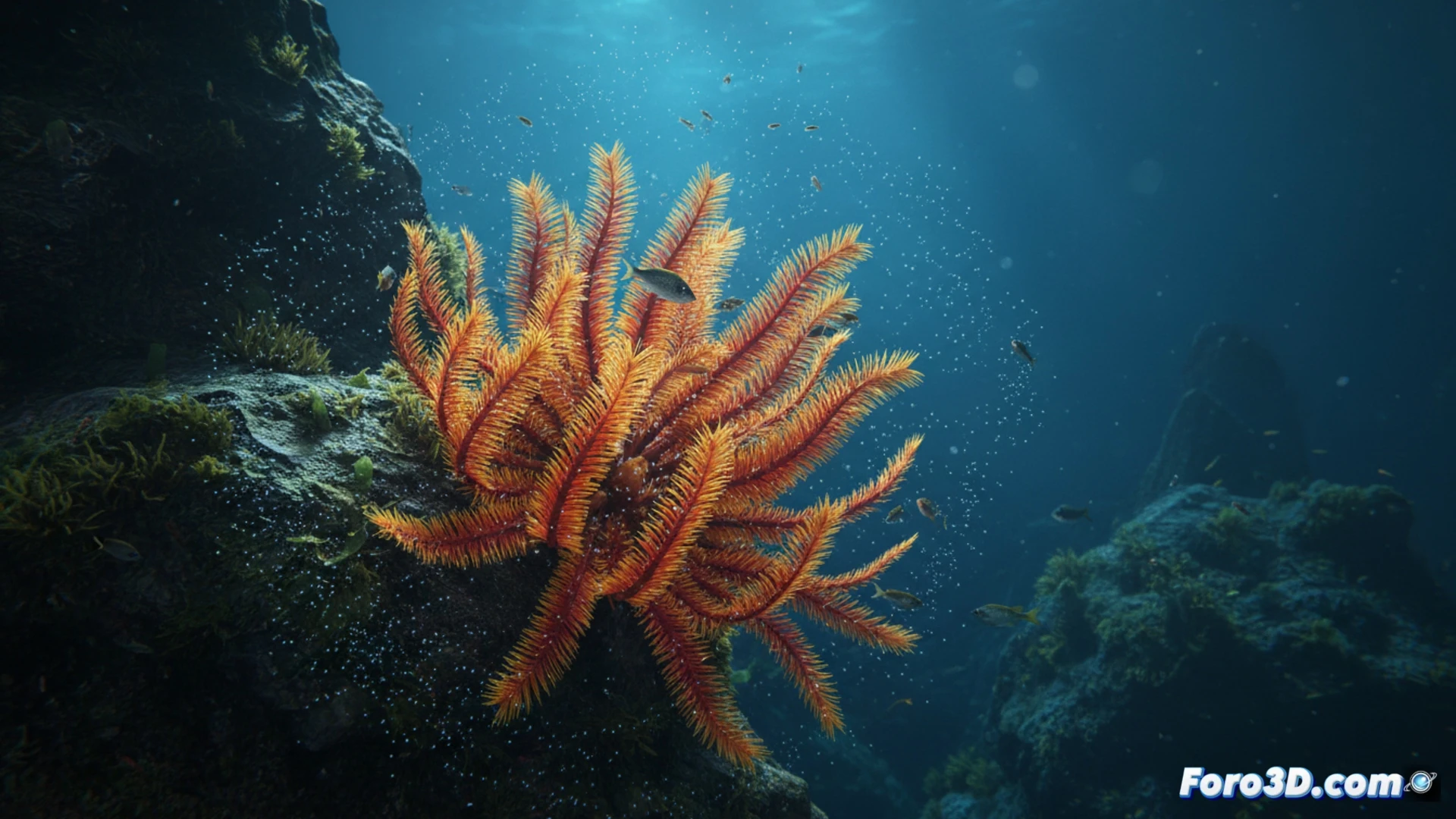
The species Poliometra sp., known as the Nazca Orange Crinoid, inhabits the summits of seamounts on the Nazca Ridge. Its vibrant coloration and feathery arms make it an ideal subject for scientific 3D visualization. This article details the process of creating a photorealistic model that captures its morphology and filtering behavior, essential for documentaries and interactive exhibits.
Digital Architecture and Filtration Mechanism 🌊
The 3D model is built from real bathymetric data of the Nazca ecosystem. The crinoid's structure requires complex rigging to simulate the flexibility of its feathery arms, composed of pinnules that generate a water current. The animation integrates a particle system that replicates the capture of phytoplankton and detritus. Each particle follows a parabolic trajectory toward the ambulacral groove, where mucus traps the food. This approach allows for precise visualization of the suspension-feeding mechanism.
Challenges in Representing Deep Benthos 🐙
The greatest technical challenge lies in balancing anatomical detail with real-time performance. The translucency of the crinoid's tissues and the ambient lighting of the depths require custom shaders. By integrating the model into a seamount environment, an educational tool is achieved that reveals the dynamics of a little-known ecosystem. This project demonstrates how 3D modeling can bridge the gap between marine science and the general public.
How can the segmented structure and filtering arms of the Nazca orange crinoid be modeled in 3D to achieve an accurate anatomical representation that facilitates its study in scientific visualization?
(PS: at Foro3D we know that even manta rays have better social connections than our polygons)