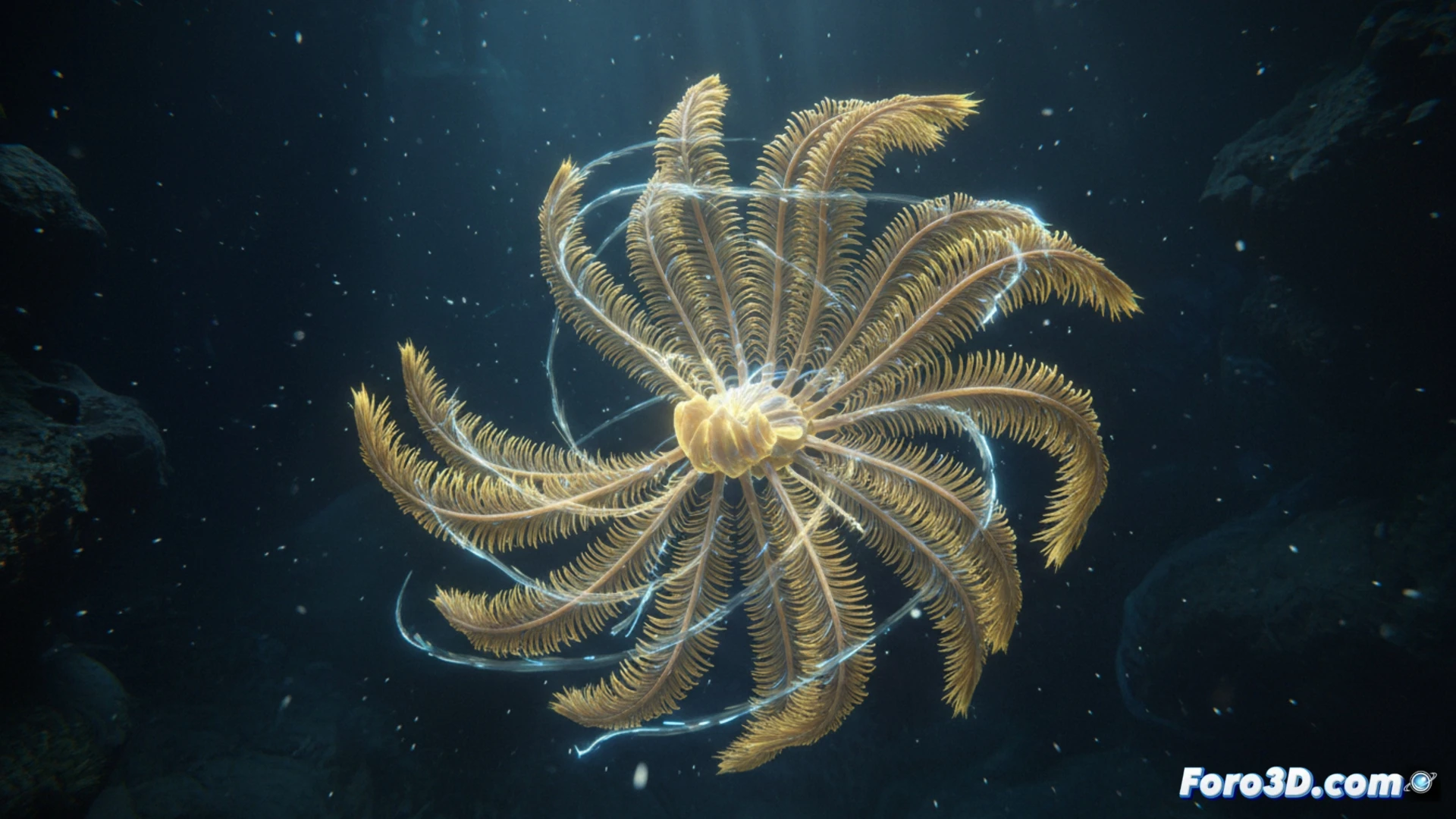
The scientific visualization of marine species such as the Yellow Feather Crinoid (a bright yellow sessile echinoderm) demands a rigorous technical approach. This organism, which filters particles on the summits of seamounts in the Nazca Ridge, presents a fascinating challenge for 3D modeling. Its anatomy, based on feathery arms and a central calyx, requires organic geometry techniques and translucent texture simulation to reflect its bioluminescence and adaptation to deep currents.
Photogrammetry and Topology for Echinoderms 🌊
To capture the fidelity of the crinoid, photogrammetry of preserved specimens or ROV images is the ideal starting point. Using Agisoft Metashape or RealityCapture is recommended to generate a dense point cloud, processing between 50 and 100 shots with side lighting to highlight the pinnules (arm branches). The resulting topology should be quadrilateral, with a polygon count between 50k and 100k for the body, optimizing joints with surface subdivisions. The bright yellow coloration is achieved with a diffuse shell shader in Blender or Maya, combining a subsurface scattering (SSS) map with a low roughness value (0.2-0.3) to mimic the calcareous cuticle of the echinoderm. For the habitat, the seamount terrain is generated with procedural displacement in Houdini or World Machine, using fractal noise with scales from 500 to 2000 meters and a 30-degree slope, adding sediments with basalt and sandstone textures.
Underwater Lighting and Filtering Behavior 🐠
Lighting in Nazca Ridge environments (at 300-800 meters depth) must simulate the selective absorption of blue-green light. In Unreal Engine or Unity, a directional light is configured with 20% intensity and cyan color (RGB 0.2, 0.6, 0.8), complemented by an exponential fog volume for turbidity. The crinoid's filtering behavior is animated with inverse kinematics (IK) on its 10 to 20 arms, using a smooth sinusoidal cycle (0.5 Hz frequency) that simulates particle capture. For education, the model is exported in glTF format with species metadata, allowing interactive visualization on platforms like Sketchfab.
Which photogrammetry or volumetric lighting techniques are most effective for capturing and reproducing the translucency of the bright yellow color in the tissues of the Nazca Yellow Feather Crinoid during scientific 3D modeling?
(PS: at Foro3D we know that even manta rays have better social connections than our polygons)