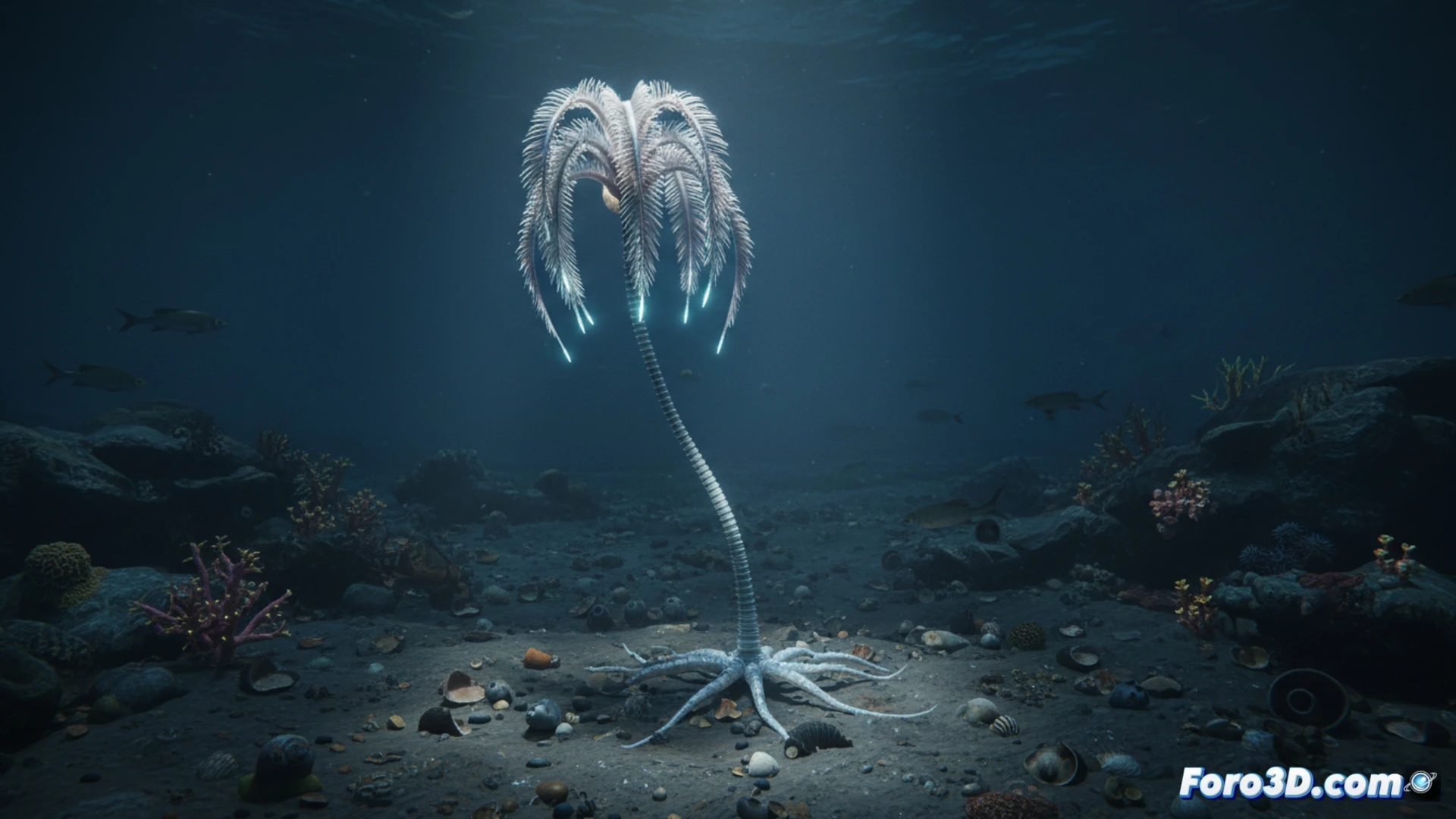
The crinoid Bathycrinus sp., known as the mud lily, features an extremely long and thin stem that allows it to raise its crown of arms above the stagnant water layer. This biological adaptation is key to its survival on ocean floors with low currents. For scientific visualization, recreating this morphology in 3D enables analysis of its structure and function in the benthic ecosystem.
Building the anatomical model and stem dynamics 🌊
The 3D model must prioritize the geometry of the stem, composed of multiple segments (columnals) that provide flexibility. The use of Nurbs curves or splines is recommended to control its length and curvature, replicating hydrodynamic resistance. The crown of arms, with fine pinnules, requires detailed meshing to simulate its particle capture. The animation should include a slow oscillatory movement, synchronized with the current, and an interactive infographic showing how the stem overcomes the stagnant water layer to access suspended nutrients.
The value of precision in scientific communication 🔬
This project not only represents a technical modeling challenge but also reinforces the importance of 3D visualization in biological research. By recreating Bathycrinus, the public can be educated about little-known evolutionary strategies. The interactive infographic, by pointing out the stagnant water zone and the flow zone, turns an abstract concept into a clear visual experience, demonstrating that digital art is an essential tool for science.
How can the segmented and flexible structure of the Bathycrinus crinoid stem be modeled in 3D to simulate its hydrodynamic behavior when rising above the seafloor?
(PS: at Foro3D we know that even manta rays have better social connections than our polygons)