The discovery of Ameripathes pseudomyriophylla, a new species of black coral found on the Nazca Ridge, represents a milestone for marine biology. This specimen, belonging to a family previously unrecorded in the region, was collected more than 1,500 meters below sea level. For the scientific visualization community, the immediate challenge is to translate the biological samples into accurate three-dimensional models that capture their unique morphology and allow their study without the need to manipulate the fragile original tissue.
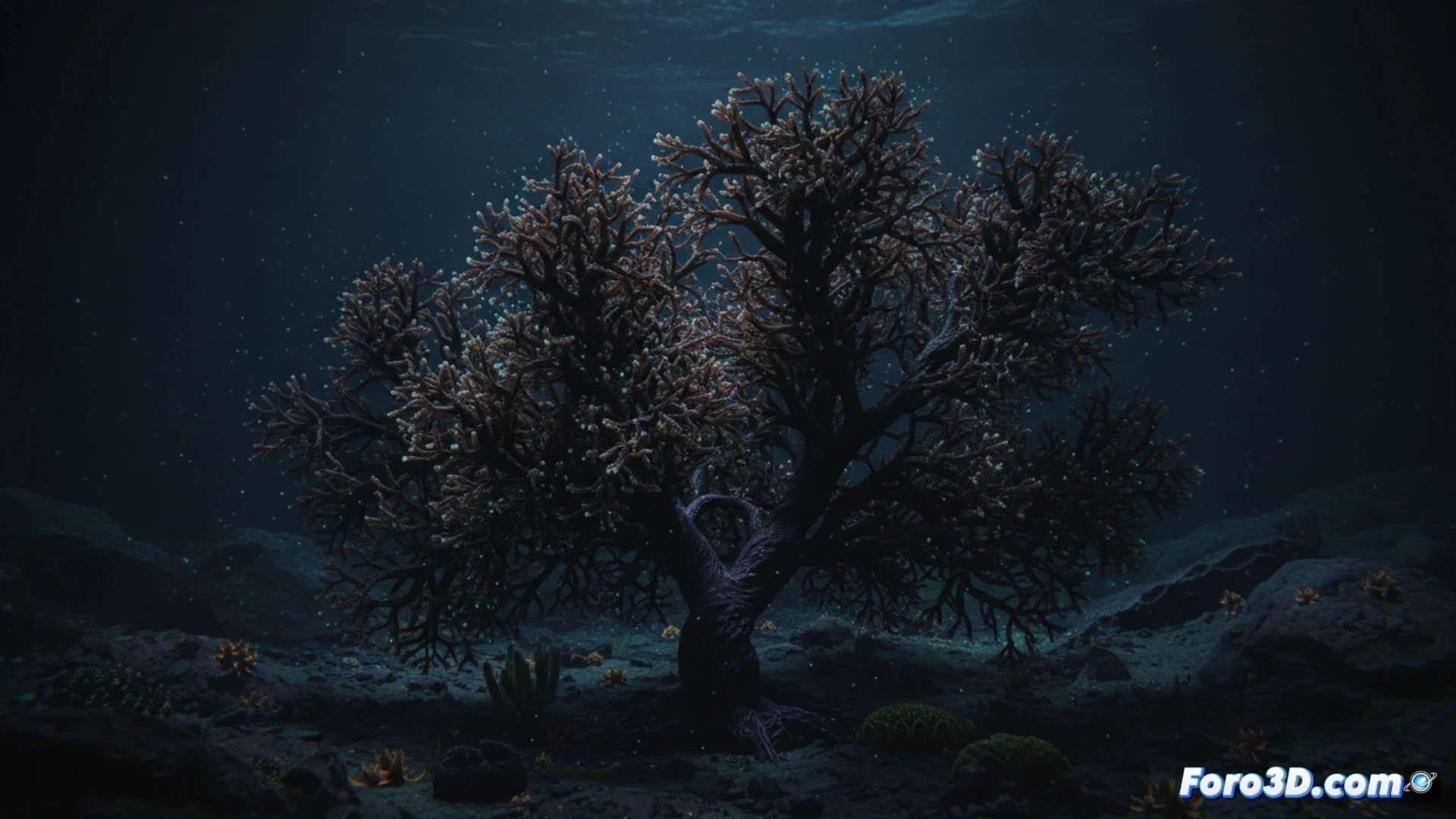
Workflow for the digital reconstruction of the skeleton 🖥️
The technical process begins with high-resolution microphotogrammetry applied to the collected fragments. Given the small size and complexity of the skeletal spines, structured light scanning is required to capture the calcareous texture of the coral. Subsequently, retopology software allows cleaning the polygonal mesh, removing noise generated by water and adhered sediments. The final stage involves applying a translucent shading in the rendering engine, simulating the interaction of bioluminescent light at extreme pressure, a crucial factor for marine biologists to validate the three-dimensional structure against the real samples.
Visualization of abyssal ecosystems for outreach 🌊
Beyond the isolated model, the true value of this 3D recreation lies in the possibility of integrating the coral into a simulation of the Nazca Ridge ecosystem. By digitally reconstructing the cold currents and the topography of the seabed, researchers can observe how this species anchors to the substrate and competes for space. This representation not only documents the finding but also democratizes access to an inaccessible environment, allowing the global scientific community to analyze the anatomy of the black coral without relying on direct expeditions to the abyss.
How is the challenge of modeling in 3D a biological structure as fragile and complex as the Nazca black coral faced, when the only reference data comes from samples collected at 1500 meters depth?
(PS: at Foro3D we know that even manta rays have better social bonds than our polygons)