The Iridogorgia helix coral represents a marvel of evolution in the deep ocean. Its upward spiral structure is not random; it responds to a biological need to maximize the nutrient capture surface in an environment where food is scarce. For scientific visualization specialists, this species offers a fascinating case study on how organic morphology can be translated into complex parametric geometries.
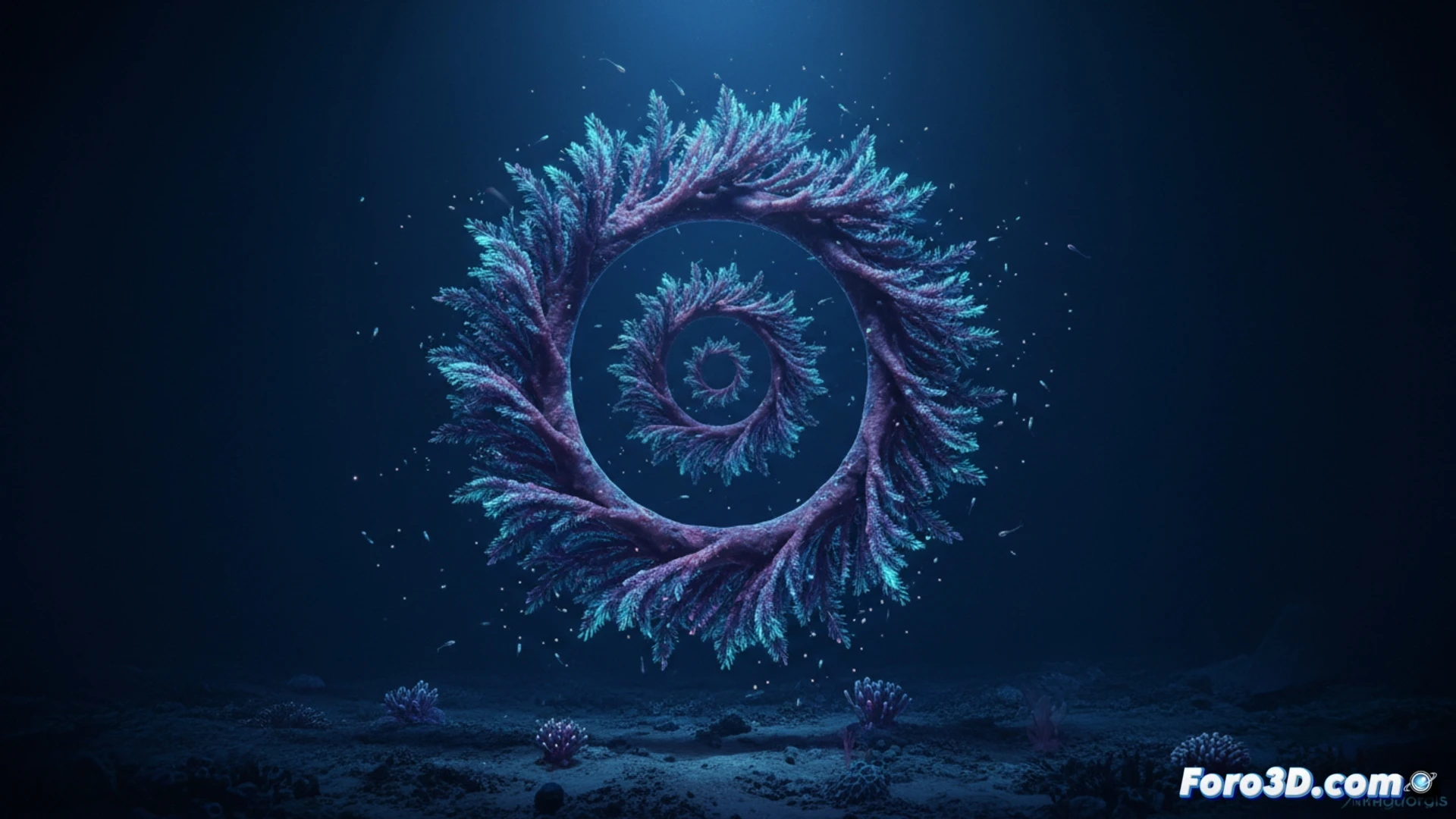
Digital recreation and hydrodynamic analysis of the spiral polyp 🌊
To model the Iridogorgia in 3D, we must address two main technical challenges. First, the generation of the logarithmic spiral that defines its growth, which can be replicated using helical curves with a constant radial increase rate. Second, the simulation of nutrient flow through its polyps, where computational fluid dynamics (CFD) tools allow us to visualize how the current impacts each whorl. When comparing this structure with other biological forms, such as the tentacles of certain anemones or the shells of extinct ammonites, we observe a recurring pattern: the spiral as an optimal solution for intercepting suspended particles while minimizing structural effort.
The spiral as a design lesson for science and art 🧬
Beyond the biological data, the Iridogorgia invites us to reflect on the efficiency of natural design. In scientific visualization, we do not only seek anatomical precision; we seek to communicate the internal logic of nature. By rendering this coral in its abyssal habitat, with dim lighting and suspended particles, we manage to convey how an apparently decorative form is actually a survival machine perfectly calibrated by ocean currents.
What mathematical parameters or parametric modeling algorithms are most effective for replicating the helical geometry and fractal branching of the Iridogorgia coral in a scientific visualization environment like Blender or Houdini?
(PS: fluid physics for simulating the ocean is like the sea: unpredictable and you always run out of RAM)