The Nazca Toadfish (Chaunops sp.) represents a fascinating challenge for scientific 3D visualization. This bathypelagic fish, with an intense, almost fluorescent red color, has developed a unique locomotor strategy: it uses its pectoral fins as limbs to move along the seabed. In this technical article, we will explore the process of digitally recreating this species, from capturing morphological data to simulating its underwater gait.
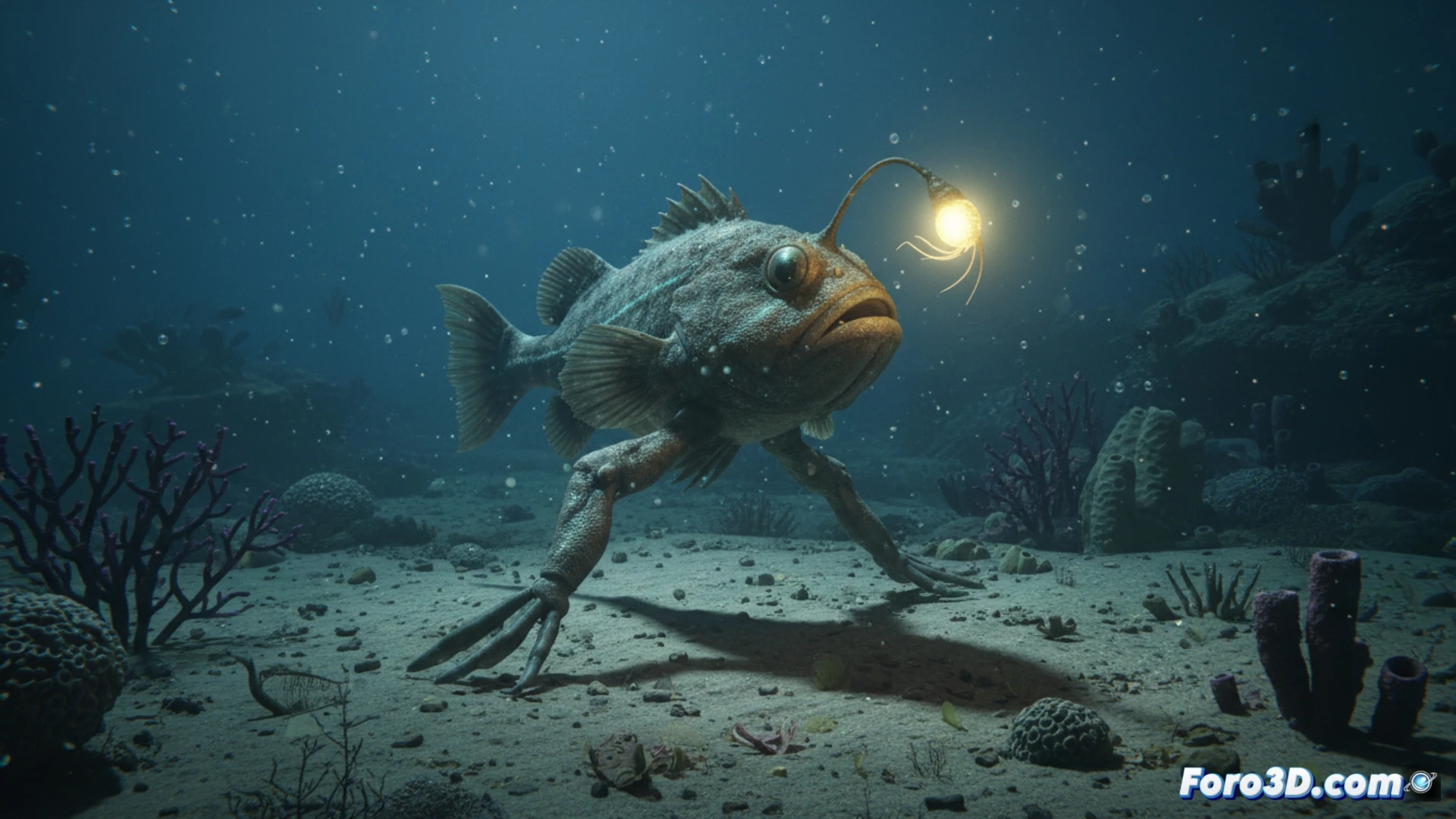
Morphology and rigging for aquatic bipedal gait simulation 🐟
The base model of Chaunops sp. requires a detailed study of its anatomy. Its globose and laterally compressed body features a rough, scaly texture that we must recreate using high-resolution displacement maps. The critical point of the project is the rigging of the pectoral fins, which act as pseudopods. To emulate their support and propulsion movement, an inverse kinematics system with five joints per fin must be implemented, allowing the bony rays to flex realistically upon contact with the substrate. Additionally, the caudal fin, reduced to a small fan, functions as a stabilizing rudder. Transverse anatomical sections, rendered in VDB volumes, will reveal the underlying muscular structure that powers this gait, showing the hypertrophy of the pectoral muscles compared to swimming species.
The art of simulating evolution on an abyssal plain 🌊
Beyond the technique, this project forces us to reflect on the representation of evolutionary adaptation in 3D. The animation should not only show a fish walking; it must narrate the transition from swimming to walking. By recreating the seabed of the Nazca Trench, with its volcanic sediments and hydrothermal vents, we contextualize the behavior. Volumetric lighting and underwater scattering are essential to convey the pressure and darkness of its habitat. The final result is an educational tool that allows biologists and the general public to understand, through simulation, how a fin can become a leg.
Considering the unique biomechanical adaptations of Chaunops sp., such as its pectoral fins modified for walking on the seabed, how can 3D modeling based on computed tomography scans reveal the joint angles and force distribution that explain its benthic locomotion?
(PS: if your manta ray animation doesn't excite, you can always add some documentary music from channel 2)