The 2024 discovery of Chaetoderma shenloong, an aplacophoran mollusk with a cylindrical body and iridescent scales evoking a mythological dragon, represents a fascinating challenge for scientific visualization. Its soft structure and lack of a shell make traditional documentation complex. Here we explore how photorealistic 3D modeling captures every detail of this abyssal creature, from the arrangement of its scales to the texture of its epidermis, offering a non-invasive study tool.
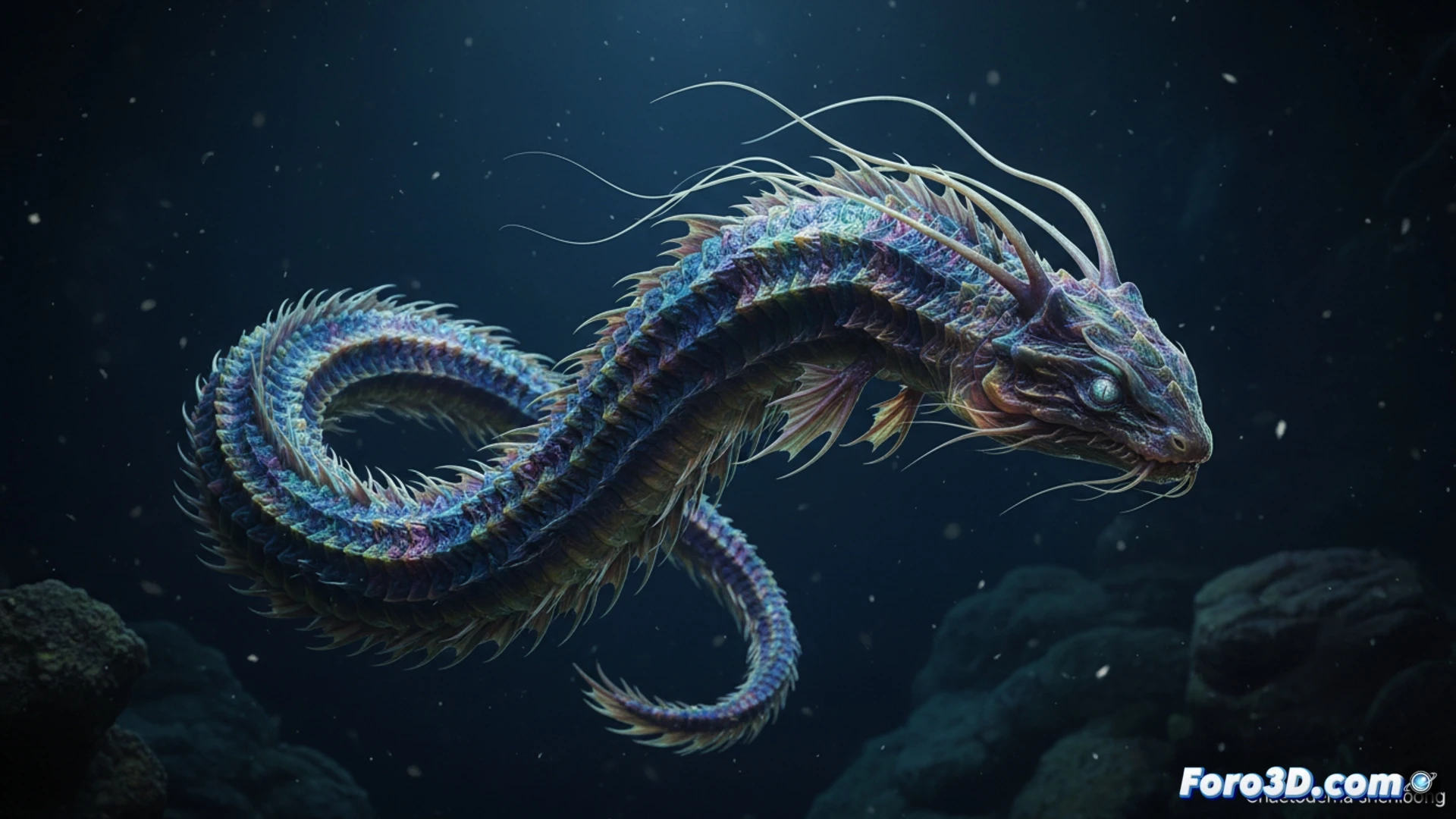
Photogrammetry and anatomical reconstruction of the specimen 🐉
To generate an accurate digital twin of Chaetoderma shenloong, the process begins with high-resolution photogrammetry on the preserved specimen. Between 200 and 400 images are captured with cross-polarized lighting to highlight the sheen of the calcareous scales. Subsequently, reconstruction software generates a high-density polygonal mesh. The critical step is creating texture maps (diffuse, specular, and normal) that replicate the animal's iridescence. Finally, a virtual skeletal rig is integrated to simulate the contraction of the cylindrical body, enabling interactive animations where the user can rotate the model 360 degrees and zoom into areas like the cephalic region or the creeping foot, facilitating comparison with other aplacophoran species such as solenogasters.
Scientific outreach without sacrificing the specimen 🧬
This visualization approach not only satisfies public curiosity but also resolves an ethical dilemma in taxonomy. By creating an interactive, downloadable 3D model of Chaetoderma shenloong, researchers avoid constant handling of the holotype, which is often fragile and unique. Animating its locomotion and reconstructing its benthic habitat allows studying its ecology without disturbing the ecosystem. At Foro3D, we believe this is the frontier of digital zoology: a sea dragon that lives forever in cyberspace, accessible to all.
When modeling the iridescent scales of Chaetoderma shenloong in 3D, how can the iridescence phenomenon be digitally recreated to achieve scientific realism without sacrificing performance in interactive visualization?
(PS: if your manta ray animation doesn't excite, you can always add documentary music from channel 2)