The discovery of the Rough Snailfish (Careproctus colliculi) in 2025 represents a milestone for marine biology. This species, found in the submarine mountain ranges of the South Pacific, possesses a unique dermal texture that challenges the conventions of organic modeling. For scientific visualization specialists, this specimen offers a perfect case study on how to represent complex biological surfaces and extreme ecosystems using advanced scanning and volumetric rendering techniques.
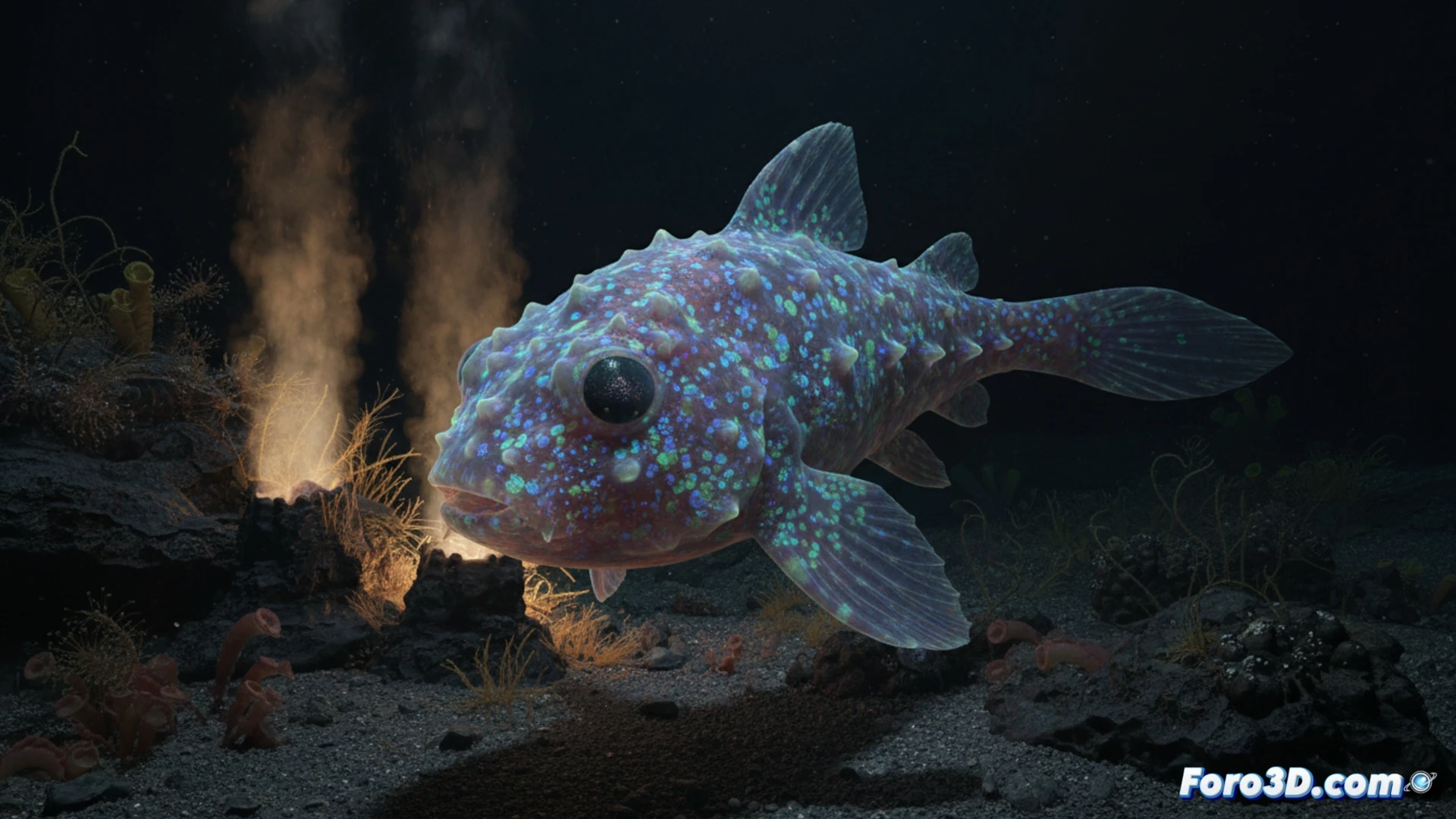
Virtual reconstruction of surfaces and bathymetry 🌊
The main technical challenge lies in capturing the microtopography of its rough skin. Using high-resolution photogrammetry from preserved samples and side-scan sonar data, a displacement map can be generated that emulates the skin ridges and folds. This map, combined with a subsurface scattering (SSS) shader adjusted to the gelatinous tissues typical of snailfish, enables photorealistic rendering. Furthermore, integrating bathymetric data from the South Pacific Ridge allows for the construction of a precise 3D environment, where ambient lighting simulates the total absence of sunlight at depths exceeding 3,000 meters, using bioluminescence sources as a reference for the scenic background.
Visualization as a conservation tool 🐟
The creation of these 3D models not only fulfills an artistic exercise but also democratizes access to science. By digitizing Careproctus colliculi, biologists can study its morphology without needing to dissect the scarce collected specimens. For the general public, an interactive animation that traverses its rocky habitat and peculiar skin texture transforms an abstract taxonomic name into a tangible experience, fostering awareness of the fragile biodiversity of the deep ocean.
What specific technical challenges does the photorealistic recreation of the gelatinous and translucent texture of Careproctus colliculi present for simulating its adaptation to the extreme pressure of the abyssal habitat?
(PS: fluid physics for simulating the ocean is like the sea: unpredictable and you always run out of RAM)