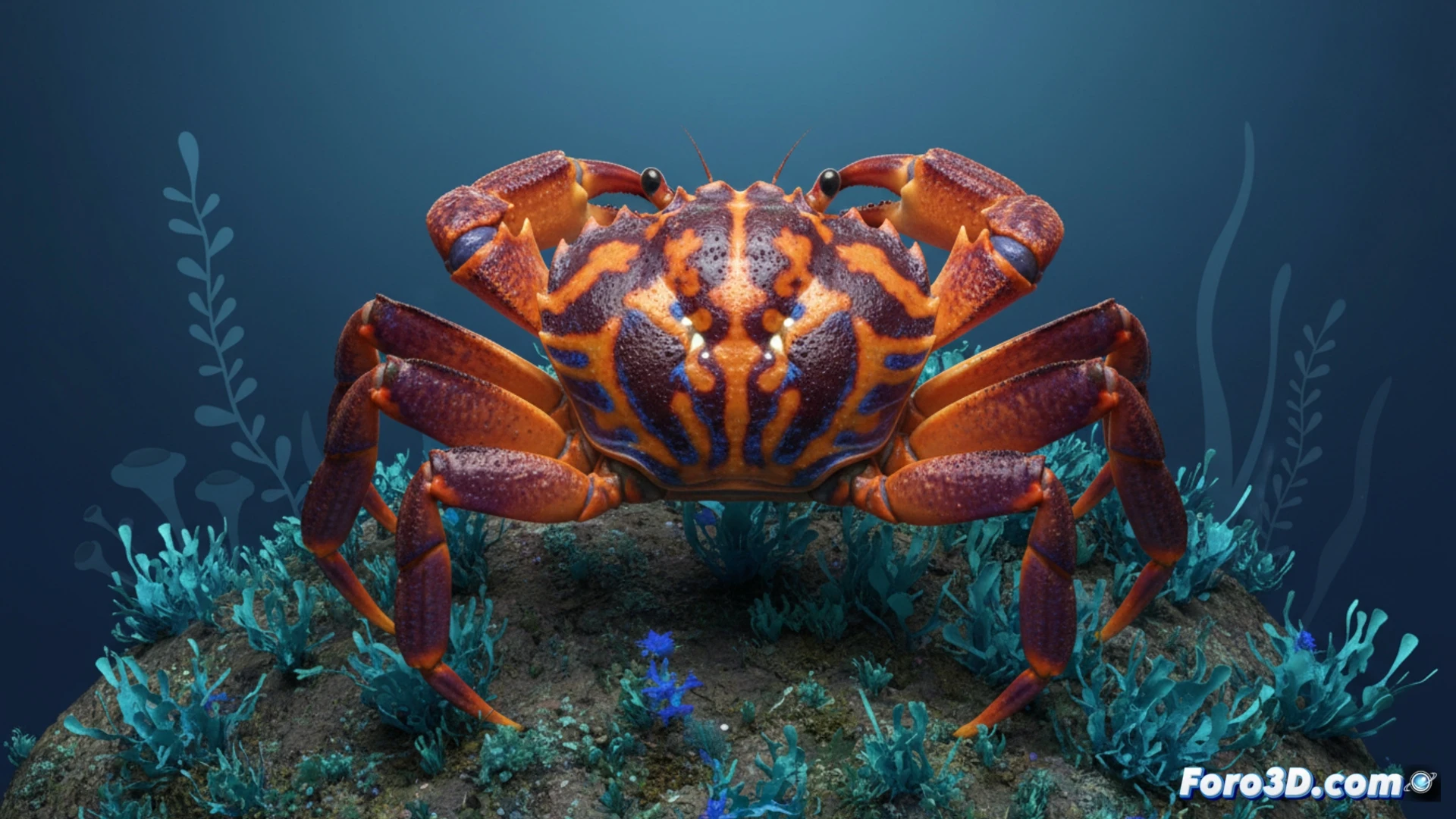
The recent description of Lepidothelphusa menneri, a tiny freshwater crab endemic to Indonesia, has captured the attention of the scientific community due to its unusual chromatic pattern. This species features a combination of vivid orange, electric blue, and dark brown, a palette that is exceptional among crustaceans of its genus. For scientific 3D visualization, this specimen offers a fascinating challenge in reproducing biological pigmentation and carapace microstructures.
Technical workflow for PBR texturing and anatomical animation 🦀
The development of the photorealistic model of L. menneri requires a meticulous approach to physically based rendering (PBR) texturing. The tricolor coloration is not random; blue is concentrated on the chelipeds and walking legs, while orange dominates the dorsal carapace and dark brown delineates the joints. To capture this distribution, the use of high-resolution albedo maps combined with roughness and specularity maps that simulate the crab's cuticle is recommended. Interactive animation should prioritize the visualization of the gills and exoskeleton in an exploded view, allowing the user to rotate the model at actual scale (approximately 2 cm carapace width). Including a freshwater environment with refraction and volumetric scattering parameters is key to contextualizing its habitat in the limestone streams of Kalimantan.
The value of chromatic rarity in scientific outreach 🔬
Beyond anatomical precision, this 3D model serves as a tool for comparing color evolution in crustaceans. By juxtaposing L. menneri with other freshwater crab species, such as Geosesarma dennerle, the rarity of its blue-orange pigmentation becomes evident, a phenomenon uncommon in acidic and dark waters. This type of visualization not only educates the public about Indonesia's biodiversity but also allows biologists to analyze camouflage patterns and sexual signaling without the need for live specimens.
How can the carapace microstructure of Lepidothelphusa menneri be accurately modeled to preserve its tricolor coloration patterns in a photorealistic scientific visualization?
(PS: fluid physics for simulating the ocean is like the sea: unpredictable and you always run out of RAM)