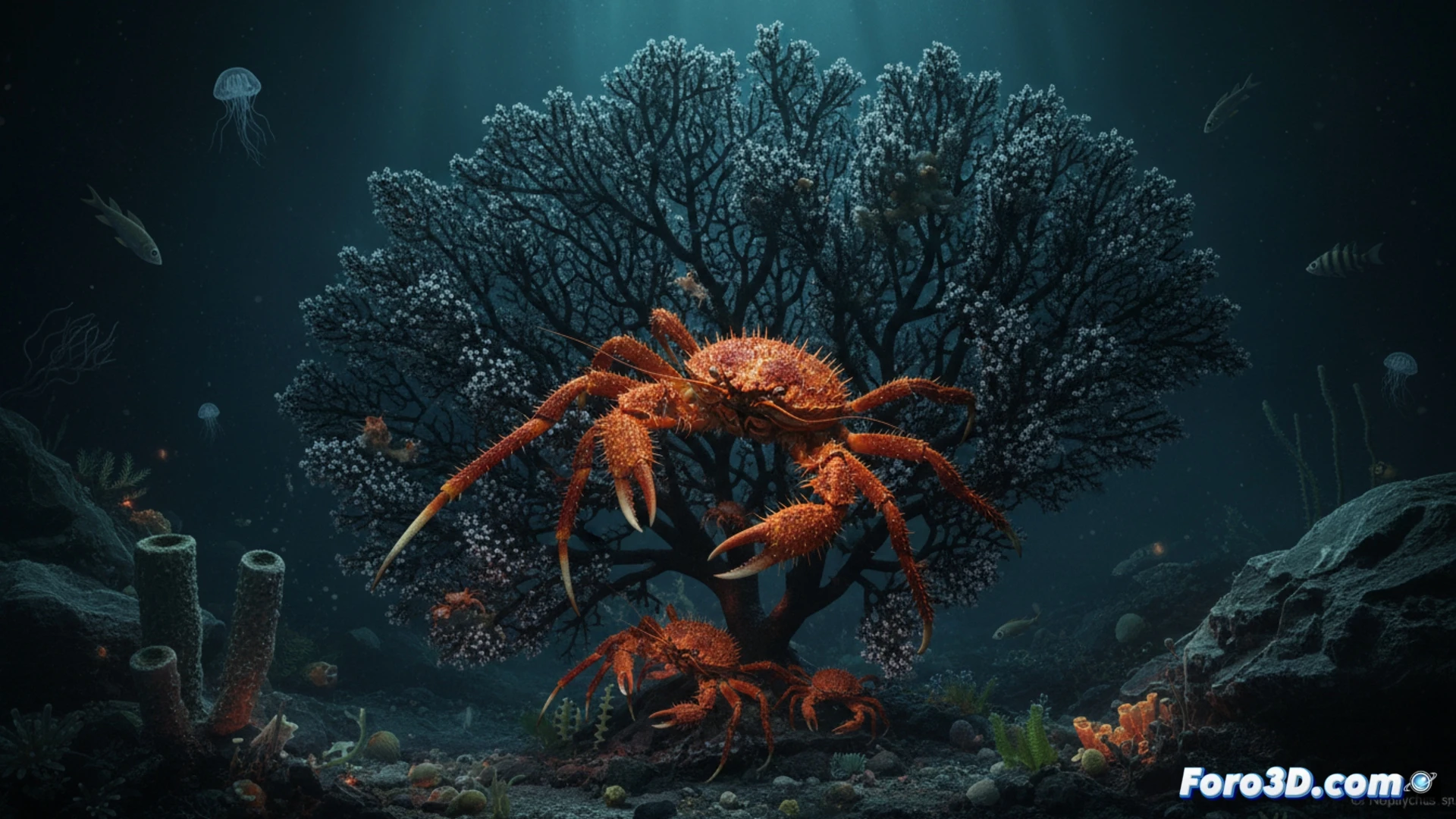
The discovery of Uroptychus sp., a tiny bright orange crustacean, in the Nazca seamounts represents a fascinating finding for marine biology. This organism stands out not only for its pigmentation but also for its exclusive symbiotic relationship with black corals. For the scientific visualization community, this case offers a unique opportunity to recreate a virtually unexplored deep-sea ecosystem, combining precise anatomical models with underwater geography. 🌊
Workflow for Bathymetric Habitat Reconstruction 🛠️
The first technical step involves generating a 3D bathymetric map of the seamount using multibeam sonar data. On this topography, the black coral (Antipatharia) is modeled as a polygonal branching structure, applying a translucent shader to simulate its chitinous skeleton. The squat lobster requires detailed rigging to animate its chelipeds and walking legs, replicating nesting behavior among the branches. The use of volumetric lighting with deep blue color attenuation is recommended to simulate light absorption at 2000 meters depth, achieving photorealistic renders that contrast the crustacean's fluorescent orange with the coral's carbon black.
Anatomical Precision as a Science Communication Tool 🔬
Modeling this crab is not just an aesthetic exercise; it is a tool for science. By creating a 3D anatomical comparison between Uroptychus and other squat lobsters, evolutionary adaptations for symbiotic life can be visualized. Animating its filter-feeding or its movement on the black coral allows researchers to explain ecological dynamics that underwater photographs fail to capture. This approach transforms expedition data into high-impact educational visual assets.
How would you tackle the challenge of accurately modeling the transparency and bioluminescence patterns of Uroptychus sp. to represent its symbiotic interaction with black corals in a seamount environment?
(PS: modeling manta rays is easy; the hard part is making them not look like floating plastic bags)