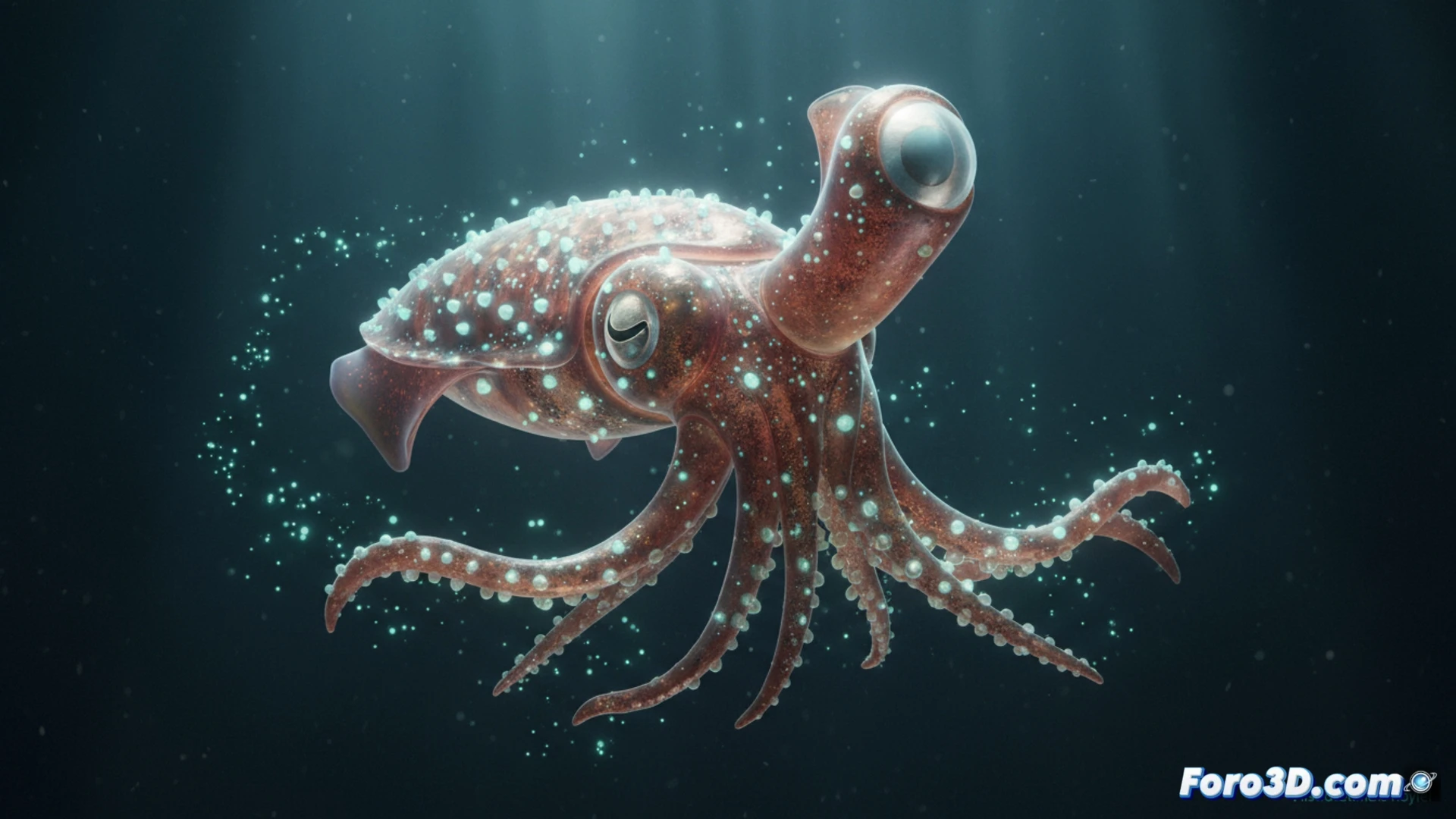
The jewel squid of the Salas y Gómez seamount presents a fascinating challenge for scientific visualization. Its most distinctive feature is ocular asymmetry: a large, tubular right eye oriented upward, and a smaller left eye looking downward. Additionally, its body is dotted with photophores that mimic precious gems. This article details the technical process for digitally recreating this creature with biological accuracy, focusing on volumetric lighting and the particle system to simulate bioluminescence.
Modeling and Rigging Pipeline for Cephalopods 🦑
For the base modeling, dynamic sculpting in ZBrush is recommended, starting from a cylinder with 256 subdivisions. The mantle mesh requires spiral topology to simulate muscle folds. Photophores are implemented as sphere instances with a multi-layer emission shader: a diffuse layer with a nacre texture and a glow layer with fractal noise for flickering. The large eye is modeled as a spherical lens with a 15 mm radius and a double crystalline lens, while the small eye uses a flat lens. For animation, a rig with FK bones is set up in the mantle and a soft dynamics system for the tentacles. The camera should simulate the squid's vision using two independent cameras: one with a 180-degree field of view looking up and another with 90 degrees looking down.
Biological Representation Challenges 🌊
The biggest technical challenge was balancing scientific realism with visual aesthetics without falling into exaggeration. The photophores must not only glow but do so with a random frequency that mimics communication signals. A Python script was implemented to control the phase of each light particle. The ocular asymmetry required visual field studies; in the final animation, the upper eye captures the silhouette of prey against the surface light while the lower eye scans the dark background. Interactive labels were integrated with HTML overlay, displaying data such as Photophore: intensity 2.3 cd/m2 on hover. This model has been used in deep-sea biology documentaries and educational simulations for virtual aquariums.
What lighting and volumetric rendering strategies do you recommend to accurately simulate the function of the photophores and ocular asymmetry of the jewel squid in a 3D model intended for scientific visualization?
(PS: if your manta ray animation doesn't excite, you can always add documentary music from channel 2)