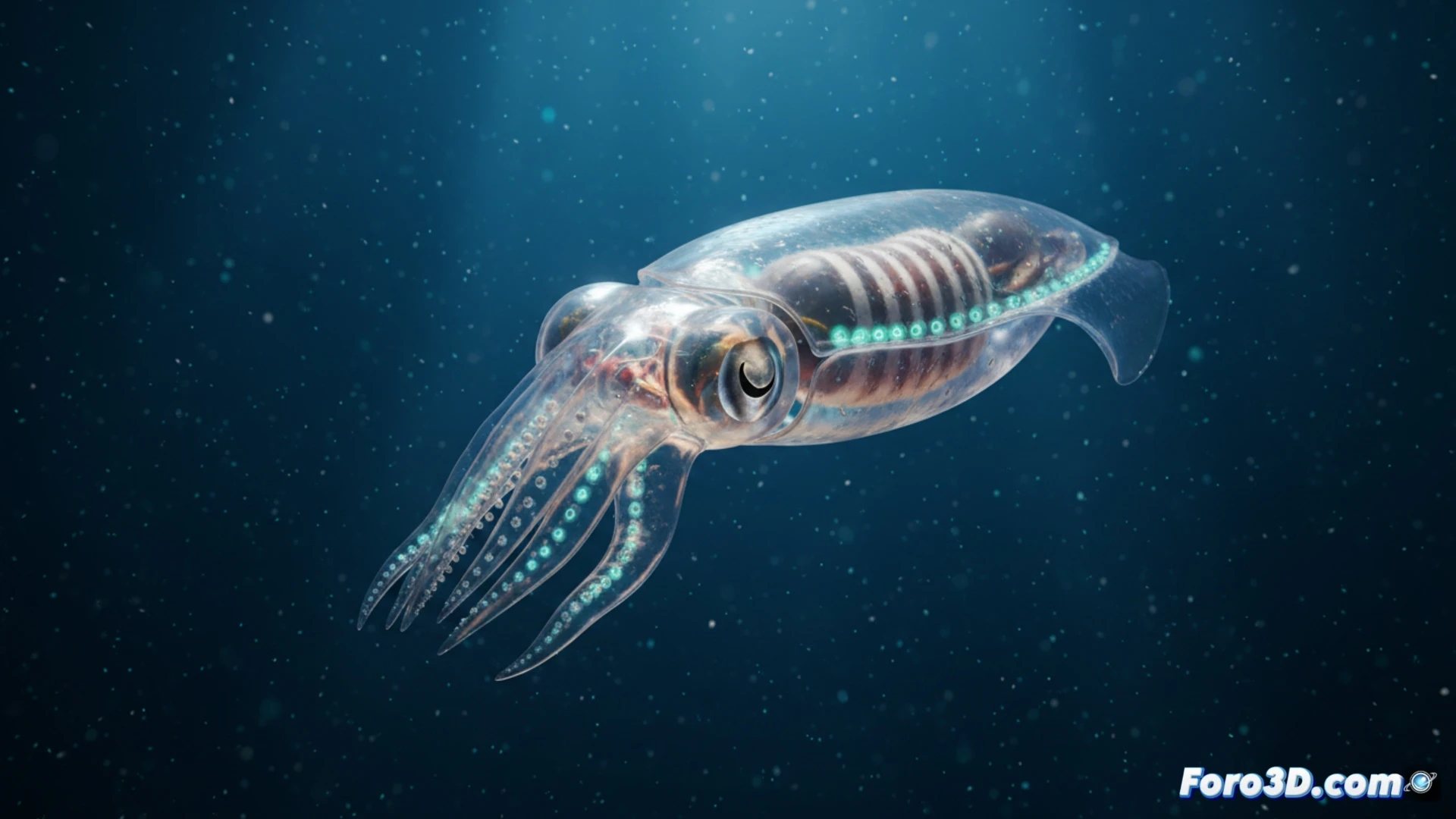
The striped glass squid (Leachia sp.) represents a fascinating challenge for scientific 3D visualization. Its transparent body and rows of photophores (light-emitting organs) along its dorsal surface require a meticulous approach to rendering translucent and emissive materials. This article explores the modeling and simulation techniques necessary to digitally recreate this creature and its countershading camouflage mechanism.
Rendering Techniques for Transparency and Photophores 🐙
For the anatomical model, using a system of geometric layers is recommended. The outer layer should employ a glass shader with a low index of refraction (close to 1.34, similar to water) and a near-zero roughness value to simulate the transparency of the mantle. The light-emitting organs require an emissive material with a blue-cyan color temperature (approximately 10,000K) to mimic the downwelling light of the ocean. Simulating camouflage involves a gradient of light intensity in the photophores: they should be brighter on the lower part of the squid and dimmer towards the upper part, counteracting the light coming from the surface. A realistic effect can be achieved using a gradient node connected to the emission scale of the material.
The Challenge of Digital Invisibility 💡
The true technical difficulty lies in simulating countershading. It is not enough to illuminate the photophores; the model must dynamically react to the ambient light of the virtual seabed. To do this, a control script can be implemented that reads the light intensity on the Y-axis of the squid and adjusts the emission of the photophores in real time. This interactive visualization allows the user to appreciate how active bioluminescence erases the animal's silhouette, a phenomenon almost impossible to capture in traditional photography but essential for understanding the evolution of life in the deep sea.
What lighting and material techniques in a rendering engine like Blender Cycles or Unreal Engine allow for a more precise simulation of light refraction and internal reflection in the gelatinous tissue and photophores of the striped glass squid to visualize its bioluminescence without losing the organism's natural transparency?
(PS: at Foro3D we know that even manta rays have better social connections than our polygons)