The discovery of the nudibranch Bathydevius caudactylus in the oceanic midnight zone represents a milestone for marine biology. This deep-sea slug has an expandable hood for hunting and a unique bioluminescence system. Its precise 3D modeling allows scientists and educators to study its anatomy without costly expeditions, facilitating the understanding of extreme adaptations that occur at depths of over a thousand meters.
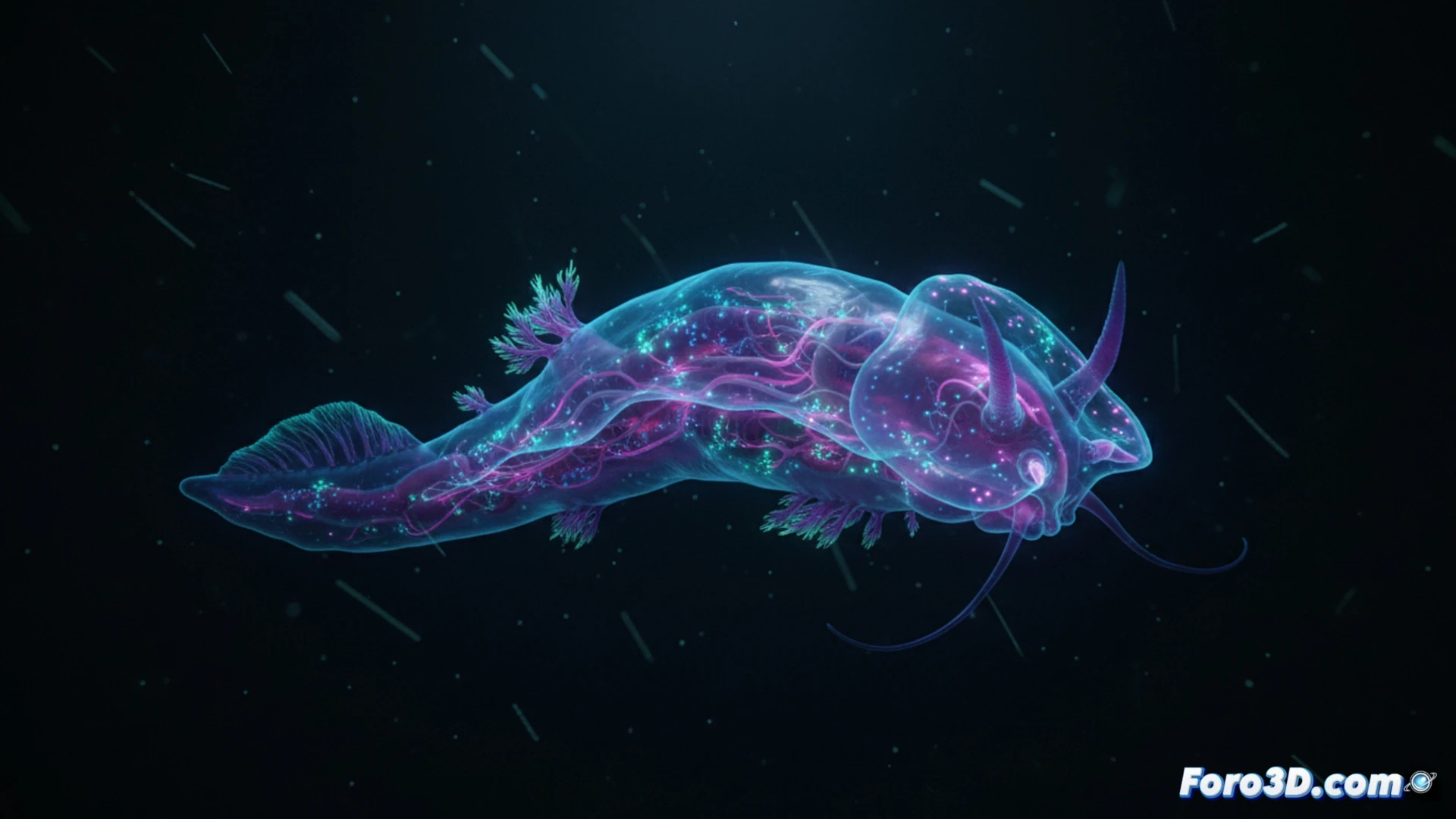
Digital anatomy and simulation of the hunting hood 🐙
To recreate Bathydevius caudactylus in a 3D environment, it is essential to model its gelatinous and translucent body, paying special attention to the folds of its hood. This structure, similar to a parachute, deploys to trap crustaceans and must be simulated with smooth fluid dynamics. The bioluminescence system requires shaders that emit blue-green light from discrete photophores, replicating the pattern the species uses to confuse predators. The habitat lighting should be almost nonexistent, with a gradient of darkness reflecting the bathypelagic zone.
Scientific visualization as a bridge to the inaccessible 🌊
The midnight zone is one of the most hostile environments for direct observation. An interactive 3D model of Bathydevius caudactylus not only documents its morphology but also allows any user to explore how the hood contracts or how its glow is activated. This tool democratizes access to knowledge, transforming expedition data into immersive experiences that educate about the fragility and complexity of abyssal ecosystems.
What technical challenges does simulating the bioluminescence of Bathydevius caudactylus present in a realistic abyssal 3D model?
(PS: if your manta ray animation doesn't excite, you can always add documentary-style music from channel 2)