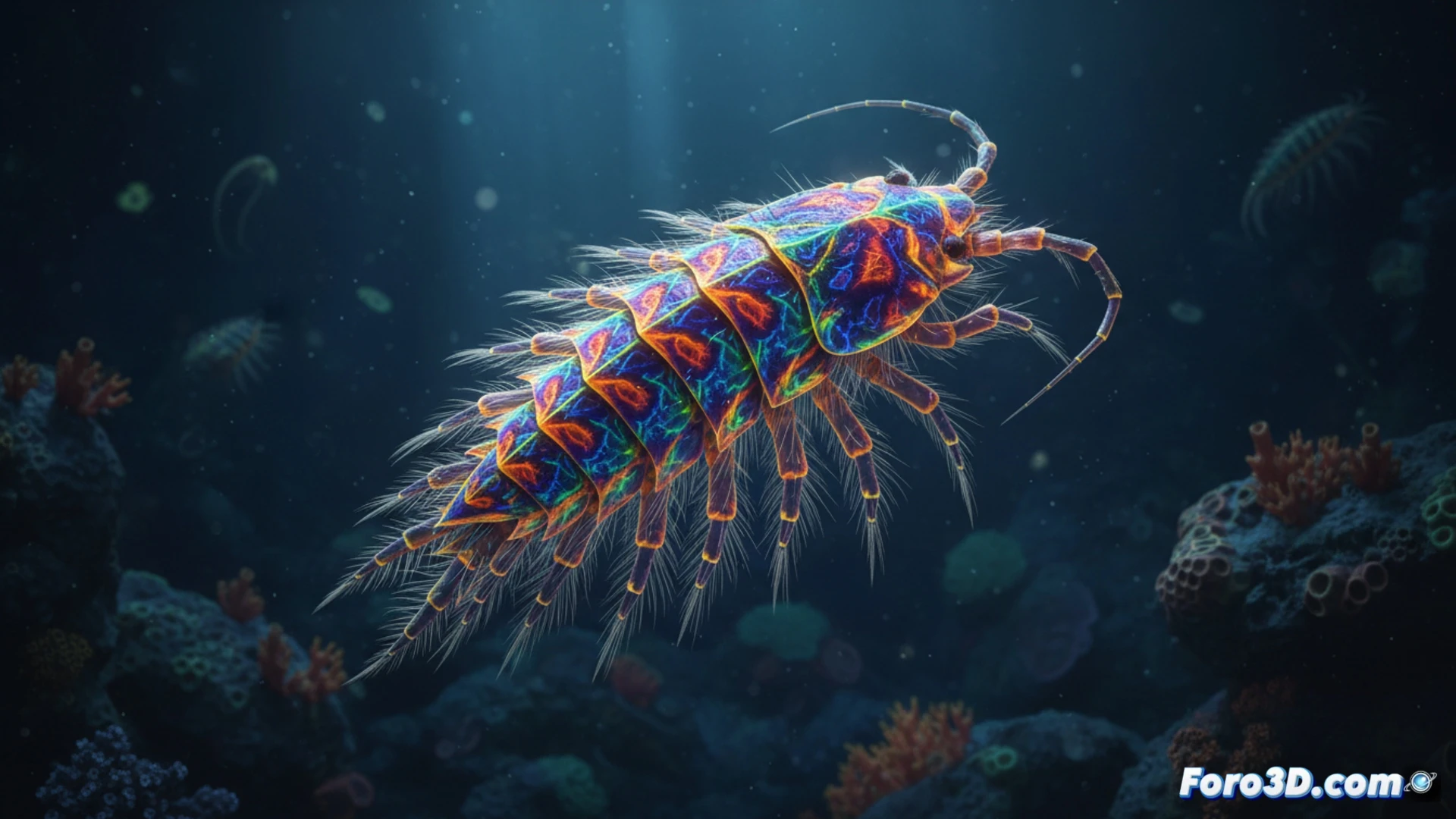
The discovery of a new species of amphipod on the Salas y Gómez Ridge has surprised the scientific community. This crustacean, found in the aphotic zone where sunlight does not penetrate, displays complex and bright color patterns, an unusual trait for deep-sea organisms. For scientific visualization, this finding represents a fascinating technical challenge: digitally recreating a bioluminescence or structural pigmentation that defies the rules of the abyssal ecosystem.
Texturing and Shading Pipeline for an Aphotic Crustacean 🦐
Developing a photorealistic 3D model of this species requires a hybrid shading approach. Since the coloration does not depend on ambient light, a material with iridescence and sub-surface scattering (SSS) properties must be simulated to emulate the neon tones and chromatic bands. The exoskeleton geometry, with its segments and appendages, is optimized through sculpting in ZBrush, while texturing in Substance Painter incorporates procedural masks to replicate the asymmetrical patterns of the real animal. The render lighting, using HDRI of dark seabeds, must be adjusted so that the color emerges without losing the context of absolute twilight.
Habitat Simulation and Outreach in Immersive Environments 🌊
To contextualize the finding, it is necessary to build a virtual diorama of the Salas y Gómez seabed. The habitat simulation includes suspended sediment particles and biogenic light sources from surrounding corals and sponges. This model not only serves for taxonomic research but also becomes a key piece for museums and educational virtual reality applications. By allowing the user to examine the amphipod from any angle, understanding of a unique evolutionary adaptation is facilitated, demonstrating that 3D visualization is the optimal tool for disseminating the biodiversity of inaccessible areas.
What specific technical challenges were encountered when 3D modeling the translucency and iridescence of the new Salas y Gómez amphipod to achieve accurate scientific visualization of its unique coloration?
(PS: if your manta ray animation doesn't excite, you can always add some documentary music from channel 2)