The discovery of the amphipod Stegocephalidae sp., nicknamed Golden Shell for its curved carapace and metallic sheen, represents a milestone for scientific 3D visualization. Collected in 2024, this marine crustacean possesses a unique morphology that challenges known anatomical conventions. Its exoskeleton, reminiscent of a gold nugget, requires precise modeling to capture the specular reflections and organic topography of its cuticle. This article explores the digital reconstruction techniques applied to this species, from initial photogrammetry to the animation of its bioluminescence and movement in the benthos.
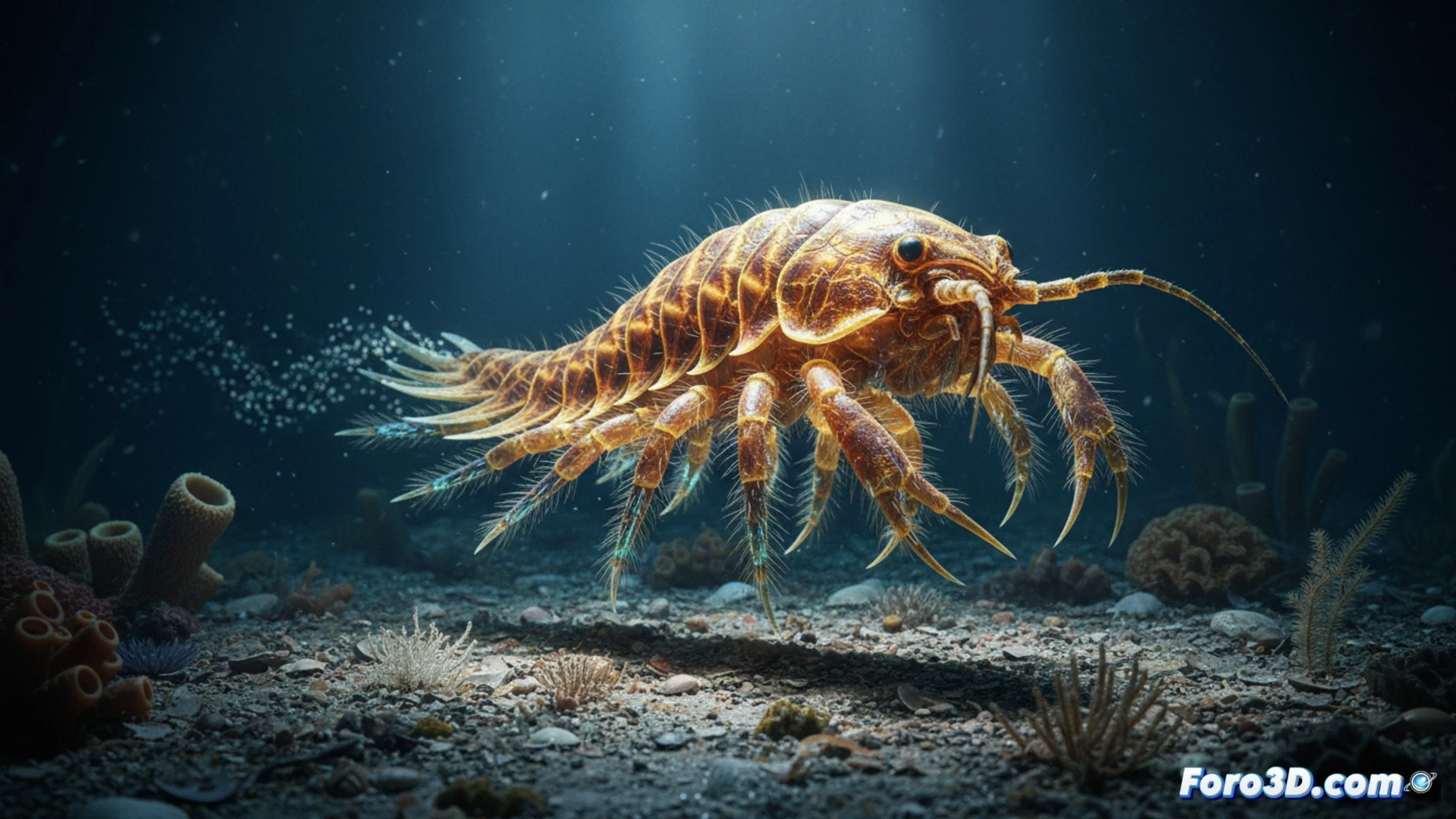
Digital reconstruction and morphometric analysis of the carapace 🦐
For the faithful recreation of Stegocephalidae sp., a workflow based on micro-CT scanning and high-resolution photogrammetry was employed. The resulting polygonal mesh required careful retopology to preserve the concave curvature of the carapace, responsible for its optical properties. In shading, a subsurface scattering (SSS) model combined with an anisotropic roughness map was applied to simulate the golden sheen without resorting to flat textures. Visual comparison with other amphipods, such as Lysianassidae, reveals key differences in the volume-to-surface ratio, suggesting adaptations to extreme hydrostatic pressures. The final model, optimized for real-time rendering, allows marine biologists to virtually rotate and dissect the specimen for biomechanics studies.
The value of beauty in biodiversity outreach 🌊
The jewel-like appearance of this crustacean is not just an aesthetic whim, but a powerful pedagogical tool. By modeling the Golden Shell in 3D, we transform a taxonomic data point into a visual experience that engages the general public. The animation of its behavior, such as particle filtration or territorial defense, contextualizes its morphology within a functional ecosystem. This approach demonstrates that high-quality scientific visualization not only serves research but also humanizes science, reminding us that nature often hides works of art in the depths.
How can the metallic sheen and curvature of the Golden Shell amphipod's carapace be digitally recreated to achieve a faithful representation in scientific visualization.
(PS: fluid physics for simulating the ocean is like the sea: unpredictable and you always run out of RAM)