The droplet fragmentation technology of L’Oréal’s Water Saver nozzle not only promises a 69% reduction in water consumption in hair salons but also opens a fascinating door for public health data visualization. By reducing flow without sacrificing pressure, this device directly impacts urban water resource management. From a visual epidemiology perspective, we can model the water flow in 3D before and after implementation, creating interactive maps that show the volume saved per wash.
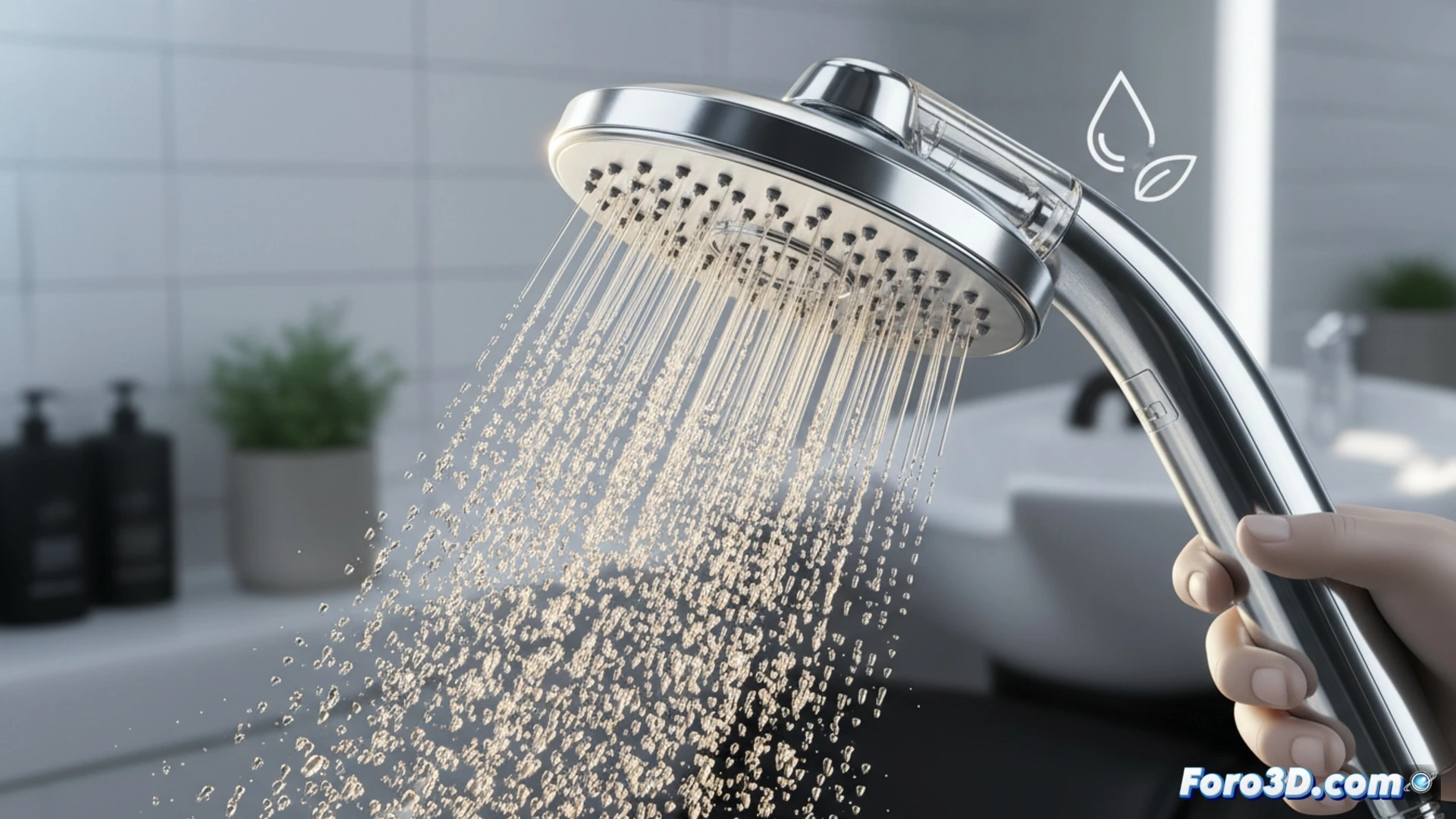
Architecture of laminar flow and fragmentation simulation 💧
To represent the impact of the Water Saver, a parametric 3D model can be built comparing two scenarios: a standard nozzle (flow rate of 12 liters/minute) and L’Oréal’s device (reduced flow rate to 4 liters/minute). The simulation must capture droplet fragmentation using a particle system, where the size and speed of each droplet are calculated based on hydraulic pressure and diffuser geometry. By integrating this data into an interactive infographic, the user can rotate the model and observe how the water volume drastically decreases. The cumulative savings are visualized as a virtual tank that fills with unconsumed water, offering a clear metric for sustainability campaigns in salons.
The value of water transparency in urban health 🌍
Beyond technical efficiency, this 3D model allows visual epidemiologists to communicate the real impact of small actions on public health. If 1,000 hair salons adopt the Water Saver, the water savings could supply a community of 500 people for a month. Visualizing this data in a three-dimensional environment, where each drop represents a preserved resource, transforms an abstract concept into a tangible reality. L’Oréal’s technology is not just an industrial advancement but a tool to educate and foster water responsibility in the professional sector.
How could 3D modeling of droplet fragmentation from L’Oréal’s Water Saver nozzle be applied to reduce exposure to pollutant aerosols in public health spaces, and how would this relate to visual epidemiology to prevent eye infections in clinics and hospitals?
(PS: visualizing obesity in 3D is easy; the hard part is making it not look like a map of solar system planets)