Ulik the Troll, created by Stan Lee and Jack Kirby, represents a fascinating technical challenge for 3D modeling in action video games. This warrior of the Rock Trolls of Asgard combines exaggerated anatomy with heavy weaponry, specifically his iconic iron fists. For a real-time engine, it is crucial to capture his raw essence without sacrificing performance. We will analyze the workflow from initial blocking to rigging, using direct references from the original comic to ensure visual fidelity. The goal is to create a playable asset that conveys power and stony resilience. ⚔️
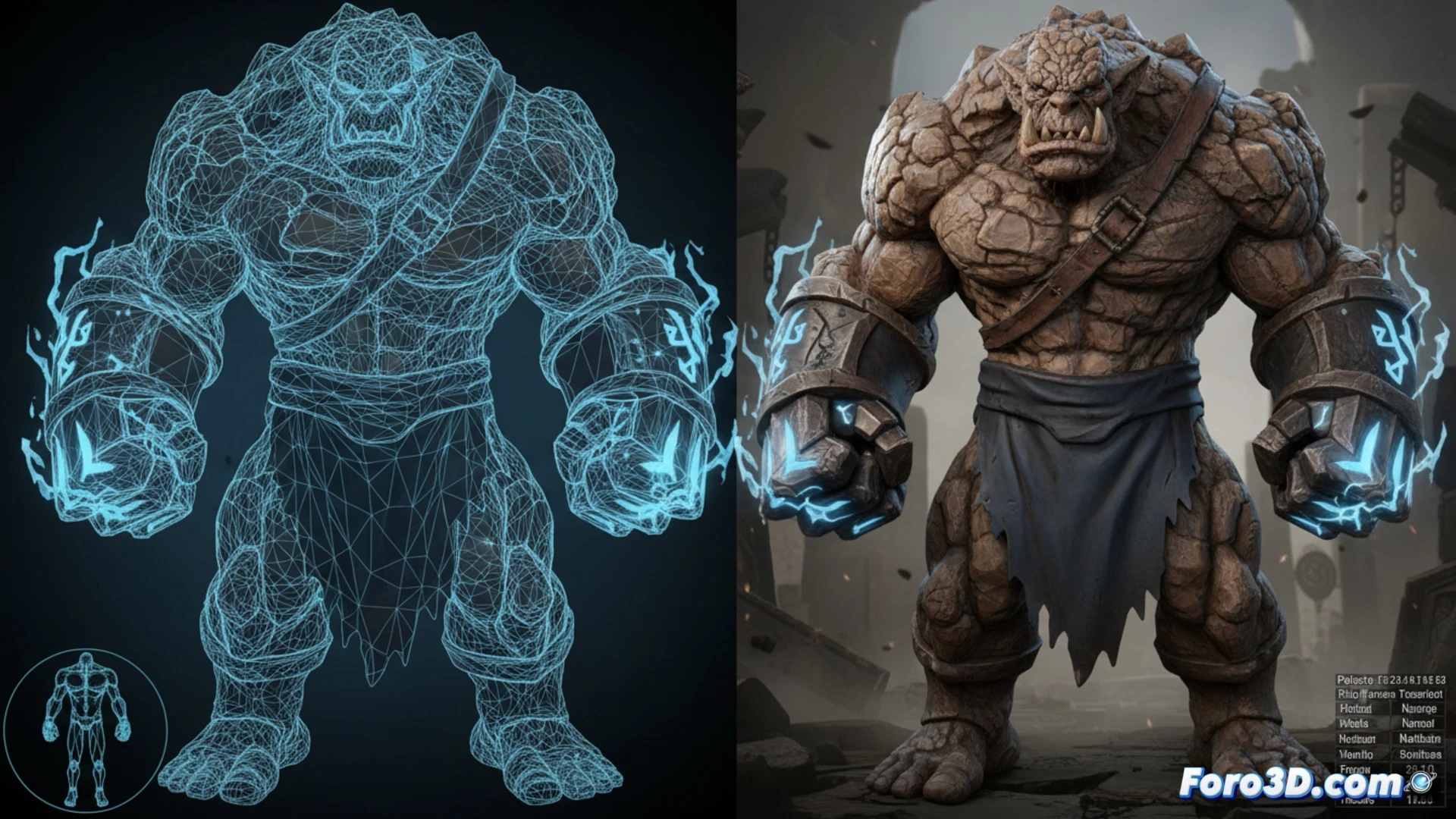
Technical Workflow: Sculpting and Optimization 🛠️
We start with a base mesh in ZBrush or Blender, prioritizing Ulik's massive silhouette. His torso should be disproportionately wide, with thick arms and short but sturdy legs. The key lies in the rock texture: use displacement maps to simulate cracks and veins in his skin, combined with a rough material in Unreal Engine or Unity. The iron fists require a separate model with high polygon density for hammered and worn details, but with an aggressive LOD. For rigging, a skeleton with additional bones in the knuckles allows for believable impact animations. Optimize using 2K or 4K textures compressed in BC7, and limit the vertex count to 15,000 for the main on-screen model. Kirby's direct reference dictates angular action lines in the limbs, translatable to an inverse kinematics rig for blunt strikes.
Lessons from Kirby: Exaggeration and Functionality 🎨
Jack Kirby's aesthetic demands impossible proportions that work in 3D if balanced with gameplay. Ulik must have enormous hands (30% larger than realistic) so his iron fists are the visual focus, but the hitbox must be adjusted with simple colliders to avoid detection errors. Hair and beard, typically wild in the comic, are best resolved with a system of flat polygons with alpha textures, rather than full sculpting, to maintain fluidity in combat. The final lesson is that Asgard rock is not flat gray; use color variations in shading to simulate moss and battle scars, bringing life to a character who, though made of stone, must feel dynamic in every animation.
How can we technically solve the transition between the iron fists and the organic rock texture of Asgard on Ulik the Troll to avoid mapping artifacts in the game engine?
(PS: game jams are like weddings: everyone is happy, no one sleeps, and you end up crying)