Snow tornadoes, or snownadoes, are ephemeral vortices that challenge the static perception of winter. Unlike snowstorms, these phenomena rise in rotating columns driven by extreme thermal gradients over icy surfaces. For scientific visualization, representing this dynamic requires a multidisciplinary approach combining volumetric particle reconstruction with electromagnetic field and fluid simulation.
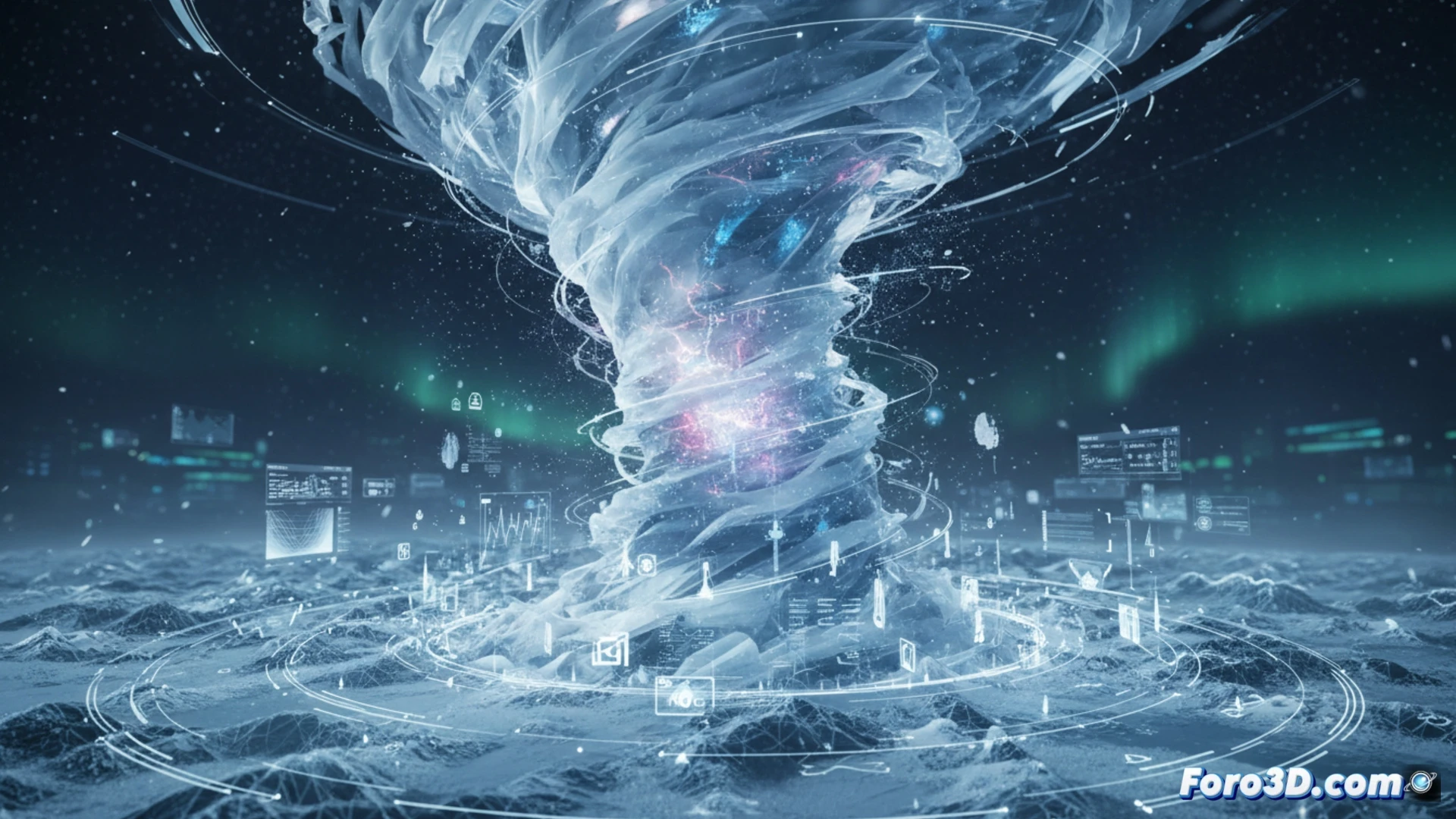
Volumetric reconstruction and multiphysics simulation 🌪️
The process begins with field data capture, where each snow crystal acts as a discrete marker. Using Volume Graphics VGSTUDIO MAX, the particle cloud is reconstructed into a 3D volume, allowing the vortex column to be isolated from the atmospheric background. The technical key lies in applying a density gradient filter to identify the snownado core. Subsequently, this geometry is imported into COMSOL Multiphysics, activating the Bio-electromagnetism module to model latent heat exchange. Although unusual, this module allows simulating how temperature differences between the frozen ground and the air generate the vortex's lifting forces. Simulations are validated by comparing the resulting angular velocity with real footage of winter storms.
Visual validation and the art of the ephemeral ❄️
The true power of these tools lies not only in numerical precision but in the ability to communicate a complex phenomenon. By rendering flow lines in VGSTUDIO and overlaying them onto the real video, immediate scientific validation is obtained: the shape of the simulated vortex must match the observed snow spiral. For the science communicator, this workflow demonstrates that even the most fleeting meteorological events can be frozen, analyzed, and understood in a 3D environment, turning meteorology into an immersive visual experience.
Since the simulation in COMSOL allows parameterizing temperature and wind speed, what critical variables should be adjusted so that the 3D model in VGSTUDIO faithfully reproduces the formation, duration, and dissipation of a snownado under real laboratory conditions?
(PS: modeling manta rays is easy; the hard part is making them not look like floating plastic bags)