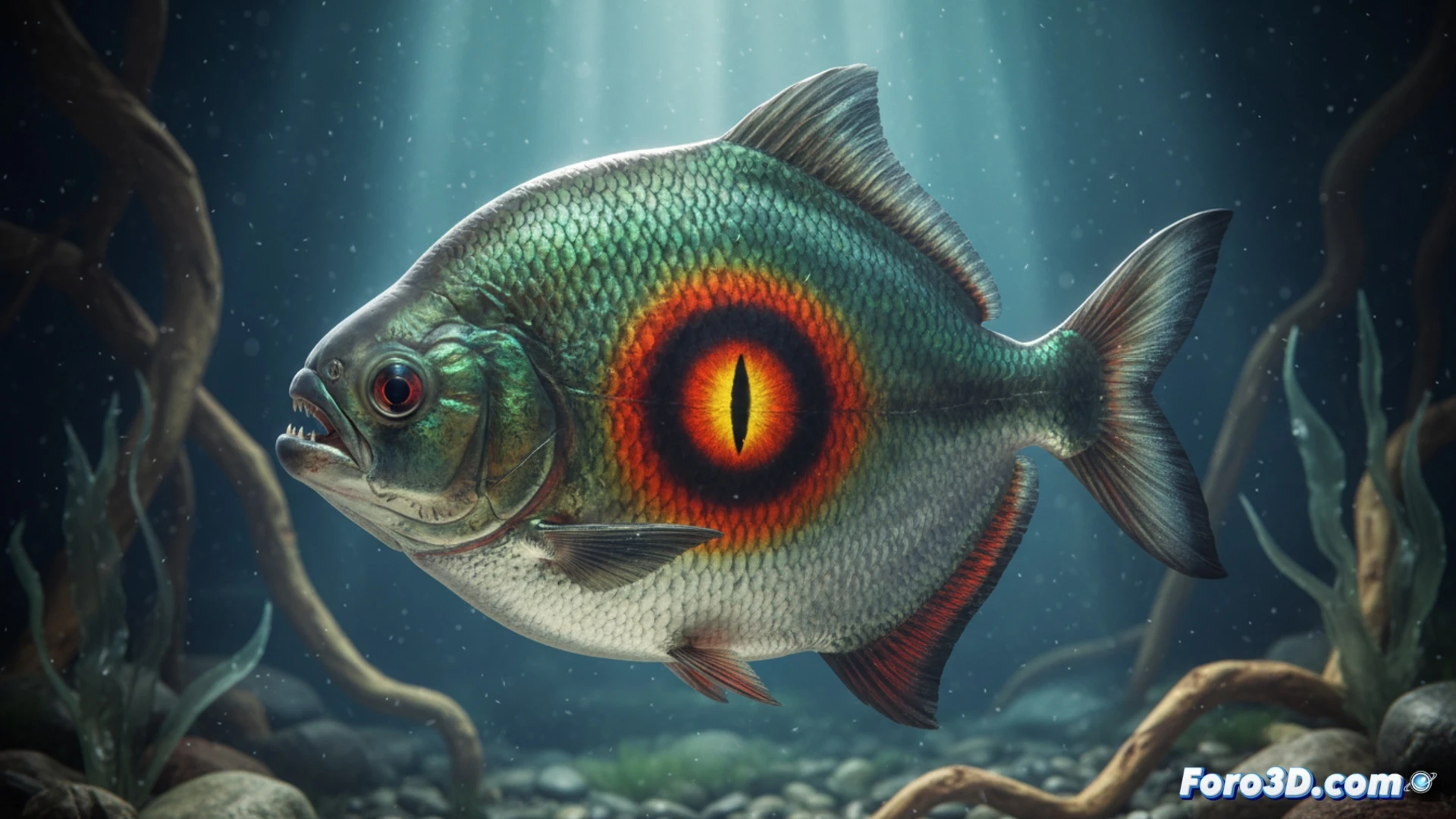
The discovery of Myloplus sauron in the Xingu River basin (Brazil) in 2024 has revolutionized scientific visualization. This species, named for its central black spot evoking the Eye of Sauron, features a disc-shaped body morphology that distinguishes it from traditional piranhas. Its study requires anatomically precise 3D models to document its unique structure and role in the Amazonian ecosystem, facilitating dissemination in interactive museums and documentaries.
Anatomical modeling pipeline and phylogenetic comparison 🐟
To digitally recreate Myloplus sauron, it is recommended to start with high-resolution photogrammetry from preserved specimens, capturing the texture of the black spot and the cycloid scale. Retopology should prioritize the laterally compressed disc shape, with elongated dorsal and anal fins. Comparison with Serrasalmus rhombeus (rhomboid piranha) requires a study of dentition and jaw: while S. rhombeus has sharp teeth for tearing, M. sauron shows dentition specialized in seeds and fruits, which changes the bite kinematics. Include a rigging system to simulate the lateral swimming typical of pacus, their actual biological group.
Reflection on the visualization of critical ecosystems 🌿
Modeling Myloplus sauron is not just a technical exercise; it is a conservation tool. The Xingu River faces threats from hydroelectric dams, and 3D visualization of its habitat (sandbanks, riparian vegetation, and black waters) allows creating immersive environments to raise awareness about endemic biodiversity. By animating its behavior of algae grazing and seed dispersal, 3D models become digital ambassadors for a species we are only beginning to understand.
How can 3D modeling of Myloplus sauron improve accuracy in visualizing cryptic morphological patterns in fish species from the Xingu River basin?
(PS: if your manta ray animation doesn't excite, you can always add documentary music from channel 2)