High-performance swimming demands extreme biomechanical repetitions that, combined with chemical exposure and the aquatic environment, create a unique occupational risk profile. Overuse injuries, such as rotator cuff tendinitis and swimmer's knee, are not random accidents but the result of dysfunctional movement patterns. 3D motion capture technology now allows us to break down each stroke and each kick to identify with millimeter precision the stress points that trigger these pathologies.
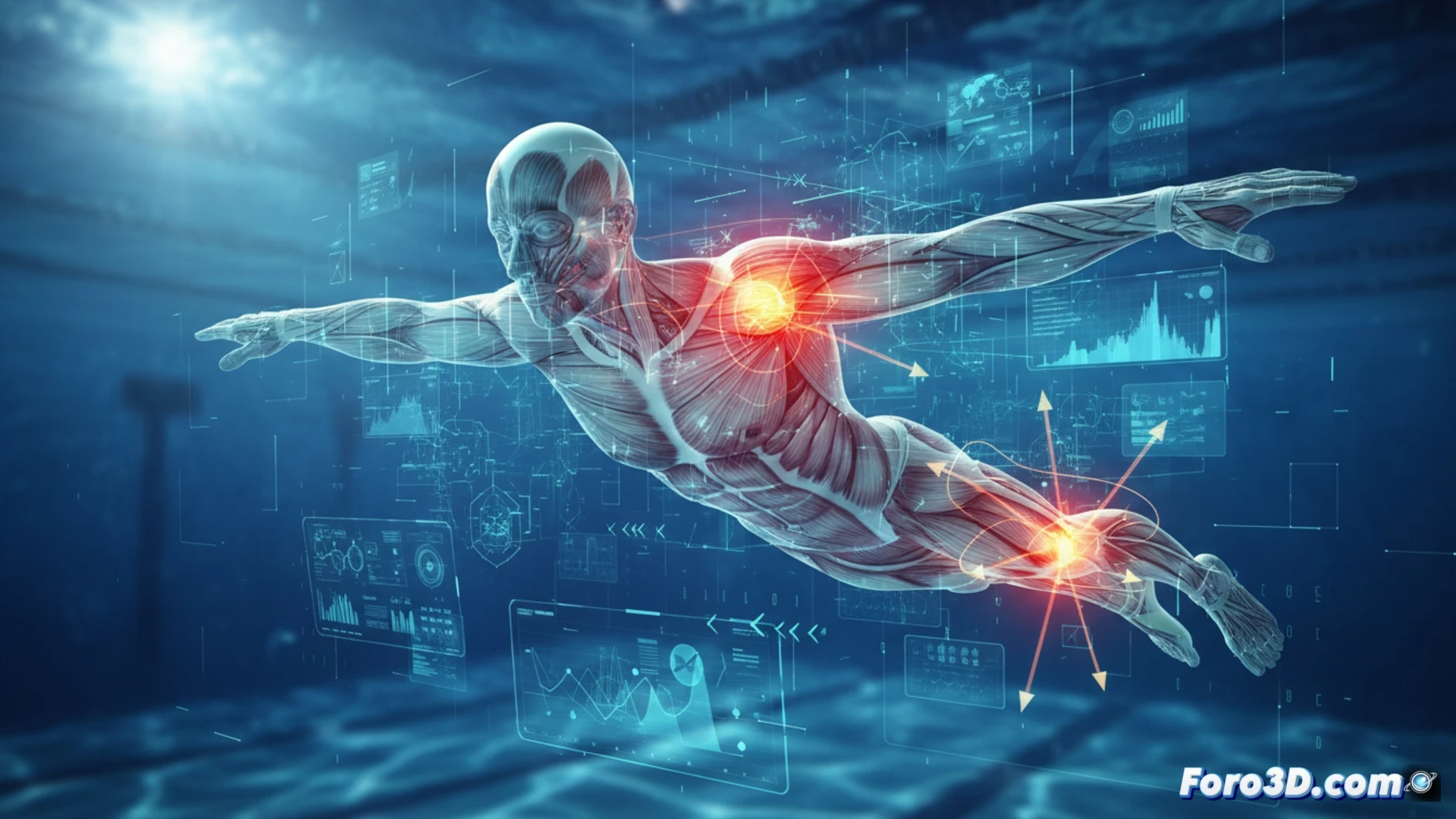
Biomechanical simulation of the rotator cuff and swimmer's knee 🏊
Using 3D anatomical models generated by state-of-the-art scanners, we can visualize the impingement of the supraspinatus tendon against the acromion during the recovery phase of the front crawl stroke. Volumetric rendering shows how excessive internal rotation of the shoulder compresses the subacromial bursa, reducing the sliding space to less than 2 mm. Concurrently, the simulation of the breaststroke kick reveals that valgus stress on the knee, combined with tibial rotation, generates shear forces exceeding 300 Newtons on the medial collateral ligament, a threshold that anticipates ligament injury or synovitis.
Visual prevention: interactive infographics against wear and tear 🦾
3D visualization not only diagnoses but also prevents. By overlaying the swimmer's bone model onto their real-time motion capture, the coach can correct shoulder alignment before repetitive friction inflames the tendon. An interactive infographic of the middle ear, for example, allows understanding why water trapped behind the edge of the ear canal favors Pseudomonas infection. This educational approach reduces the incidence of chronic injuries and improves athletic longevity, transforming the pool into an applied biomechanics laboratory.
How can 3D modeling of shoulder and knee injuries in high-performance swimmers help predict and prevent joint wear before the first clinical symptoms appear?
(PS: at Foro3D we know that a penalty simulated in 3D always goes in... unlike in real life)