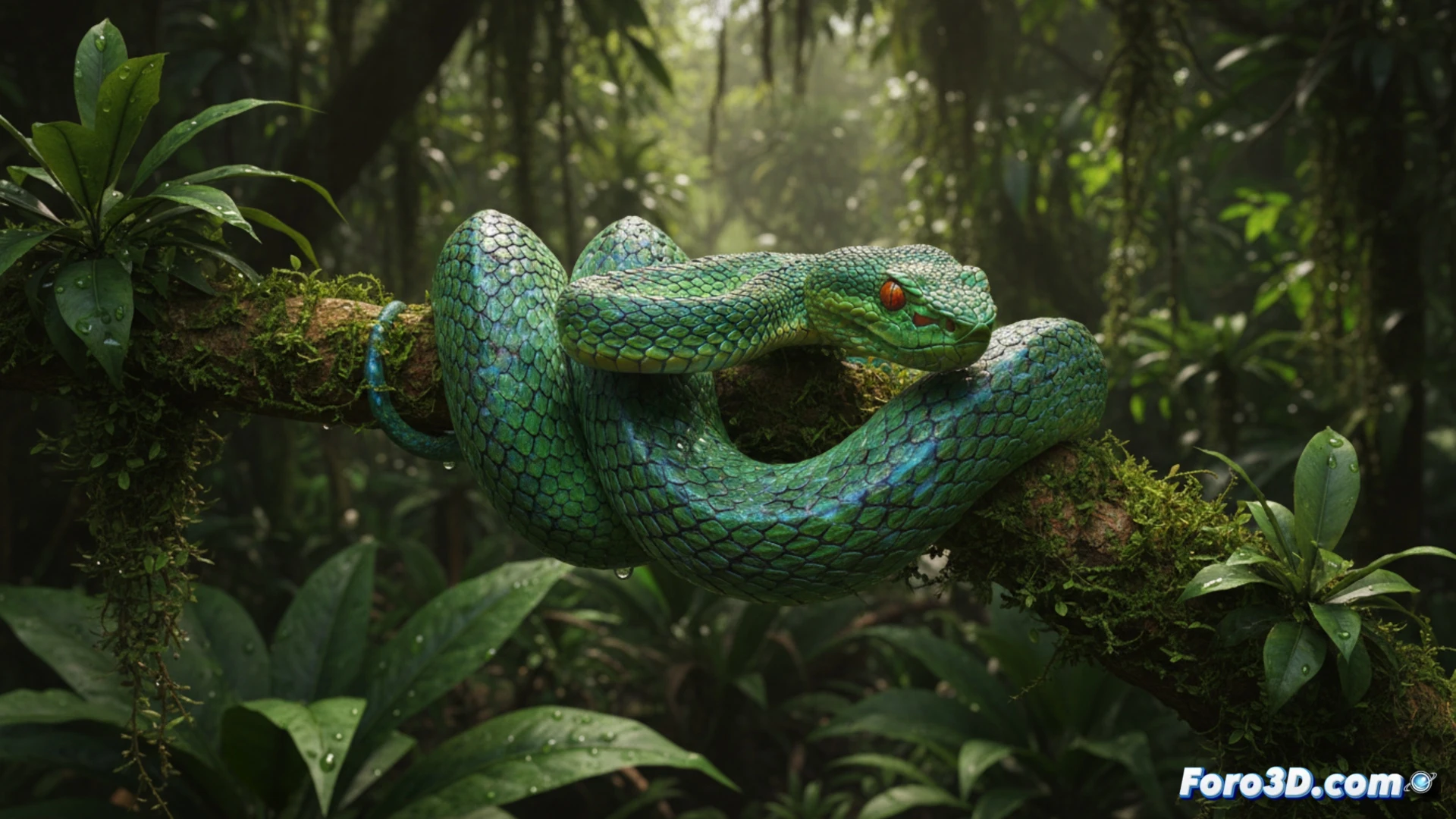
The recent description of the Trimeresurus salazar, a new species of bright green pit viper discovered in India, represents a unique opportunity for 3D artists specialized in scientific visualization. Named in honor of Salazar Slytherin for its striking emerald coloration and jungle habitat, this snake demands a precise technical approach to capture the iridescence of its scales and the complexity of its environment. This article details the necessary pipeline to create a photorealistic model and an educational animation of this fascinating species. 🐍
Technical Pipeline: Scales, Light, and Comparative Anatomy 🎨
Modeling must begin with a reference scan of a Trimeresurus specimen to ensure anatomical accuracy, especially in the shape of the triangular head and the heat-sensing loreal pit. The key lies in texturing: displacement maps are required for keeled scales and a multi-layer shader (SSS) to simulate the subcutaneous reflectance that produces its neon green hue. For animation, rigging with control of serpentine movements (sinuous) and a simulation of the forked tongue is crucial. The 3D comparison with species like Trimeresurus gramineus should be performed through controlled morphing that highlights differences in the pattern of supraocular scales and ventral coloration.
Beyond the Model: The Ecosystem as a Stage 🌿
An effective scientific visualization not only shows the animal but its context. For Trimeresurus salazar, it is vital to recreate a jungle canopy of the Indian Western Ghats. This involves a particle system for dappled light filtering through leaves and a vegetation model based on growth rules (L-systems) to represent ferns and lianas. The final challenge is volumetric lighting: we must simulate the humid understory mist so that the snake's green stands out like a bioluminescent flash, demonstrating that 3D art can be a powerful tool for taxonomic outreach.
What was the main technical challenge in capturing the iridescent texture and scale of Trimeresurus salazar to achieve a 3D model faithful to the species and useful for herpetological research?
(PS: at Foro3D we know that even manta rays have better social bonds than our polygons)