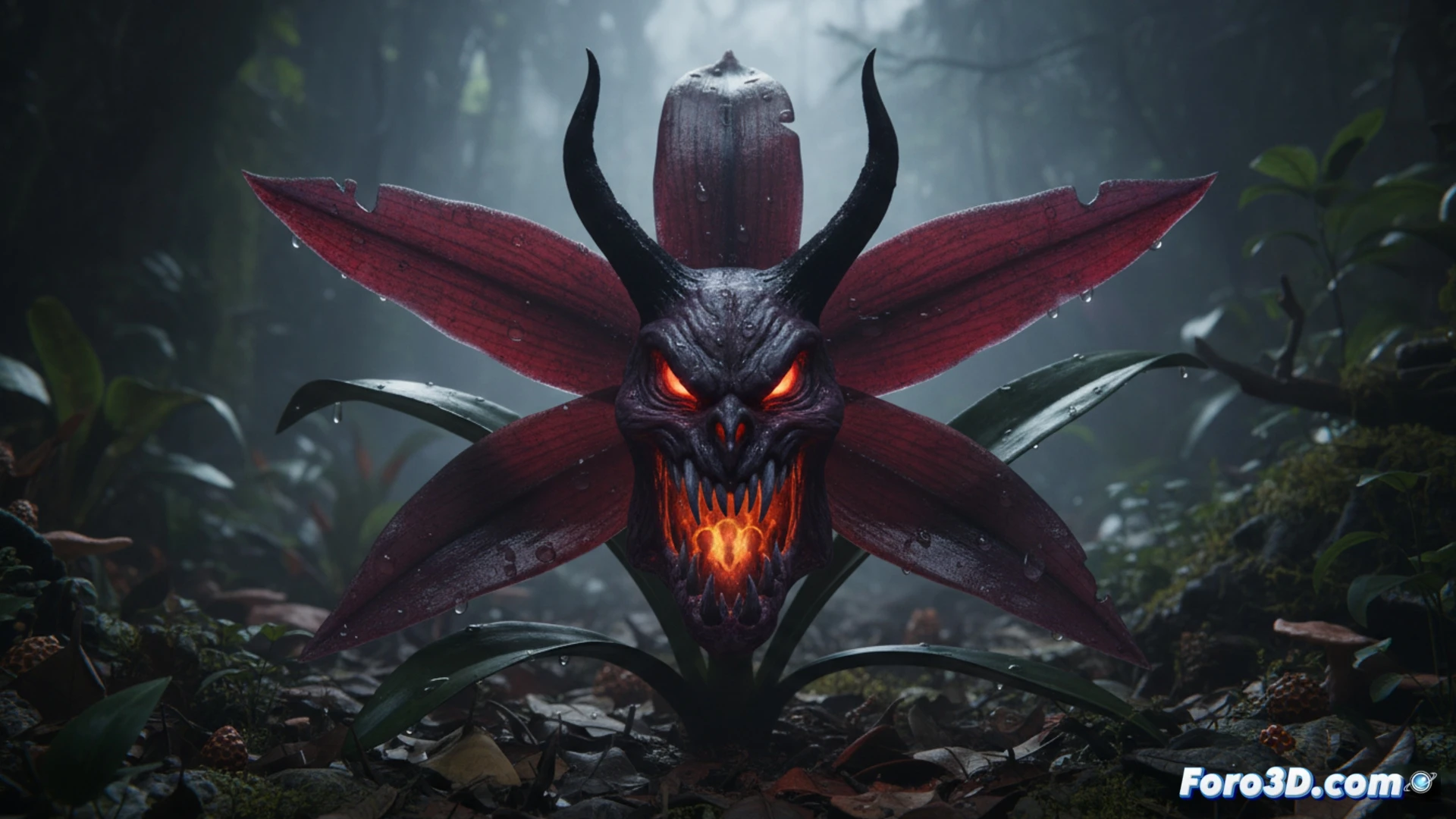
Nature never ceases to amaze us with its ability to emulate fantastic forms. In the jungles of Colombia, a team of botanists has identified a new species that seems to come straight out of a medieval bestiary: the Telipogon diabolicus. This orchid features a floral column that, instead of the typical petals, displays a three-dimensional structure that replicates with astonishing precision the horns, eyes, and jaws of an infernal face. For scientific visualization experts, this discovery represents a fascinating challenge in scanning and digital reconstruction.
Polygonal reconstruction and comparative anatomy 🌿
The architecture of the Telipogon diabolicus requires a high-resolution photogrammetry approach to capture the folds and textures of its labellum. The 3D model must prioritize the geometry of the gynostemium, the reproductive structure that fuses male and female organs. Here lies the visual trick: the devil's face is formed by the arrangement of the pollinia and the rostellum. When comparing this model with that of a standard orchid like the Cattleya, hypertrophy of the lateral lobes is observed. Pollination simulation reveals that this morphology could be an adaptation to guide a specific wasp, forcing it to touch the pollinia right in the center of the devil's forehead.
The educational value of biological rarity 🧬
Beyond the aesthetic curiosity, the 3D recreation of this demonic flora has high educational value. It allows biologists and students to virtually dissect the flower without damaging the scarce wild specimens. By rendering the cloudy habitat of the Colombian forest, we can contextualize its evolution. The Telipogon diabolicus reminds us that scientific visualization not only documents reality but also helps us understand how natural selection can sculpt forms that border on the surreal, turning a simple flower into an icon of biodiversity.
What technical and methodological challenges arise when modeling such a complex botanical structure as the flower of the Telipogon diabolicus in 3D, and how can they be overcome to achieve accurate scientific visualization of its morphological details?
(PS: at Foro3D we know that even manta rays have better social bonds than our polygons)