The discovery of the Ayerbe Snail-eating Snake (Sibon ayerbeorum) in the jungles of the Colombian Chocó represents a milestone for herpetology. Its color pattern, composed of contrasting rings and iridescent scales, poses a fascinating technical challenge for scientific visualization. This article explores the process of creating a photorealistic 3D model focused on the exact representation of its pigments and the topography of its scales, essential for outreach and conservation.
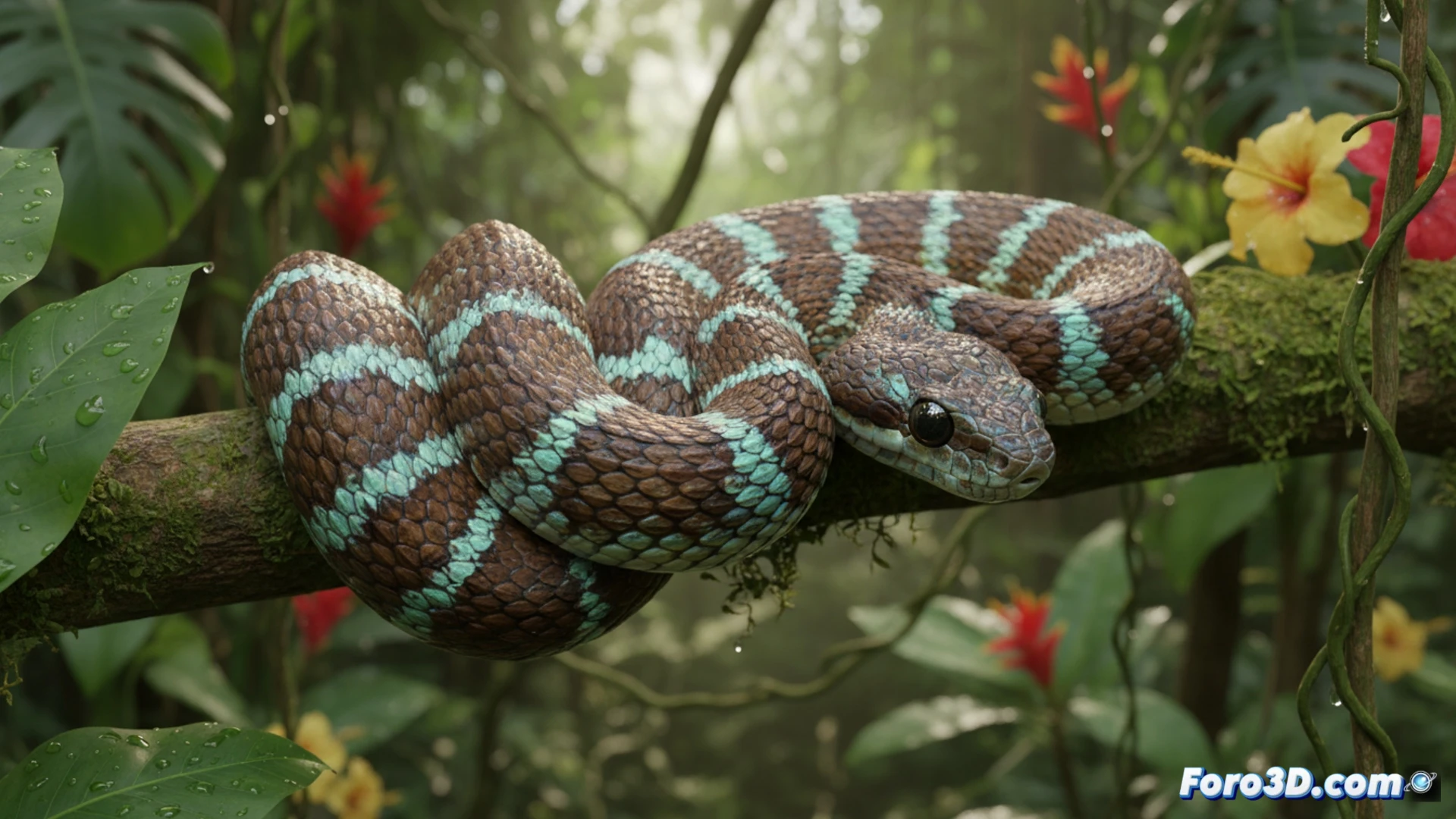
Digital reconstruction and interactive anatomical annotations 🦎
To capture the essence of Sibon ayerbeorum, the modeling must prioritize the microgeometry of the dorsal scales and the light dispersion in its chromatic pattern. Using field data and photogrammetry, the body surface is reconstructed with displacement maps that replicate the keratinized texture. The integration of interactive annotations allows the user to identify key differences with sister species of the genus Sibon, such as variation in head shape or band arrangement. The Chocó habitat is recreated with canopy vegetation and leaf litter, using procedural vegetation to simulate the ecosystem's biodiversity. A global illumination system with ambient light and soft shadows enhances the metallic reflections of the snake.
Visual impact as a conservation tool 🌿
The scientific visualization of Sibon ayerbeorum goes beyond aesthetics; it acts as a catalyst for environmental education. By presenting an interactive digital replica, researchers and the general public can study its morphology without disturbing the natural habitat. This 3D model facilitates species identification in monitoring campaigns and raises awareness about the fragility of the Chocó, a region threatened by deforestation. Technology thus becomes a bridge between the laboratory and the jungle, promoting the conservation of this jewel of Colombian biodiversity.
As a 3D modeler, what were the main technical challenges when recreating the iridescent color patterns of Sibon ayerbeorum for accurate scientific visualization?
(PS: fluid physics for simulating the ocean is like the sea: unpredictable and you always run out of RAM)