The discovery of Scinax v-signatus in the lowland Amazon in 2024 represents a milestone for herpetology, but also a technical challenge for scientific visualization. This species, named for the unmistakable V-shaped mark between its eyes, demands a 3D model that captures this diagnostic trait with millimeter precision. High-resolution photogrammetry from type specimens allows the generation of a polygonal mesh that preserves skin texture and head geometry, essential for digital identification.
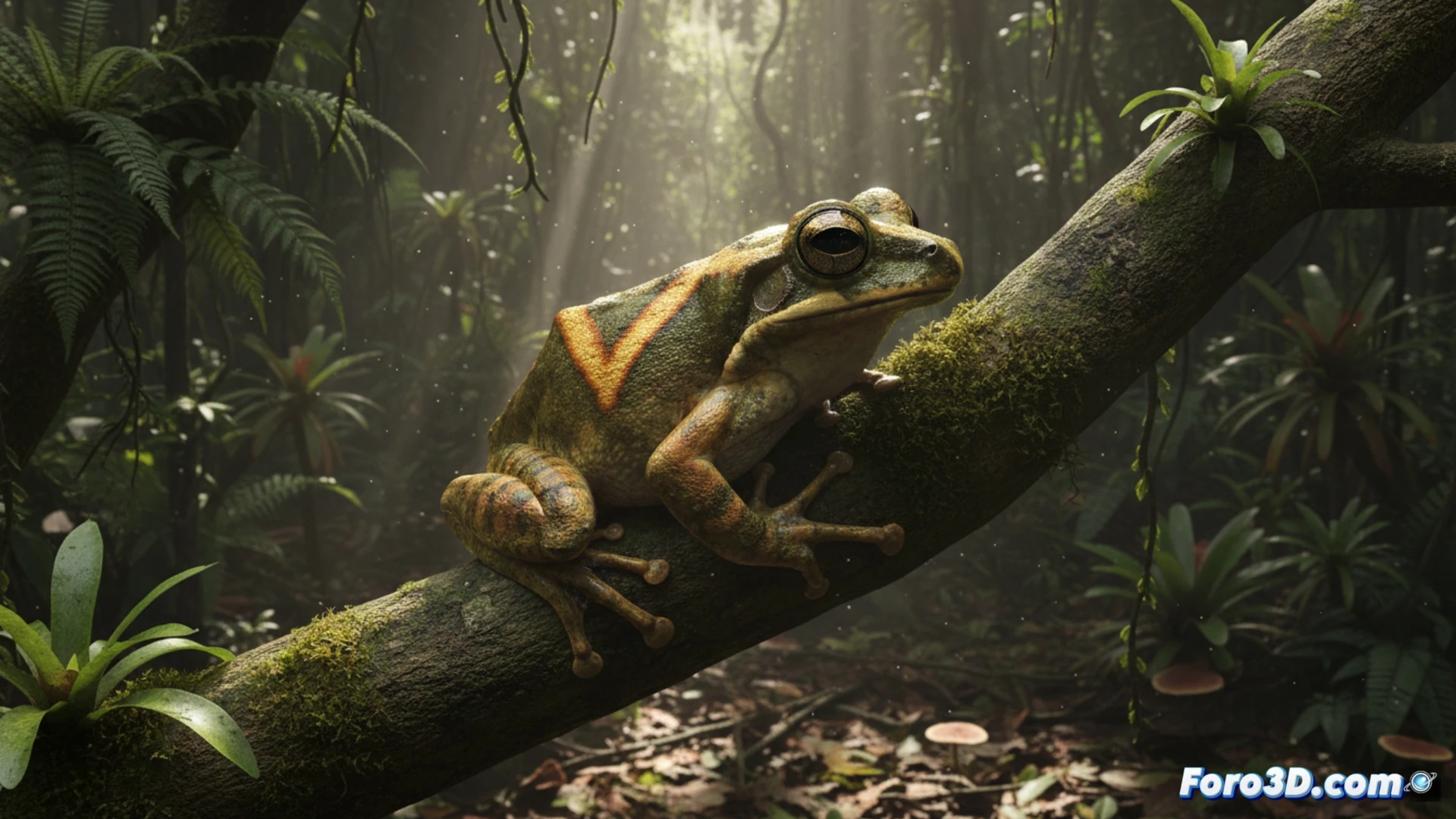
Workflow: Photogrammetry and Anatomical Reconstruction 🐸
The process begins with capturing 400 to 600 images of the fixed specimen, using a cross-polarized lighting rig to eliminate harsh shadows. Using Structure from Motion (SfM) software, a dense point cloud is generated and cleaned of environmental noise. The resulting mesh, approximately 2 million polygons, is retopologized to 50,000 quads for animation. The diffuse texture is projected from the original photos, while displacement and roughness maps are calculated from skin details. The final model is integrated into a lowland jungle environment with HDRI lighting and procedurally generated vegetation, achieving photorealism that allows for public dissemination without sacrificing scientific rigor.
Interactive Visualization for Conservation 🌿
The 3D model of Scinax v-signatus is not just a portfolio piece; it is a conservation tool. By allowing any researcher to rotate, isolate, and measure the V-shaped mark from a web viewer, access to the holotype is democratized. Furthermore, the animation of its arboreal behavior, with a rig that simulates the flexion of its adhesive discs, helps understand its ecological niche. This approach transforms a field discovery into a perpetual digital asset, protecting the original data from physical deterioration and bringing the Amazon closer to the laboratory of any 3D artist.
Which UV mapping and procedural texturing techniques are most effective for accurately replicating the cryptic coloration and micro-folds of the skin of Scinax v-signatus from limited field data in the lowland Amazon?
(PS: if your manta ray animation isn't exciting, you can always add some BBC documentary music to it)