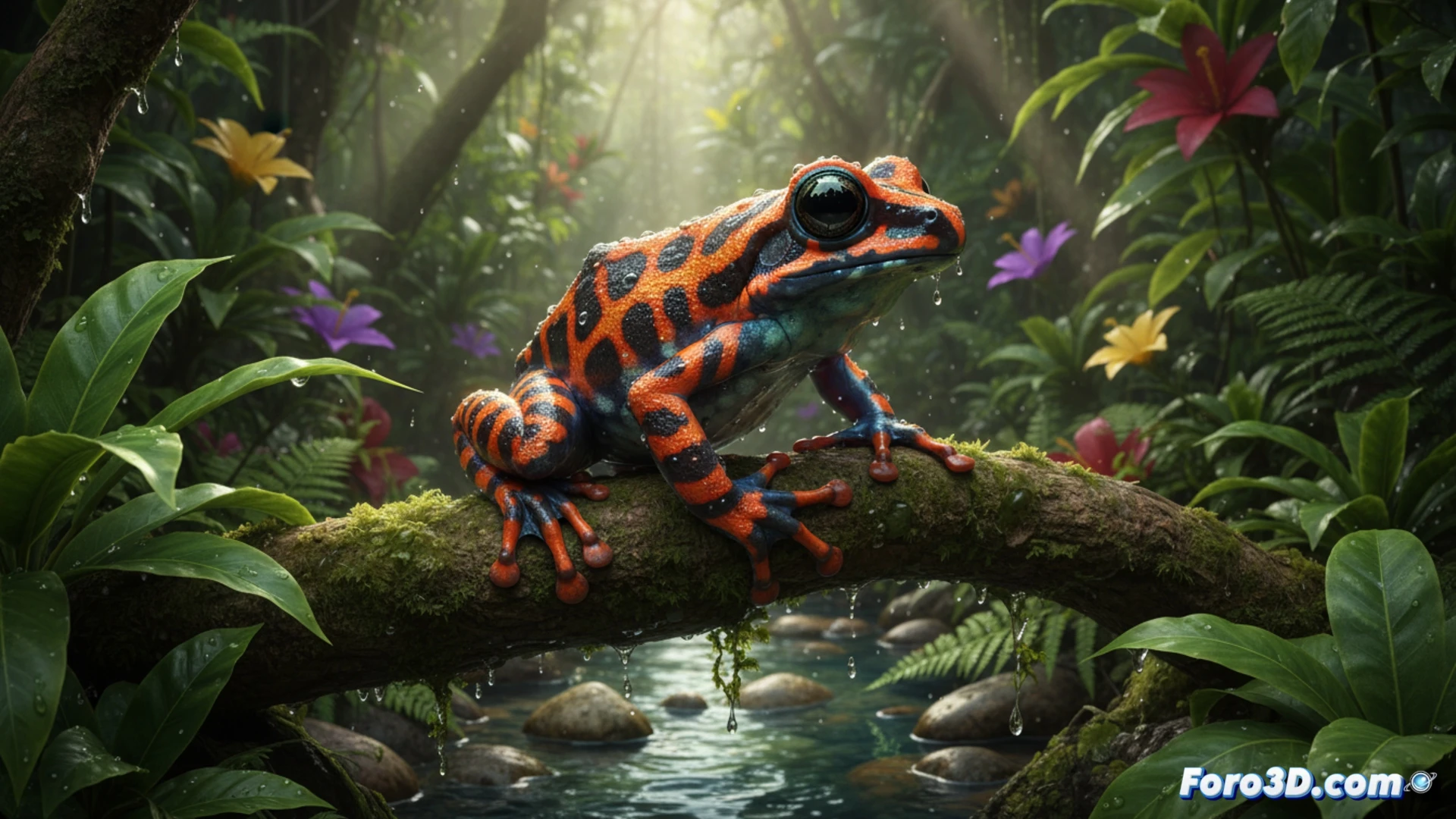
The recent description of Hyloscirtus sethmacfarlanei, an Ecuadorian torrent frog named in honor of Seth MacFarlane, offers a fascinating case for scientific visualization. Its black skin contrasts with bright yellow spots, an aposematic pattern that warns of its toxicity. This article details the process of creating a photorealistic 3D model for educational and outreach purposes, focusing on anatomical accuracy and habitat representation.
Technical workflow for modeling and texturing 🐸
To capture the essence of this species, we started with high-resolution photogrammetry from preserved specimens and field photographs. The base model was sculpted in ZBrush, prioritizing the rough, granular texture of the dermis, typical of torrent amphibians. The yellow spot pattern was generated using procedural mask maps in Substance Painter, replicating the irregular distribution of venom in the epidermis. Reflectance was adjusted using an SSS (Subsurface Scattering) shader to simulate the translucency of moist skin. The defensive animation, which includes body arching and exposure of the parotoid glands, was rigged with a non-linear bone system to avoid artificial deformations.
Implications for conservation and education 🌿
Beyond the technical challenge, this model serves as a conservation tool. By integrating toxicity data and distribution maps into an interactive 3D viewer, we allow virtual museums and educational applications to showcase the frog without disturbing its fragile ecosystem. MacFarlane's funding for the protection of its habitat in Ecuador underscores how pop culture can drive science. Visualizing this amphibian in detail not only educates about aposematism but also humanizes the urgency of preserving Andean biodiversity.
As a 3D modeler, what texturing techniques do you recommend to accurately capture the toxicity patterns and reflectance properties of the mucous skin of Hyloscirtus sethmacfarlanei in a scientific visualization environment?
(PS: if your manta ray animation doesn't excite, you can always add documentary music from channel 2)