In the remote and conflict-ridden mountains of the Serranía de San Lucas, Colombia, a team of herpetologists has identified a new species: the San Lucas Jumping Frog (Dendropsophus sanlucas). This small arboreal amphibian, just a few centimeters long, displays a unique pattern of yellow lateral stripes on a brown background. Its discovery in 2023 represents a milestone for Colombian biodiversity, but also a logistical challenge for its study and dissemination, as the area is difficult to access.
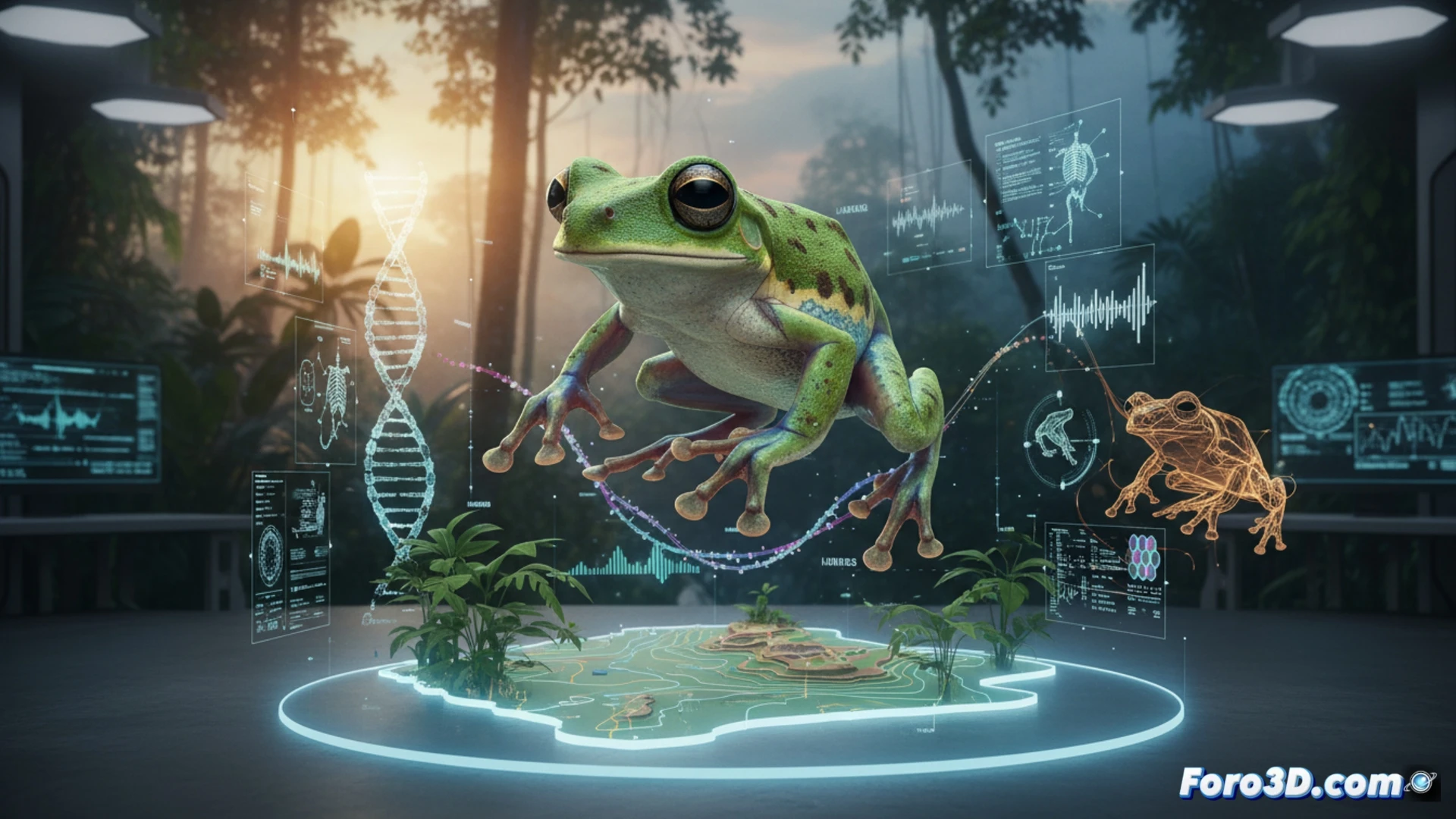
Photogrammetry and Anatomical Modeling for Conservation 🐸
To document this species without removing specimens from its fragile ecosystem, scientists use field photogrammetry. By capturing dozens of high-resolution images of a found specimen, a point cloud is generated, which is later reconstructed into a polygonal 3D model. This model allows for precise visualization of the frog's arboreal morphology, including its adhesive toe pads and skin texture. The digital representation highlights the yellow lateral stripes, a key taxonomic feature, and allows researchers to take virtual measurements without handling the animal.
Visualizing the Remote Ecosystem of the Serranía 🌿
Beyond the anatomical model, scientific visualization reconstructs the habitat of Dendropsophus sanlucas. Using field data on vegetation, humidity, and altitude, a 3D environment of the Serranía de San Lucas is created. This digital recreation allows the scientific community and the general public to explore a remote ecosystem threatened by illegal mining. Thus, 3D modeling becomes a dissemination tool that transcends geographical barriers, showing the importance of conserving these pristine areas.
What technical and artistic considerations must be balanced when 3D modeling a species like the San Lucas Jumping Frog to ensure both scientific accuracy and visual appeal in a scientific visualization context?
(PS: at Foro3D we know that even manta rays have better social connections than our polygons)