The discovery of Dendropsophus mapinguari in the Brazilian Amazon (2021) offers a fascinating case for scientific visualization. Named after the legendary Amazon monster, this tree frog is distinguished by a unique rhythmic call among its relatives. Its morphology, adapted to life in the forest canopy, presents challenges and opportunities for accurate 3D modeling, from the texture of its skin to the biomechanics of its vocal sac.
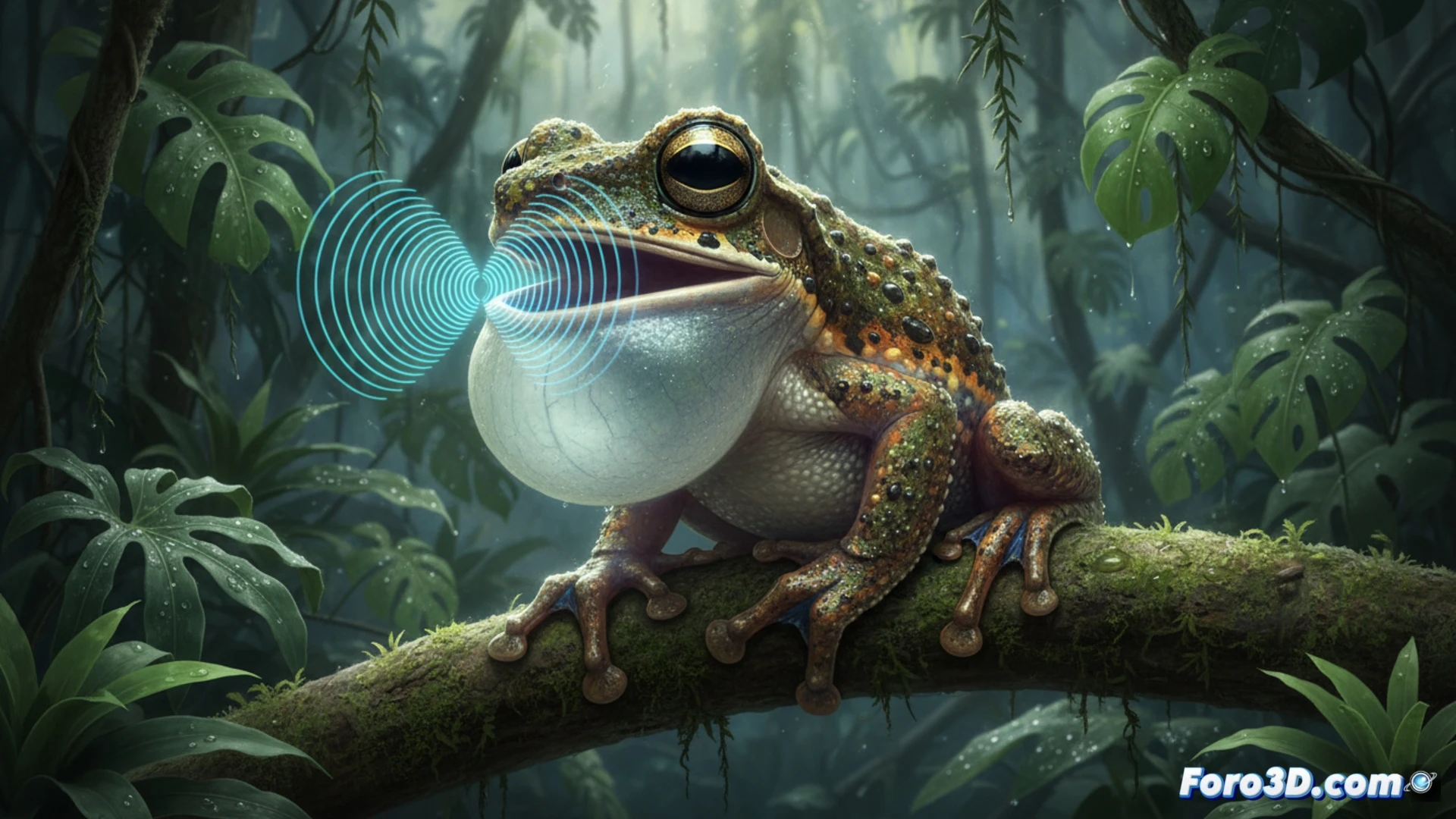
Digital anatomy and acoustic simulation of the call 🐸
A high-fidelity 3D model must capture the arboreal adaptations of D. mapinguari, such as its adhesive toe pads and slender body, ideal for jumping between branches. The key to the project is the simulation of its rhythmic call, a trait that reproductively isolates it from sister species. By reconstructing its vocal apparatus in animation software, we can visualize the vibration of the vocal folds and the expansion of the buccal sac. A visual comparison with Dendropsophus minutus, its closest relative, would reveal differences in note frequency and duration, allowing researchers to observe the evolution of acoustic behavior in an interactive 3D environment.
Myth as inspiration for scientific realism 🌿
Naming a real creature after a myth like the Mapinguari reminds us that science and narrative are not at odds. For the visualizer, this link is an opportunity to contextualize the model. When rendering the Amazonian habitat, we can play with understory lighting and ambient humidity, creating a scene that evokes the mystery of the legend. The result is not only a research tool but also a piece of science communication that connects the public with real biodiversity, demonstrating that reality can be as astonishing as the myth that inspired it.
What advantages does 3D modeling of the mapinguari frog and its rhythmic call offer for understanding acoustic communication in the canopy of the Brazilian Amazon?
(PS: if your manta ray animation doesn't excite, you can always add some documentary music from channel 2)