The recent description of Pristimantis gretathunbergae, a new species of rain frog discovered in the cloud-covered peaks of Panama, presents a perfect case study for scientific visualization. This amphibian, just a few centimeters in size, possesses hypnotic black eyes and a unique skin texture that distinguish it from its congeners. For the 3D modeling community, this discovery opens the door to creating high-fidelity digital assets that capture every morphological detail of the species.
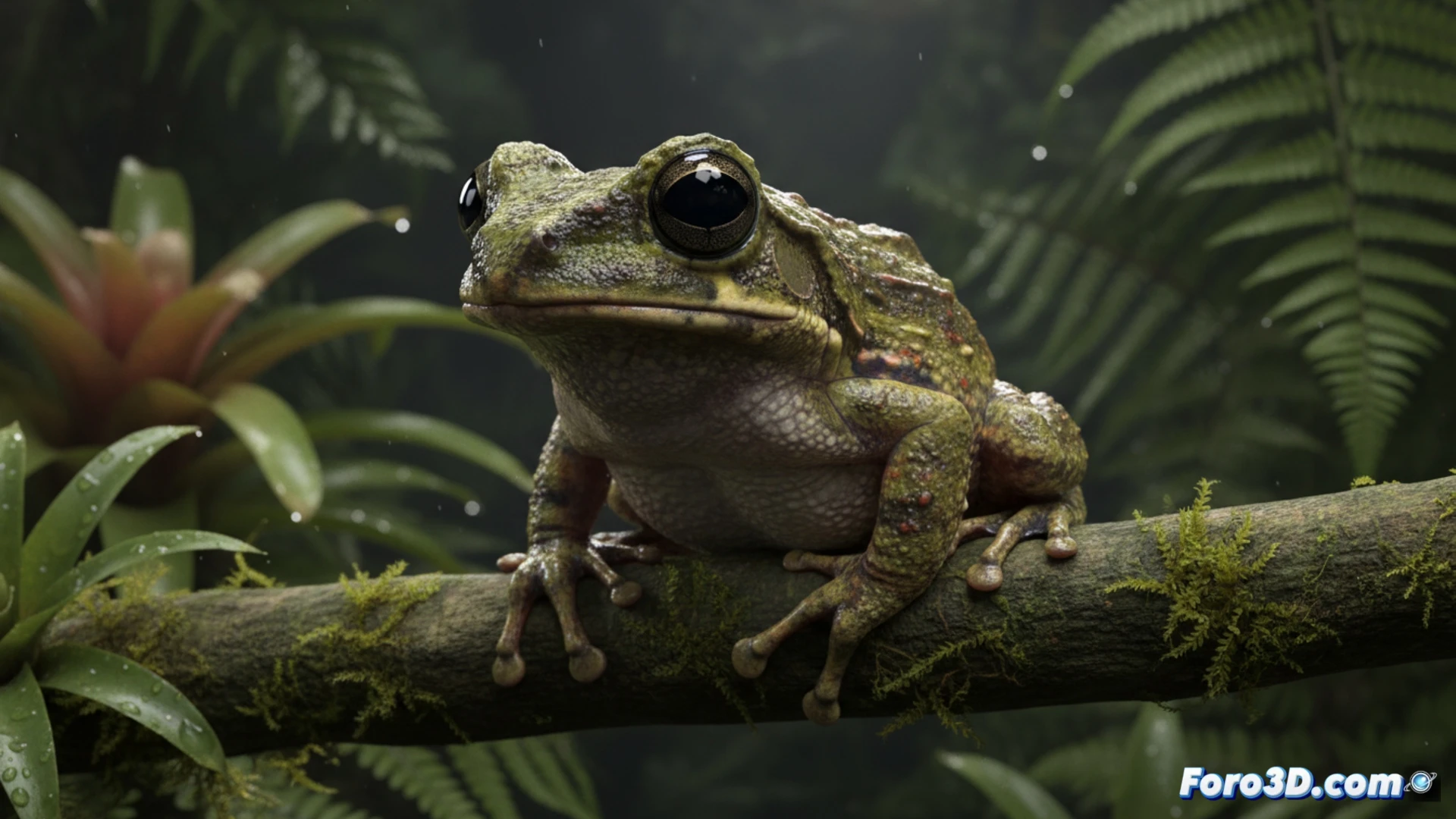
Photogrammetry and Virtual Reconstruction of the Mist Habitat 🐸
The ideal methodology for digitizing Pristimantis gretathunbergae involves using photogrammetry from preserved type specimens. A capture station with cross-lighting is required to eliminate shadows and highlight the granular texture of its skin. The technical challenge lies in replicating the black iridescence of its iris, a distinctive feature that could be simulated with a dark glass shader in engines like Blender or Unreal Engine. Subsequently, reconstructing its environment, the cloud island, requires simulating water vapor particles and a diffuse lighting system that mimics light filtered through the canopy of the Panamanian cloud forest, with relative humidity values close to 100%.
The Digital Model as a Conservation Tool 🌿
Beyond visual realism, the 3D model of this frog serves a critical function. By creating an accessible digital twin, researchers can study the amphibian's anatomy without physically handling the scarce living specimens. This asset can be integrated into virtual museums to raise awareness about the impact of climate change on high-altitude ecosystems. An animation showing the frog on a bromeliad leaf, with artificial mist moving, serves as a powerful outreach tool to explain why these species are biological indicators of global warming.
As a 3D modeler, what is the greatest technical challenge when digitally reconstructing the cryptic coloration and microscopic textures of Pristimantis gretathunbergae from museum specimens to ensure scientific accuracy in citizen science applications?
(PS: modeling manta rays is easy, the hard part is making them not look like floating plastic bags)