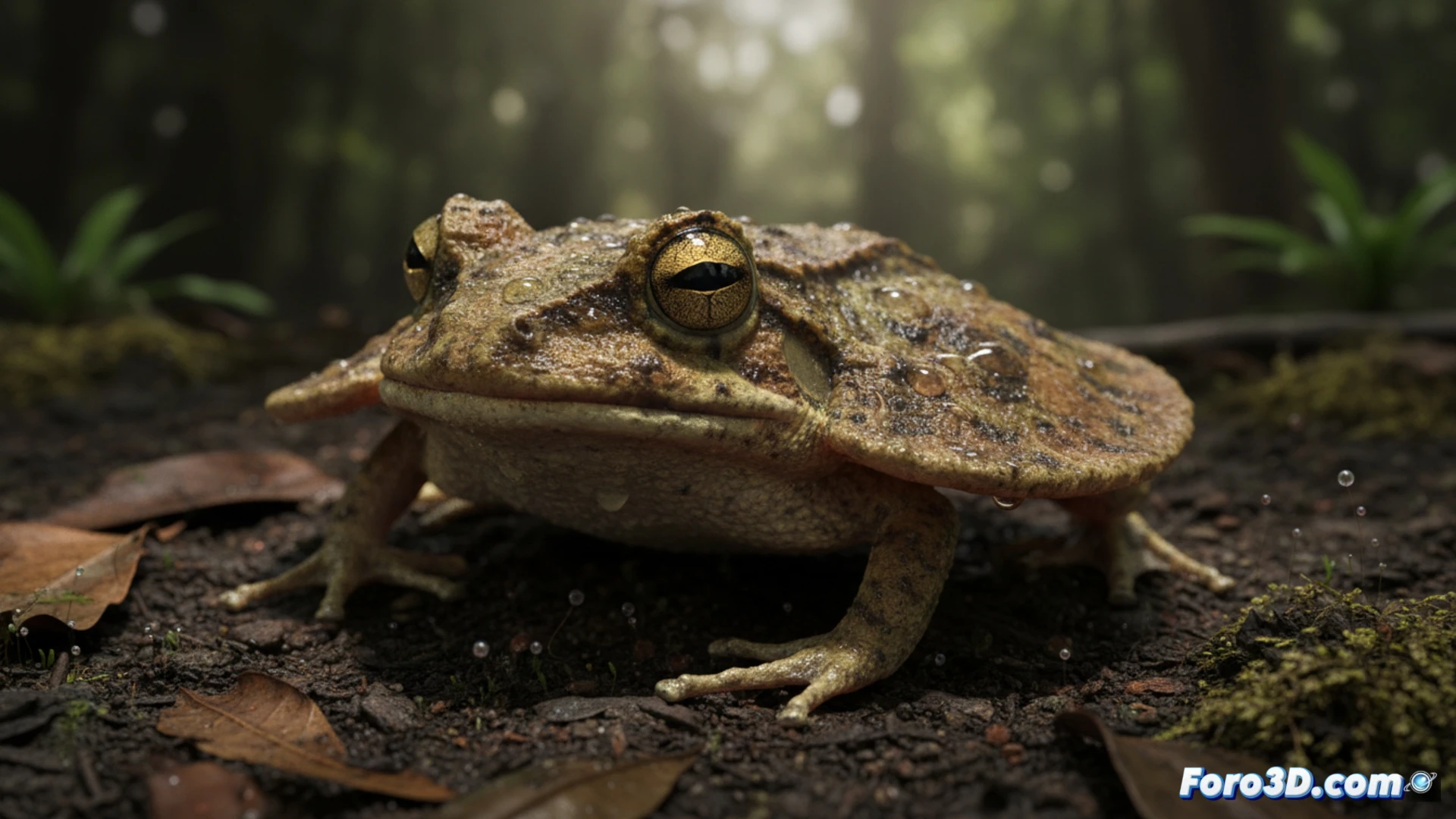
The discovery of Synapturanus ajju in the Peruvian Amazon (2024) represents a milestone in herpetology. This amphibian, known as the Ajju disc frog, has an extremely flattened and circular body, a unique morphological adaptation for life in the mud of the flooded forest. From the Scientific Visualization niche, we propose the creation of a photorealistic 3D model that captures this singular anatomy, allowing its study and dissemination without disturbing its fragile ecosystem.
Modeling and Anatomical Texturing Process 🐸
The workflow begins with reconstruction in digital sculpting software (such as ZBrush or Blender) based on published scientific descriptions. Priority is given to the flattened morphology of the body disc and the arrangement of its limbs, designed for underground movement. Texturing uses displacement and roughness maps to simulate moist, granular skin, employing cryptic coloration references (brown and earthy tones) that allow it to camouflage in mud. For animation, rigging is programmed to replicate the burrowing movement, where the frog twists and sinks into a simulated substrate with mud particles, recreating the behavior observed in the field. Scientific sources, such as the original description article in the journal Evolutionary Systematics, ensure the accuracy of every anatomical detail.
The Challenge of Visualizing the Invisible 🌍
Representing a species that spends almost its entire life underground requires a balance between scientific rigor and visual narrative. The model must not only be anatomically correct but also communicate the pressure and darkness of its muddy habitat. Dim lighting and volumetric effects in the mud will be key to conveying the sensation of being beneath the flooded forest floor. This project aims to be an educational tool that brings the public closer to a creature that would otherwise remain hidden from our eyes, underscoring the importance of conserving these very specific Amazonian ecosystems.
What specific technical challenges does the 3D reconstruction of such a small and cryptic organism as Synapturanus ajju present to achieve anatomical fidelity useful in scientific research?
(PS: at Foro3D we know that even manta rays have better social bonds than our polygons)