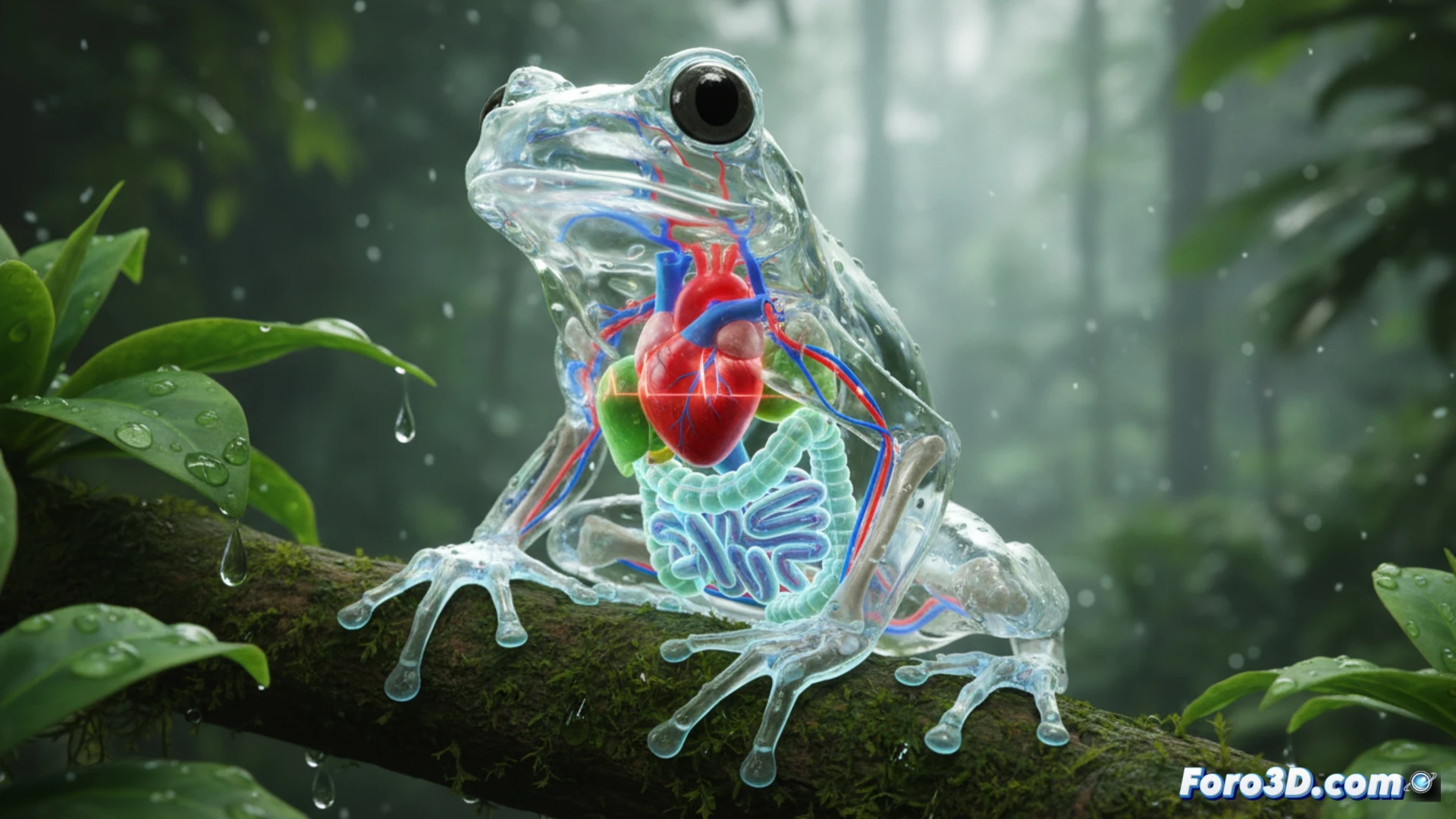
The species Hyalinobatrachium mashpi, discovered in Ecuador in 2022, has a unique characteristic in the animal kingdom: its ventral skin is completely translucent, allowing the heartbeat and functioning of its internal organs to be observed live. This feature makes it an ideal subject for the Scientific Visualization niche, where 3D modeling can faithfully replicate its anatomy for educational and outreach purposes.
Volumetric Rendering Techniques and Translucent Materials 🐸
To digitally recreate the glass frog, it is advisable to start from micro-CT tomography data or high-resolution photogrammetry. In software like Blender or Maya, a model with detailed internal geometry must be built: skeleton, circulatory system, and viscera. The key to realism lies in subsurface scattering (SSS) shaders and the configuration of materials with a low refractive index (around 1.33, similar to water). Volumetric rendering allows simulating internal haze and opacity gradation, making the red heart and organs visible through the skin without losing the amphibian's moist texture.
Impact on Biological Outreach and Education 🔬
This type of model not only meets a technical challenge but also transforms the way comparative anatomy is taught. By being able to rotate, section, and animate the model, students can observe physiological processes such as blood circulation or digestion in real time. Digital transparency eliminates the need for invasive dissections and allows fragile species like the glass frog to be digitally preserved, contributing to conservation and a deep understanding of Ecuadorian biodiversity.
As a 3D modeler, what shading and subsurface scattering techniques do you recommend to faithfully replicate the transparency and internal patterns of the organs visible in the ventral skin of the glass frog Hyalinobatrachium mashpi?
(PS: fluid physics to simulate the ocean is like the sea: unpredictable and you always run out of RAM)