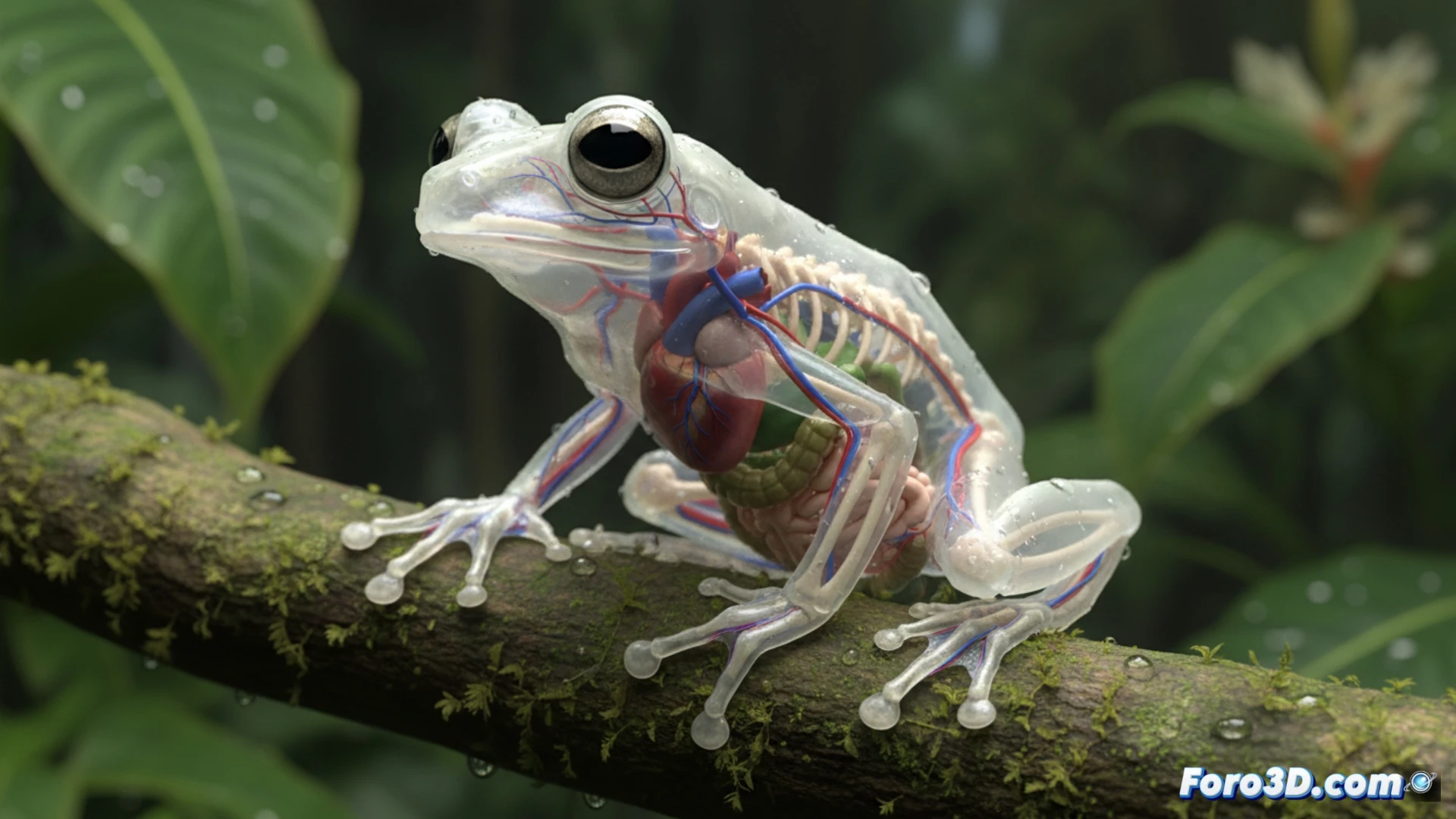
The recent documentation of Hyalinobatrachium guayacano in Costa Rica reveals a specimen whose translucent abdomen exposes arteries and white bones with clarity. For scientific visualization, this anatomical feature represents a technical challenge: digitally recreating biological transparency without losing structural precision. Three-dimensional modeling allows for virtually dissecting the amphibian, offering a unique educational window into its internal systems.
Photogrammetry and Translucent Rendering for Biological Specimens 🐸
The digital capture of the frog requires high-resolution photogrammetry with controlled lighting to record both the opaque dorsal surface and the crystalline ventral one. In the modeling software, density maps and subsurface scattering (SSS) are applied to simulate how light passes through the skin and muscle tissue. The main challenge is calibrating the opacity of the dermis so that blood vessels and the skeleton are visible without distortion. Tools like Blender or ZBrush allow isolating anatomical layers, generating an asset that biologists can rotate to study cardiac irrigation or bone structure without invasive intervention.
Transparency as a Tool for Scientific Outreach 🔬
This 3D model transforms biological rarity into an accessible educational resource. By removing the barrier of real dissection, students and researchers can explore the internal physiology of Hyalinobatrachium guayacano from any device. Translucent visualization not only preserves the specimen but also democratizes anatomical knowledge, allowing the beauty of its visible arteries to inspire new questions about the evolution of this adaptation in neotropical amphibians.
What lighting techniques and translucent materials do you recommend to accurately simulate the visibility of the arterial and skeletal system through the skin of the glass frog in a 3D model intended for scientific visualization?
(PS: at Foro3D we know that even manta rays have better social bonds than our polygons)