The discovery of the Chimaera supapae in the depths of the Andaman Sea represents a milestone for marine biology. For the scientific visualization niche, this creature offers a fascinating technical challenge: digitally reconstructing a being of which we have barely any physical samples and morphological descriptions. The goal is to generate a photorealistic 3D model that not only disseminates the finding but also serves as a study tool for researchers.
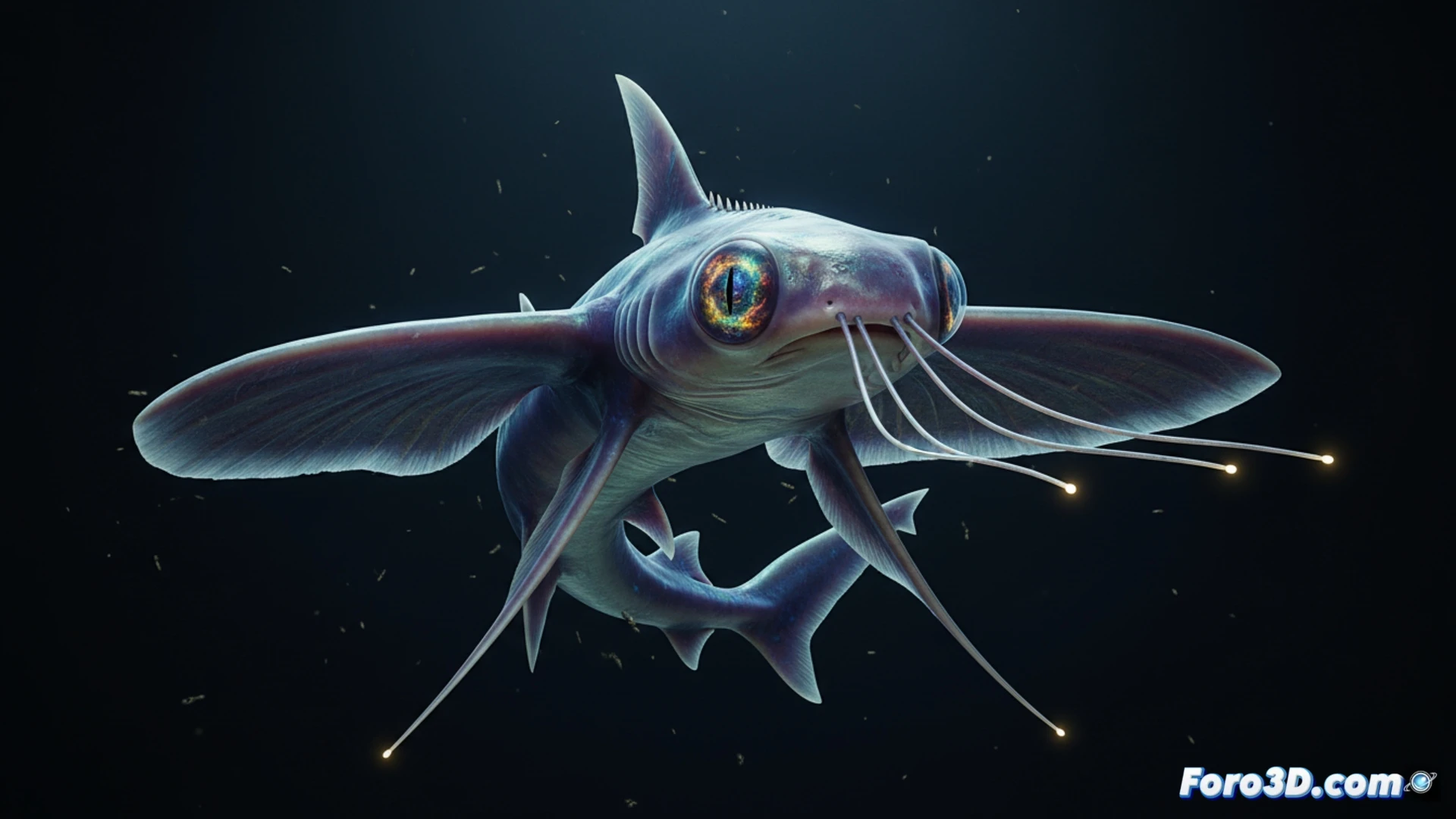
Anatomical Reconstruction and Texturing of the Specimen 🐟
The process begins with the analysis of data from the original description. The base of the model is a cartilaginous skeleton that must be sculpted with precision in software such as Blender or ZBrush. The critical point is the recreation of the giant, iridescent eyes; for this, multi-layer shaders are used to simulate underwater light scattering (subsurface scattering) and a color gradient ranging from emerald green to deep blue. The skin texture, smooth but with sensory pores, is generated by projecting high-resolution images of museum specimens and adjusted with roughness maps to simulate the mucus covering the animal. The fins, thin and translucent, require a vertex system with dynamic weight to simulate their undulation in the current.
Habitat Visualization and Scientific Outreach 🌊
Beyond the isolated model, the final piece must be integrated into a scene that reflects its ecosystem: the bathyal zone of the Andaman Sea. This involves lighting the scene with monochromatic blue ambient light and adding marine snow particles (organic detritus) to provide scale. The real value of this visualization lies in its ability to communicate the rarity of the animal; by rendering the model with an animation rig, biologists can study the mechanics of its caudal fin or the position of its luminescent organs, transforming a textual discovery into an immersive visual experience for the scientific community.
What is the main technical challenge when recreating the iridescence of the eyes of the Chimaera supapae in a 3D model when seeking to simulate its luminescent behavior in the deep sea?
(PS: modeling manta rays is easy, the hard part is making them not look like floating plastic bags)