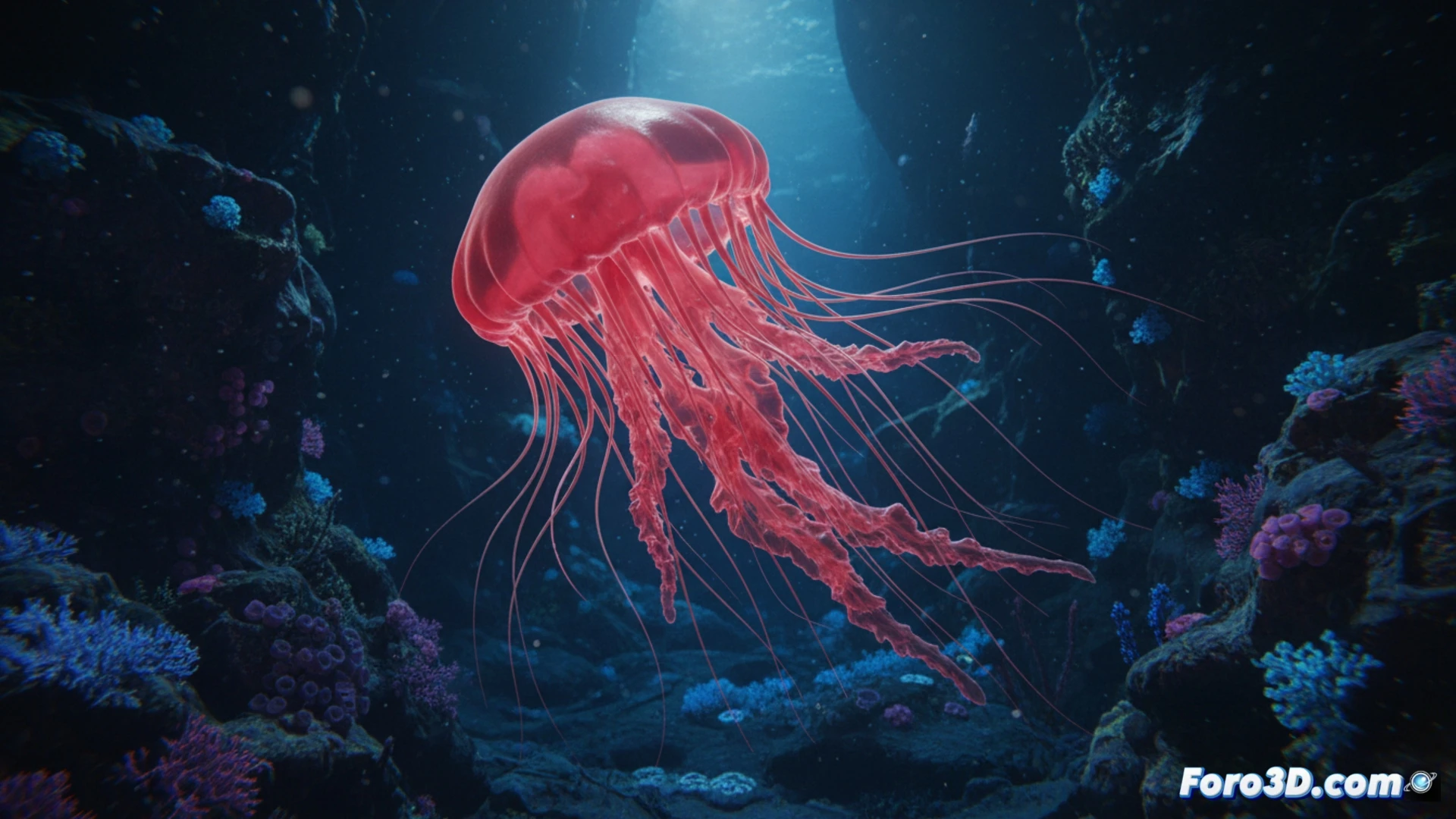
The Poralia rufescens, known as the Blood Jellyfish, has been sighted in the submarine canyons of the Atlantic, challenging our understanding of life in the deep sea. Its body, an intense red and almost translucent, appears to bleed under the lights of submersibles, offering a unique visual spectacle. This finding is not only a biological milestone but also a perfect opportunity to apply scientific 3D visualization techniques, allowing researchers and the public to explore its anatomy without disturbing its fragile ecosystem.
Morphological Reconstruction and Habitat Simulation 🧬
For our photorealistic model, we started from high-definition video data captured by the ROV (Remotely Operated Vehicle). The polygonal mesh of the Poralia rufescens is built with a focus on surface subdivision to capture the fluidity of its bell, which can reach 60 centimeters in diameter. Texturing is key: we apply a subsurface scattering (SSS) shader to emulate the translucency of its tissue, combined with a roughness map that simulates the viscosity of the epidermis. The environment simulation includes a particle system for bioluminescent plankton and a volumetric lighting engine that replicates the bluish light of a submersible. By projecting a beam of warm light onto the model, the SSS reacts, making the intense red of the jellyfish seem to radiate from within, recreating the 'bleeding' effect observed in the actual recordings.
Chromatic Adaptation and Evolutionary Comparison 🌊
The red coloration of the Poralia rufescens is not arbitrary; it is an evolutionary adaptation for invisibility. In the depths, where red light is absorbed first by water, this hue acts as perfect camouflage. By contrasting our 3D model with representations of other abyssal jellyfish, such as the Atolla wyvillei (with its alarm bioluminescence) or the Chrysaora fuscescens (from surface waters), we can visualize how morphology and color specialize. Our simulation allows scientists to adjust depth and light spectrum parameters to understand how the Poralia rufescens perceives and is perceived by predators and prey, offering a digital window into survival strategies in the abyss.
How would you animate the behavioral patterns described in the study?