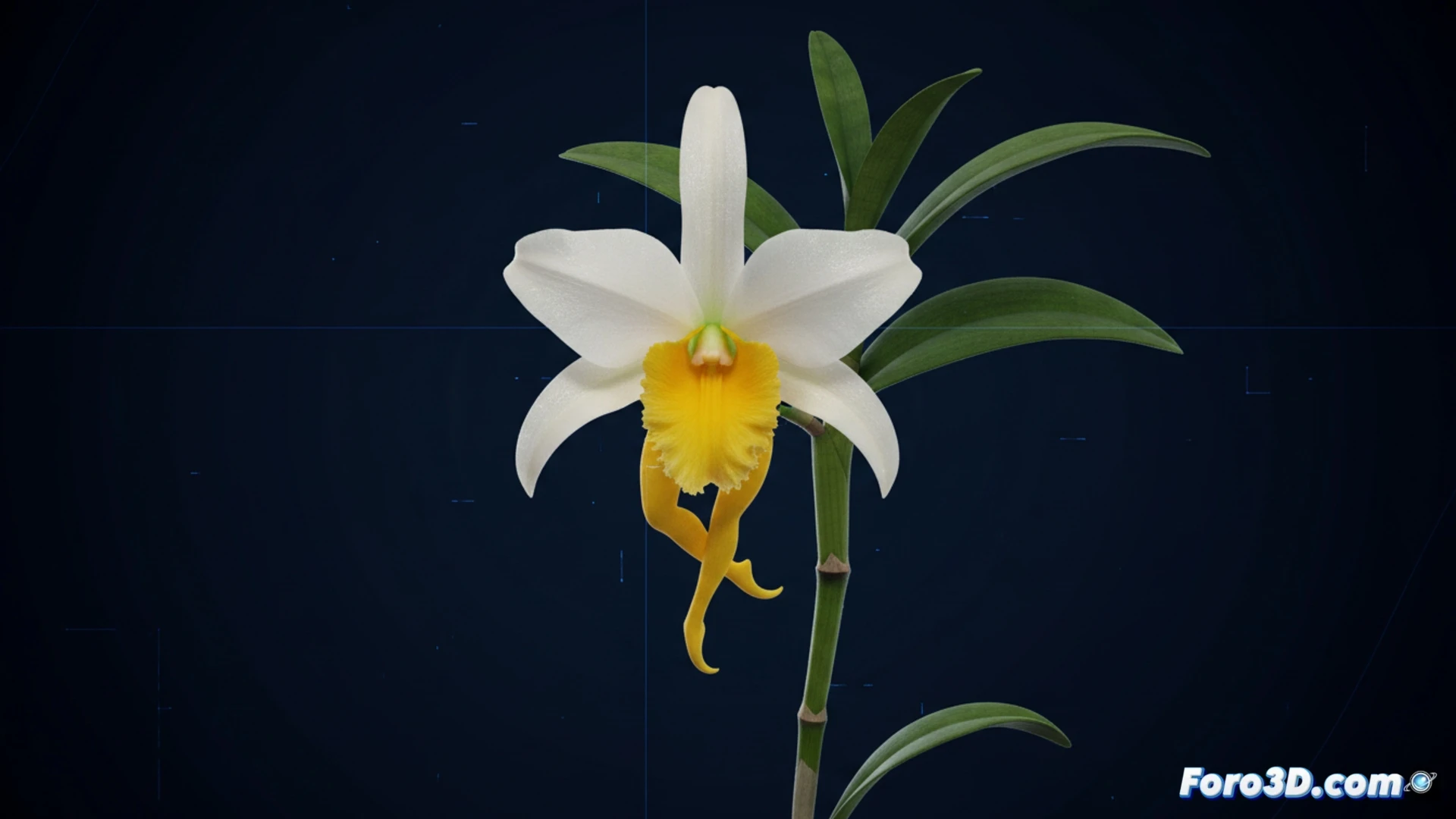
The recent description of Dendrobium jaintianum in India (2023) has captured the attention of the botanical community due to its unique morphology. With immaculate white petals and a yellow lip that evokes the silhouette of a dancer in motion, this species presents a fascinating challenge for scientific 3D visualization. Accurately representing its floral anatomy allows not only for documenting its structure but also for exploring the evolutionary adaptations that give it such a singular appearance.
Modeling and rigging pipeline for anatomical research 🌸
To capture the essence of Dendrobium jaintianum, the process begins with photogrammetry of herbarium specimens to obtain an accurate polygonal base. The structure of the lip, which forms the dancer's body, requires detailed NURBS modeling to replicate its dynamic curvature. The white petals, acting as the moving dress, benefit from light fabric simulations to achieve visual fluidity. The dorsal sepal, acting as the head, is modeled with a slight tilt. High-resolution PBR textures are applied, using subsurface scattering (SSS) maps to simulate the translucency of the petals. Floral rigging, though complex, is key to animating pollination and demonstrating how the flower attracts its nocturnal pollinators.
Educational applications and the legacy of a natural silhouette 🦋
This 3D model transcends mere aesthetics by integrating into virtual reality platforms for botany classrooms. Students can virtually dissect the flower, observing the arrangement of the column and pollinia from any angle. Furthermore, the animation of the lip, which mimics a dancer's swaying in the wind, serves as a teaching tool to explain mimicry in orchids. Ultimately, this project demonstrates that nature is the best designer, and that our role as modelers is to translate its choreography into visual data that inspires future generations of scientists.
Can the combination of photogrammetry of botanical specimens and parametric modeling in Blender accurately replicate the unique and asymmetric morphology of the sepals of Dendrobium jaintianum for scientific analysis?
(PS: if your manta ray animation doesn't excite, you can always add documentary music from channel 2)