The recent description of Nepenthes trogon in Malaysia (2024) offers a fascinating challenge for scientific visualization. This carnivorous plant, named for its chromatic resemblance to the trogon bird, presents intense red pitchers that lie at ground level. Its hunting strategy, focused on walking ants, makes this species an ideal subject for developing hyperrealistic 3D models that detail its unique morphology and its interaction with the understory ecosystem.
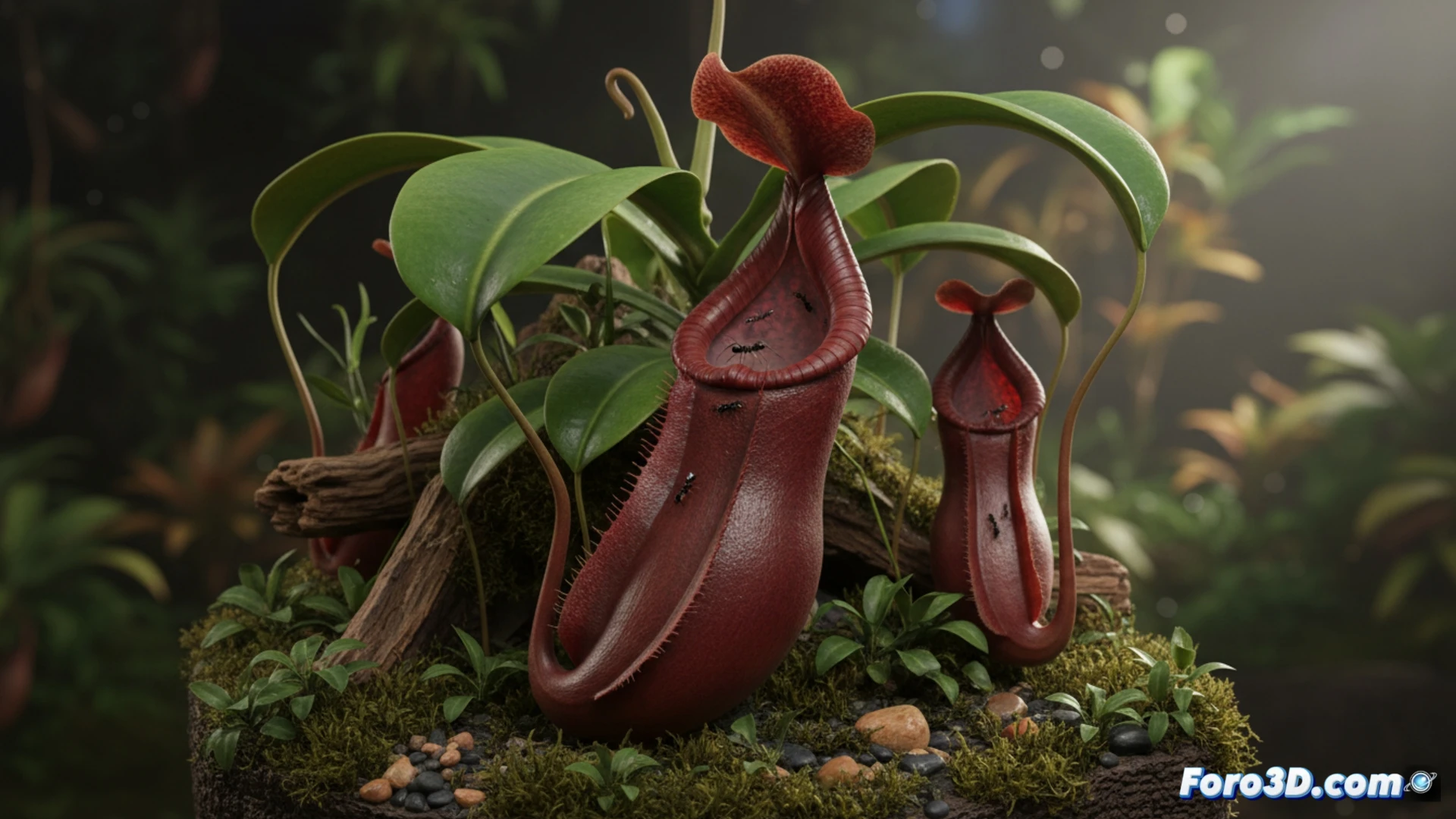
Digital anatomy and simulation of the capture mechanism 🧬
For a rigorous 3D model, it is crucial to accurately represent the structure of the ascidium (pitcher). The peristome, or pitcher rim, must be modeled with a grooved and waxy texture, key for ants to slip into the interior. The lid or operculum, which prevents dilution by rain, requires translucent shading. A technical animation could simulate the pH gradient in the digestive fluid, from the upper zone (less acidic, where prey drown) to the bottom (proteolytic enzymes). It would be valuable to include a polygonal mesh comparison with other upright-pitcher Nepenthes, highlighting the ground adaptation of N. trogon.
Beyond the model: botanical outreach in 3D 🌿
The true potential of this 3D model lies not only in realism but in its educational capacity. By rendering the plant in its natural context, with dim forest canopy lighting and particles simulating leaf litter, one can visually explain why the red color is effective for attracting ants in the darkness of the ground. An interactive model would allow the user to section the pitcher to observe digestive glands and decomposing prey, transforming a taxonomic fact into an immersive learning experience about the evolution of carnivorous plants.
What advantages does photogrammetry offer over traditional manual modeling for accurately capturing the complex three-dimensional morphology of the peristome and operculum of Nepenthes trogon in a scientific visualization article?
(PS: fluid physics for simulating the ocean is like the sea: unpredictable and you always run out of RAM)