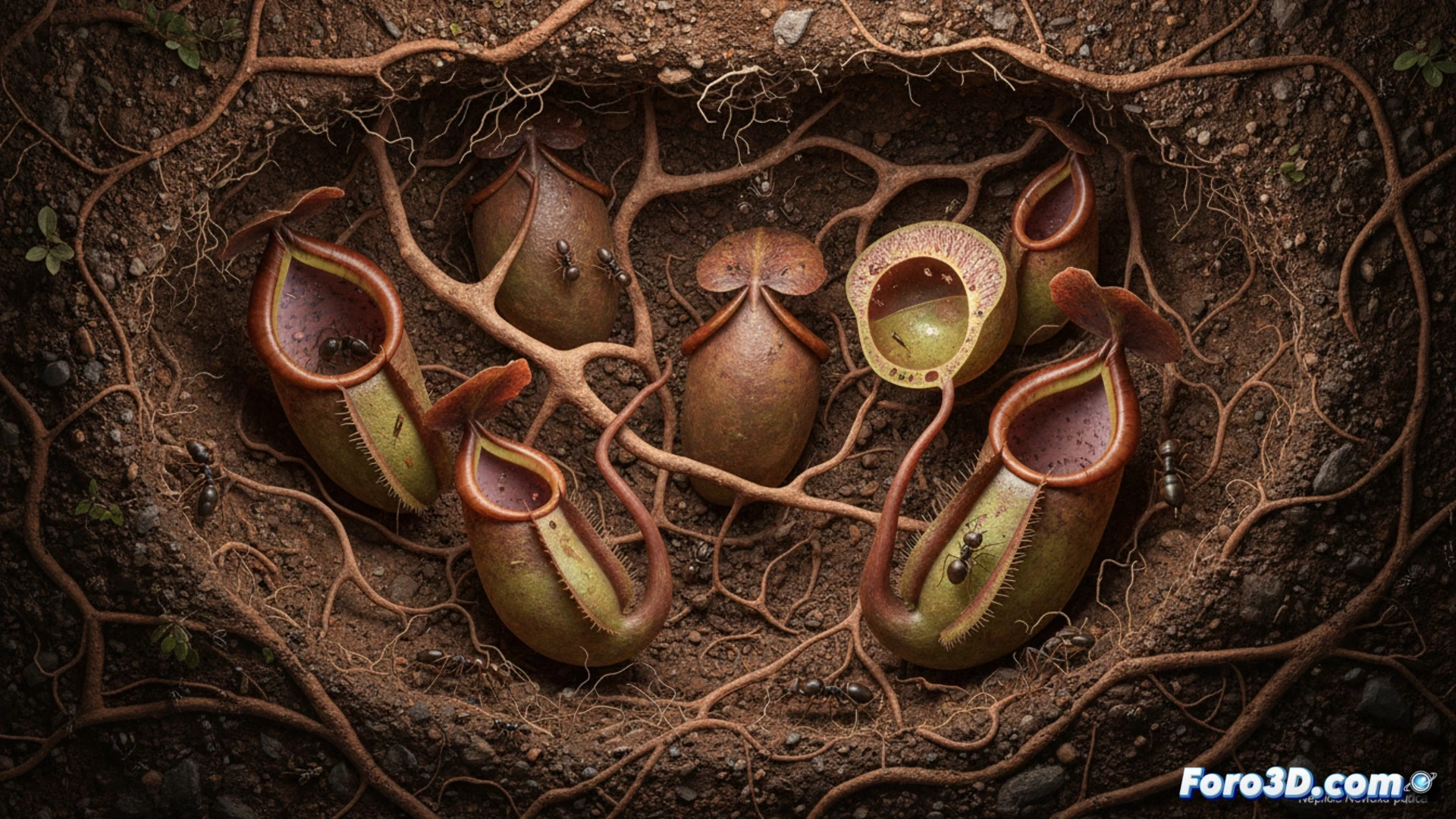
The discovery of Nepenthes pudica in Borneo has redefined the morphology of carnivorous plants. Unlike its epiphytic relatives, this species has evolved to bury its pitchers in the ground, capturing ants and mites in an underground ecosystem. To visualize this adaptation, we propose a detailed 3D model that allows analysis of its hidden anatomy and simulation of its hunting mechanism.
Model construction and simulation of the underground ecosystem 🌿
The 3D model must represent two key cross-sections: one of the Bornean peat soil and another of the interior of the pitcher. The geometry of the capture organ requires a curved design with a reduced operculum and a waxy internal surface, textured with a translucency gradient to simulate filtered light. The animation should include particles of detritus and ants (genus Camponotus) falling through a root channel. The critical step is the simulation of the digestion chamber: a semi-transparent viscous fluid with enzyme bubbles that activates upon contact. For visual comparison, an epiphytic Nepenthes rajah should be placed alongside, showing its hanging aerial pitchers, contrasting the rough surface texture with the smooth, buried one of pudica.
The challenge of representing invisible evolution 🔍
The most fascinating aspect of this project is translating an evolutionary adaptation into a visual language. By modeling the underground traps, we not only show a structure but also explain why the plant chose the soil: to avoid competition for flying insects and take advantage of a moist, protected niche. The final render should evoke a sense of discovery, as if the viewer were digging with their own hands through the leaf litter of Borneo to reveal a biological secret hidden in plain sight.
What specific technical challenges does the volumetric reconstruction and realistic texturing of underground cavities and internal digestive fluids present in a cross-section of Nepenthes pudica?
(PS: if your manta ray animation isn't exciting, you can always add documentary music from channel 2)