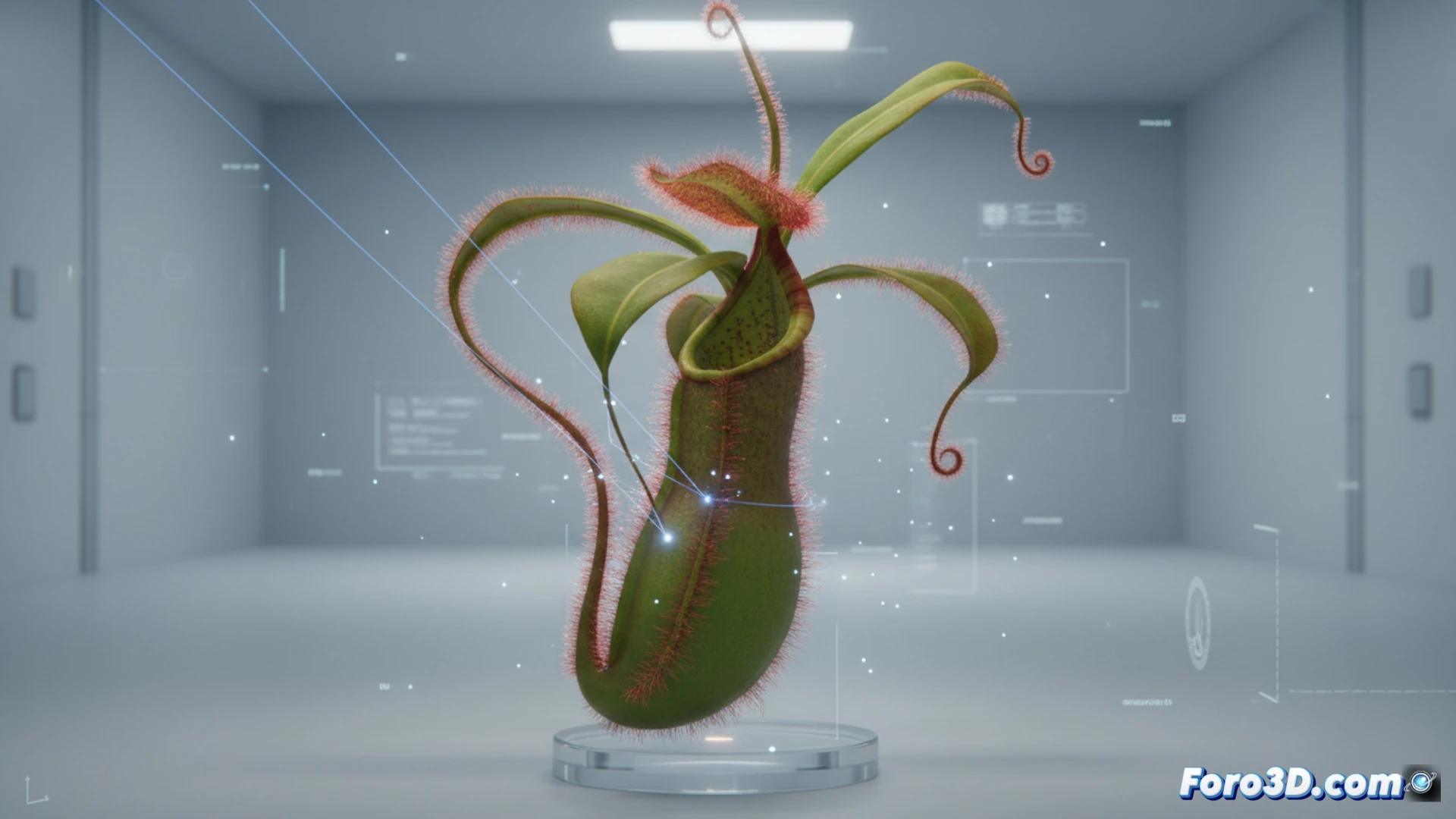
The Nepenthes hirtella, known as the Soft-Haired Pitcher Plant, is a species endemic to the cloud forests of the Philippines, officially discovered in 2023. Its most distinctive feature is a dense layer of short, reddish hairs covering its traps, a unique trait among carnivorous plants. For the scientific community, accurately representing this morphology is a challenge requiring advanced 3D modeling and texturing techniques, aiming to create educational resources that explain its capture mechanism without harming living specimens.
Technical process of photogrammetry and texturing 🌿
To capture the Nepenthes hirtella in 3D, the ideal workflow combines field photogrammetry with corrective manual modeling. In the cloud forest, between 200 and 400 high-resolution photographs of the specimen are taken, prioritizing diffuse lighting to avoid harsh shadows on the red hairs. The reconstruction software generates a base mesh that is then retopologized in applications like Blender or ZBrush. The real challenge is texturing the trichomes (hairs): displacement and alpha maps are created from microscopic images to simulate the density and vibrant red color. Animating the capture mechanism requires simulating the elasticity of the peristome (pitcher rim) and the viscosity of the digestive fluid, integrating particle physics to represent the movement of insects.
The value of visualization in scientific outreach 🔬
This 3D model not only serves as a digital document of a newly discovered species but also transforms the teaching of botany. By animating the trap in its virtual cloud forest habitat, students can observe in detail how the red hairs act as a visual lure for pollinating insects, a behavior difficult to film in nature. Scientific visualization also allows simulating extreme light and humidity conditions to predict how the plant responds to climate change, turning an artistic model into an active research tool.
How can the unique morphology of the peristome and lid of Nepenthes hirtella be modeled in 3D to accurately simulate its function in prey capture within a scientific visualization environment?
(PS: at Foro3D we know that even manta rays have better social bonds than our polygons)