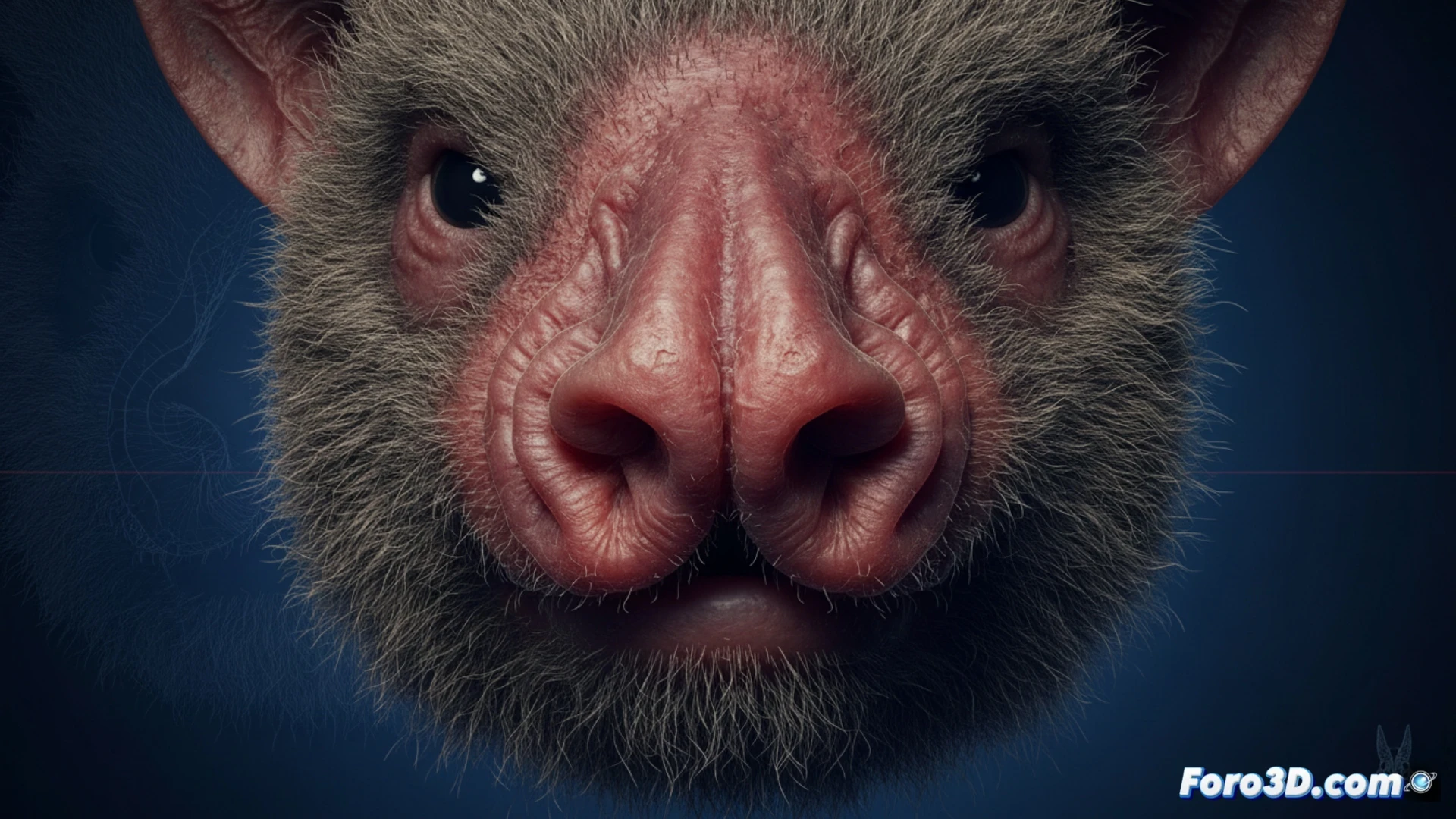
The Vietnamese leaf-nosed bat (Hipposideros sp.) possesses one of the most complex nasal structures in the animal kingdom, an evolutionary marvel designed for echolocation in the dense jungle. For a Foro3D writer, this species represents a fascinating technical challenge: recreating in three dimensions the intricate leaflets and folds that modulate sound. This article explores how to approach modeling this biological adaptation for use in scientific visualization and outreach.
Digital sculpting techniques for acoustic anatomy 🦇
To model the nose of Hipposideros, it is recommended to start with a high-resolution photogrammetric scan of a museum specimen, capturing every fold of the nose leaf. In software like Blender or ZBrush, digital sculpting should focus on the resonant cavities and lateral folds that act as acoustic lenses. Once the geometry is modeled, the next step is the simulation of sound waves using particles or vector fields. By rendering the emission of ultrasound, one can visualize how the nose focuses the sound beam, allowing the bat to distinguish a night moth among dense foliage. The key is to texture with displacement maps that mimic the rough, vascularized skin, crucial for the scientific fidelity of the model.
Visualizing evolution in the dark 🌙
Beyond technical modeling, this project forces us to reflect on the role of 3D art in science. By animating the breathing and contraction of the bat's facial muscles, we show not just a structure, but a living, dynamic process. The representation of echolocation waves interacting with the jungle environment translates abstract data into an immersive visual experience. For biologists and science communicators, this type of model not only explains a trait but tells the story of a struggle for survival in the Vietnamese night, demonstrating that 3D modeling can be the ultimate tool for deciphering the secrets of evolution.
How can the complex geometry of the Vietnamese leaf-nosed bat's nose, with its structure of lobes and folds, be modeled to simulate its function in echolocation and airflow analysis?
(PS: at Foro3D we know that even manta rays have better social connections than our polygons)