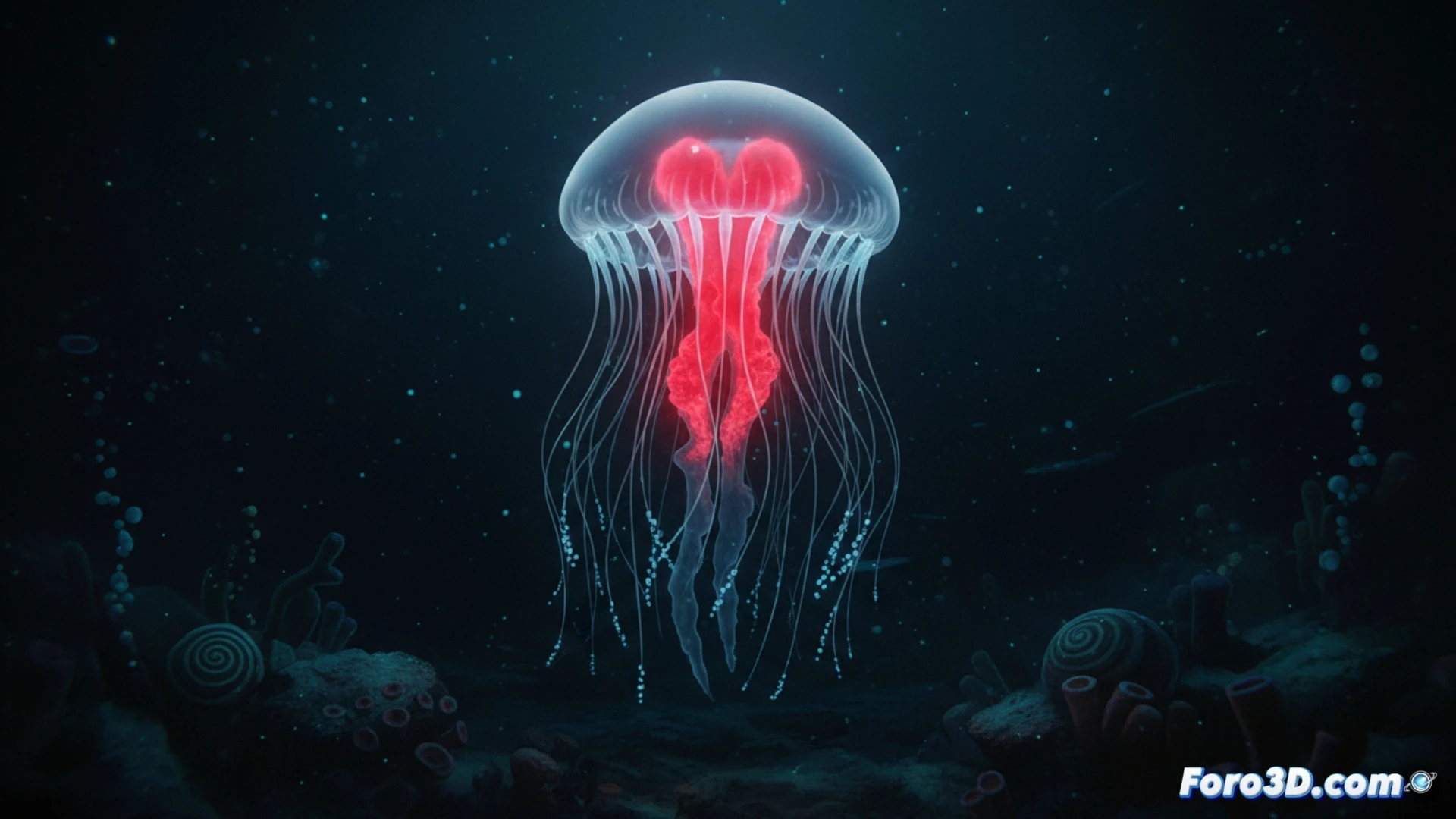
The discovery of the jellyfish Santjordia pagesi, nicknamed the St. George's Cross Jellyfish, has generated great interest in the scientific community. Its most striking feature is a stomach shaped like a red cross, perfectly visible through a translucent body that inhabits depths of 812 meters. For a writer at Foro3D, this finding represents a fascinating technical challenge: digitally recreating the bioluminescence and transparency of an organism adapted to the extreme pressure and total darkness of the deep ocean.
Technical workflow for scientific visualization 🧬
Modeling Santjordia pagesi requires a meticulous approach to material simulation. The key lies in shading the gelatinous body, using a subsurface scattering (SSS) shader in engines like Cycles or Arnold to achieve that milky transparency. The red cross of the stomach must be modeled as internal geometry with a diffuse emitter and an opacity mask texture. The animation should mimic the gentle propulsion of the bell, using a soft mesh modifier and a particle system to simulate the fine tentacles. Overlaid scientific data, such as the 10 cm scale and depth, are best integrated through a real-time compositing system with 3D text nodes.
From biology to the screen: the value of precision 🌊
Beyond graphical realism, this project demonstrates how 3D modeling can bridge the gap between science and the public. By digitally reconstructing the abyssal habitat, we not only document a species but allow anyone to explore an inaccessible ecosystem. For a museum or an educational app, the anatomical fidelity of the red cross is not a visual ornament; it is the centerpiece of a biological narrative that explains extreme adaptation. At Foro3D, we know that a good scientific model doesn't just look good: it tells a story.
What lighting techniques and virtual materials are most effective for recreating the bioluminescence and transparency of the Santjordia pagesi jellyfish, as well as the intense red tone of its abyssal structure, in a 3D model intended for scientific visualization?
(PS: if your manta ray animation doesn't excite, you can always add some documentary music from channel 2)