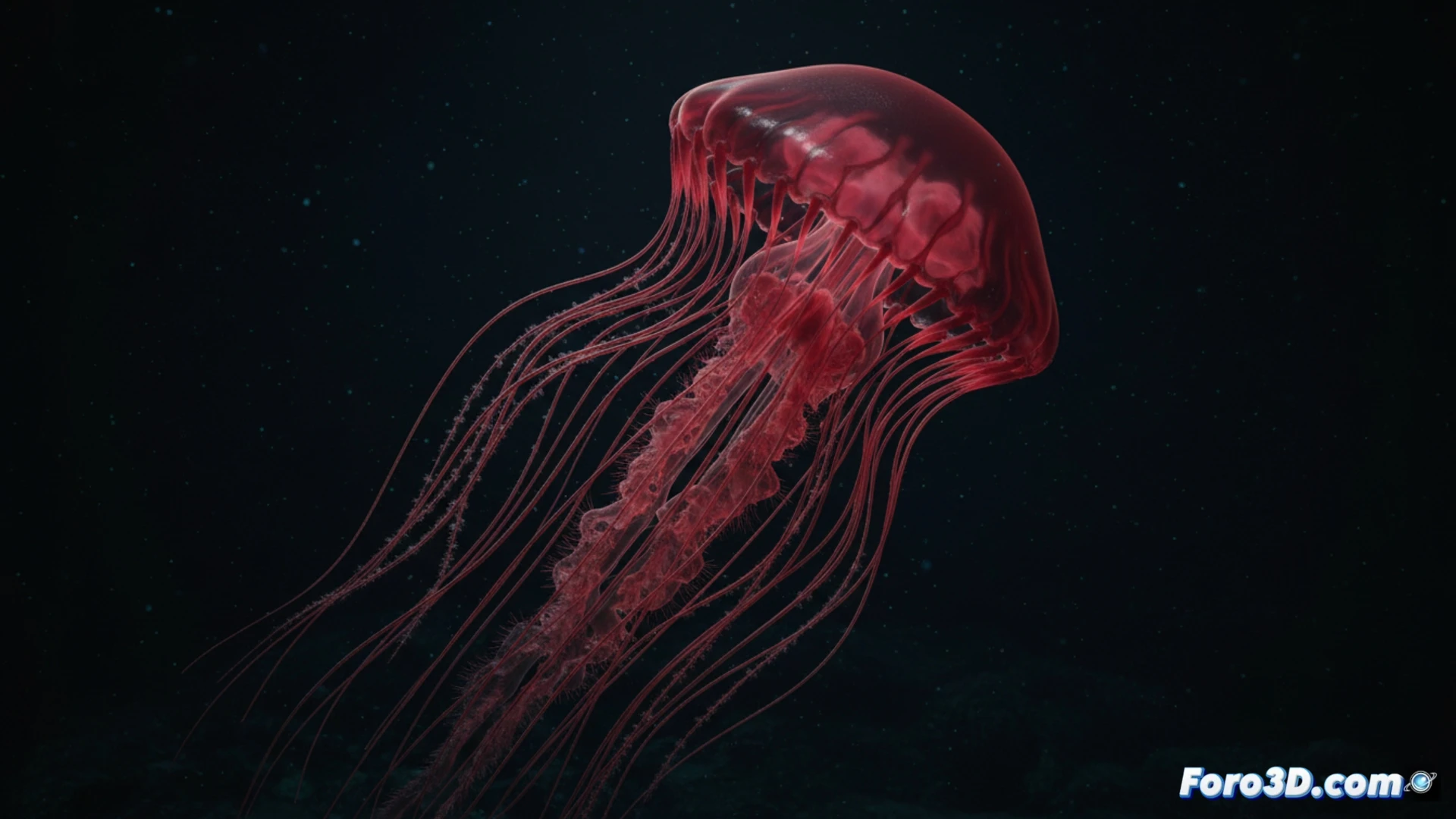
The hadal zone, comprising the deepest ocean trenches below 6,000 meters, harbors extraordinary creatures such as the jellyfish Benthocodon sp. This organism, with an intense dark red color and translucent body, lives close to the seafloor. Its study presents enormous logistical challenges for marine biologists. This is where 3D scientific visualization becomes an indispensable tool for unveiling the secrets of these hard-to-reach species.
Anatomical modeling techniques and simulation of abyssal ecosystems 🌊
To digitally recreate Benthocodon sp., a multidisciplinary approach is required. The modeling must capture its hemispherical bell, about 2-3 centimeters in diameter, using translucent materials with subsurface scattering (SSS) to emulate the body's gelatinous nature. The red pigmentation, which acts as camouflage against the bioluminescence of its prey, is achieved with color and roughness maps. Simulating the hadal environment involves recreating extreme pressure and total darkness, using particle systems for marine sediment and rigging to animate the tentacles in a slow drifting motion. The feeding behavior, based on capturing small crustaceans like amphipods, is programmed through collision dynamics and attraction systems.
The value of digital reconstruction in researching the inaccessible 🔬
Creating this model not only serves an aesthetic purpose but fulfills a critical function in outreach and research. By digitizing Benthocodon sp., scientists can conduct morphometric studies without the need for costly expeditions. Furthermore, it allows for the generation of interactive educational material that brings the general public closer to ecosystems that remain more unknown than the surface of Mars. At Foro3D, we believe that every precisely placed polygon is a step towards understanding the biodiversity of our own planet.
What 3D modeling methodologies allow for the most faithful representation of the transparency and bioluminescence of the hadal jellyfish Benthocodon sp. for use in scientific visualization?
(PS: at Foro3D we know that even manta rays have better social connections than our polygons)