The Strumigenys zandala, popularly known as the galactic armor ant, exhibits one of the most extreme mandibular morphologies in the animal kingdom. Discovered in the forest canopy of Southeast Asia, this species has developed a jaw-closing system that rivals the most advanced hydraulic mechanisms in engineering. Its appearance, seemingly plucked from a science fiction film, is actually the result of millions of years of evolutionary pressure to capture soft-bodied prey at supersonic speeds.
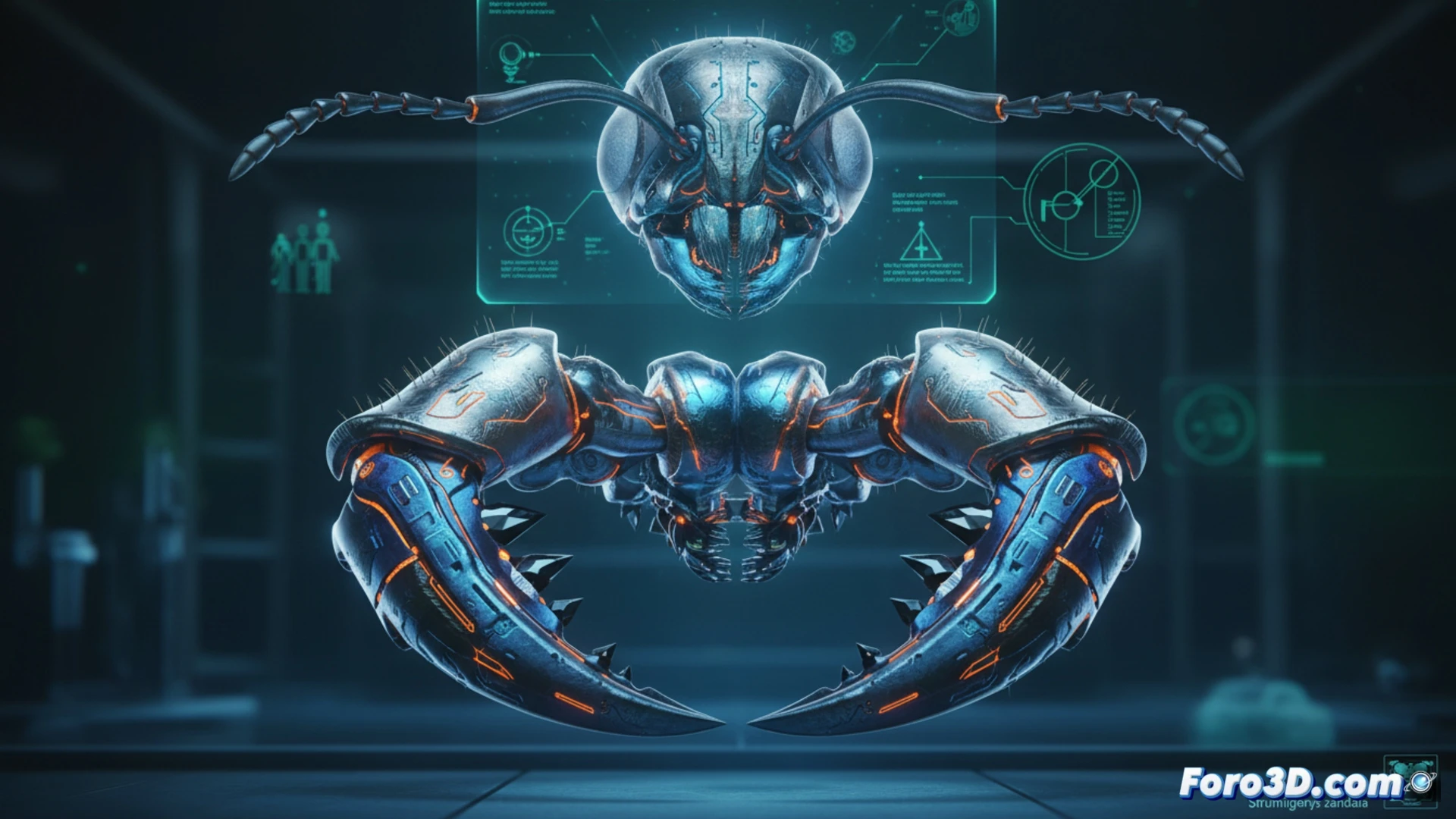
Anatomical reconstruction and simulation of the firing mechanism 🐜
For the 3D modeling of this species, the main technical challenge lies in the jaw articulation. Unlike other trap-jaw ants, Strumigenys zandala possesses a locking and spring system that stores potential energy. In our model, we have recreated the sclerotized cuticle and adductor muscle fibers that enable closure in less than 0.13 milliseconds. The animation shows how the jaw opens at an angle of nearly 180 degrees, and upon detecting contact with prey, it fires like a harpoon. We have used fluid dynamics simulations to visualize the air displacement generated by the movement, a crucial detail for understanding how the ant hunts in the darkness of the understory.
Alien aesthetics as an educational tool 👽
When rendering this ant, we encountered a fascinating dilemma: reality surpasses fiction. The chitinous structures, with their iridescent textures and angular shapes, resemble an interstellar battle helmet. This visual aspect is not an accident but a pedagogical opportunity. By comparing our 3D model with that of related species such as Strumigenys rostrata, we can trace evolutionary lines that explain how extreme specialization leads to morphologies bordering on the fantastic. Interactive diagrams allow the user to break down each mandibular segment, revealing that the true wonder lies not in its appearance, but in the biomechanical precision of its hunting.
Which biomechanical simulation and topological meshing techniques are most effective for accurately modeling the hyper-fast jaw kinematics of the Strumigenys zandala ant in a scientific visualization environment?
(PS: if your manta ray animation doesn't excite, you can always add documentary music from channel 2)