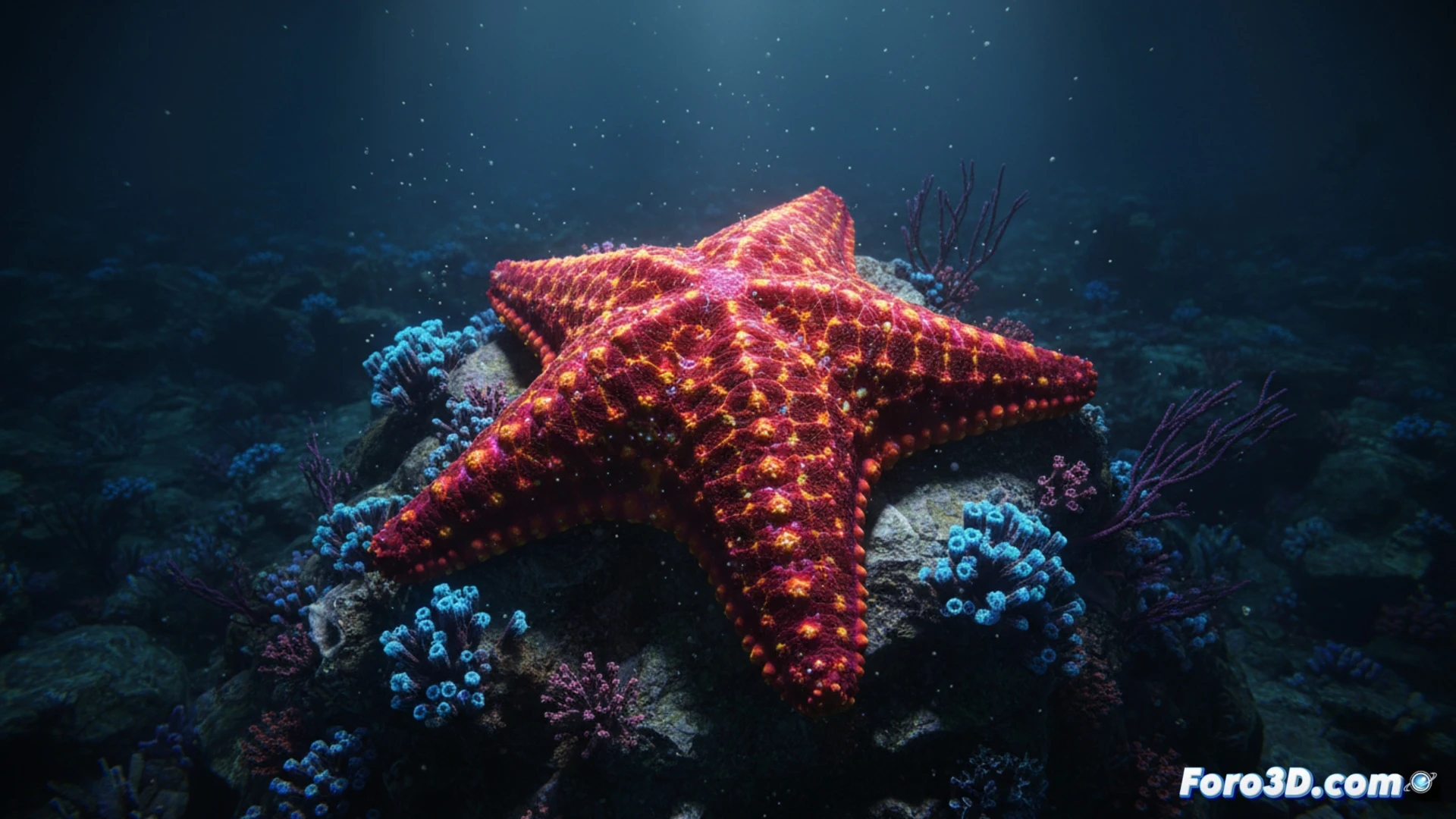
The discovery of the Plinthaster dentatus, known as the Nazca Cookie Starfish, represents a milestone in deep-sea marine biology. This echinoderm inhabits coral gardens at depths of over a thousand meters and stands out for its almost perfect pentagonal symmetry and vibrant pigmentation that contrasts with the abyssal darkness. Its unique morphology makes it an ideal candidate for photorealistic 3D representation, allowing scientists and the public to explore its anatomical details without the need for a costly underwater expedition.
Modeling Process and Recreation of the Abyssal Habitat 🌊
To create an accurate digital asset, modeling begins with the analysis of high-resolution scientific photographs and tomography data. The geometry is built starting from a base pentagon, to which subdivisions are applied to achieve the granular texture and small characteristic protuberances of its epidermis. Shading requires a layer system that simulates the birefringence of red and orange pigments under the bluish light of the seabed. The recreation of the environment at a thousand meters relies on real bathymetric data from the Nazca Ridge, applying a particle system to represent marine snow and using displacement maps for hard corals and glass sponges, achieving volumetric lighting that simulates the scattering of sunlight at that depth.
The Value of Visualization in the Conservation of Abyssal Species 🐚
Scientific visualization transcends mere aesthetics; it is a conservation tool. By creating a digital twin of the Nazca Cookie Starfish, researchers can measure its symmetry, analyze growth patterns, and simulate ecological interactions without disturbing the fragile ecosystem. This 3D model, accessible for virtual reality platforms, allows the general public to understand the hidden biodiversity of ocean trenches, fostering an emotional connection with species they will never see alive and promoting protection policies for deep-sea coral habitats.
What specific technical challenges does the capture and digital reproduction of the calcareous texture and symmetrical patterns of Plinthaster dentatus present for scientific 3D visualization?
(PS: modeling manta rays is easy, the hard part is making them not look like floating plastic bags)