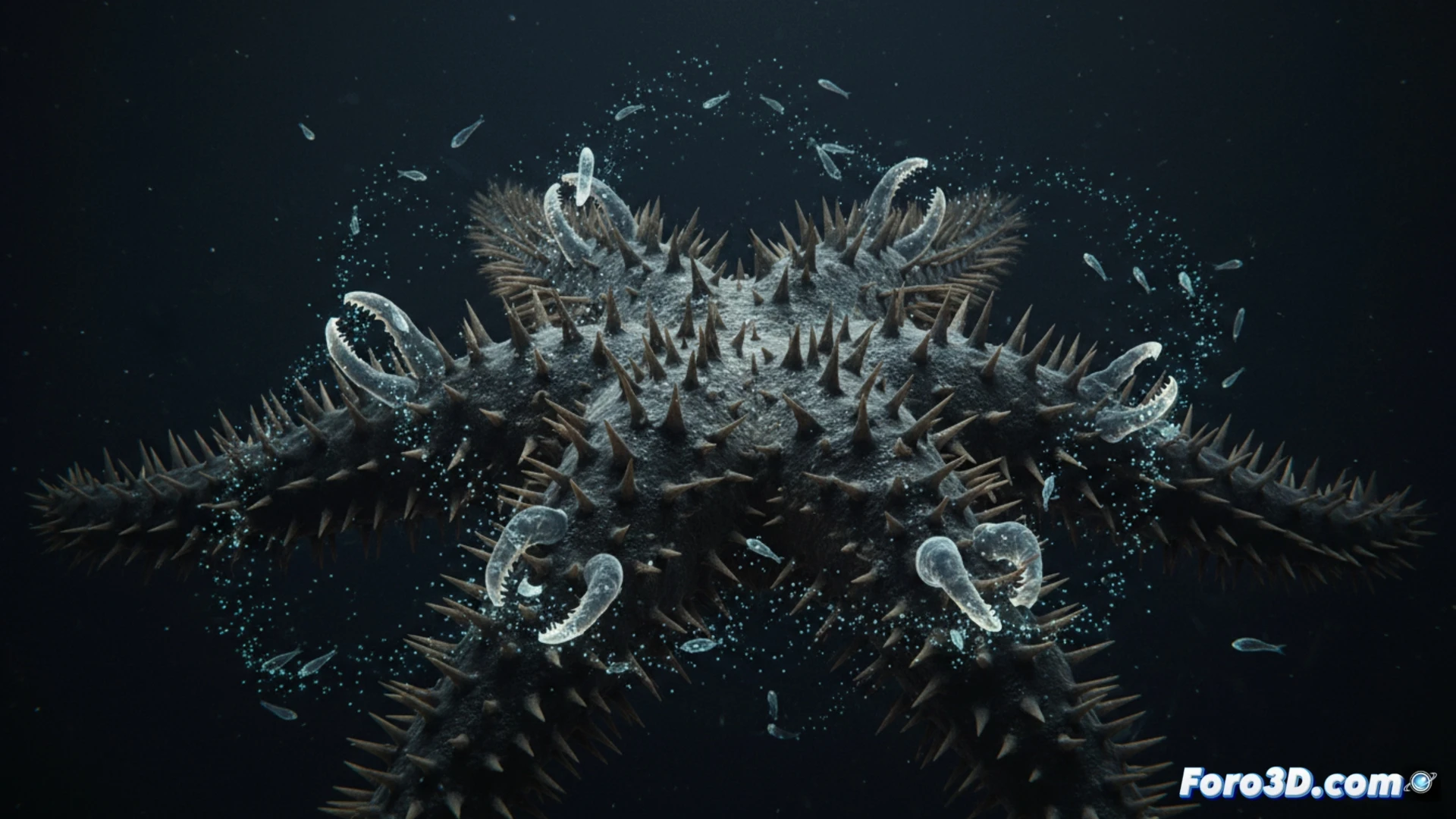
The abyssal Crown of Thorns starfish (Coronaster sp.) represents a fascinating challenge for scientific visualization. Inhabiting the ocean depths, this echinoderm is distinguished by its multiple thin and fragile arms, covered in tiny pincers known as pedicellariae. These structures, invisible to the naked eye, are the key to its survival in total darkness. A detailed 3D model allows us to unravel the secrets of its anatomy and hunting method, offering a window into an extreme ecosystem where light does not reach.
Digital Anatomy and High-Fidelity Renders for the Scientific Niche 🌊
For an accurate representation, modeling must focus on two critical aspects: the radial morphology of its arms and the microstructure of the pedicellariae. The use of digital sculpting (ZBrush or Blender) is recommended to create the characteristic rough texture of its epidermis and the trifid pincers. Rigging is essential to simulate the undulating and slow movement of the arms. High-quality renders should employ dim volumetric lighting, simulating the bioluminescent light of the seabed, with a macro focus that reveals the pedicellariae in action, opening and closing to trap small crustaceans. The animation should show the capture process: the arm curves, the pincers snap shut and hold the prey, all in slow motion to appreciate the biomechanics.
Beyond the Model: Infographics and Virtual Museums 🐚
The value of this model transcends the mere render. Integrating it into interactive infographics allows the viewer to explore the evolutionary adaptations of Coronaster sp., such as chemoreception in its arms or resistance to abyssal pressure. For a virtual museum or documentary, an immersive scene can be created: the starfish on a substrate of dark sediment, surrounded by suspended particles. The animation of the pedicellariae becomes the focal point, educating the public on how life thrives at the limits of the known, transforming a biological fact into an unforgettable visual experience.
How can the biomechanics of pedicellariae in an abyssal crown of thorns starfish be modeled to simulate their capture function in a high-pressure environment without distorting the polygonal mesh?
(PS: modeling manta rays is easy, the hard part is making them not look like floating plastic bags)