The scientific community has received with astonishment the discovery of Abyssocladia diegoramosi, a carnivorous sponge found in the Antarctic depths in 2024. Unlike its filter-feeding relatives, this organism uses sticky filaments to capture small crustaceans. For the field of scientific visualization, this specimen represents a fascinating technical challenge: recreating in 3D its unique morphology and innovative hunting mechanism in an extreme abyssal environment.
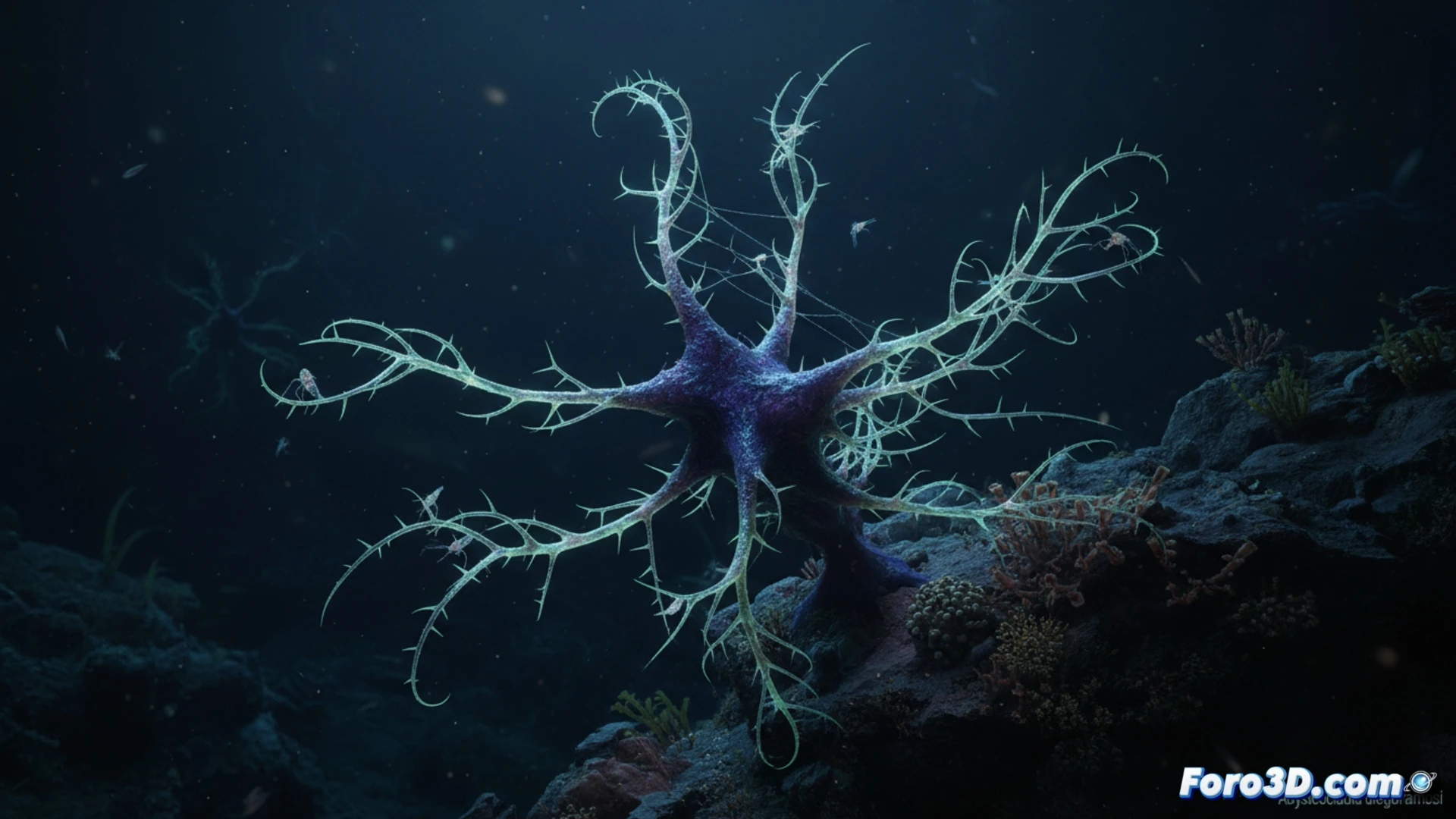
Technical workflow for recreating the capture mechanism 🧊
Modeling should begin with the sponge's basal structure, using a particle system to generate the adhesive filaments. The key lies in the dynamic simulation of these appendages, which in reality deploy like a microscopic fishing net. The use of software such as Blender or Houdini is recommended to apply soft body physics and procedural rigging. The animation should show the filament making contact with a crustacean (modeled with a segmented exoskeleton) and the subsequent slow contraction toward the central body, mimicking peristaltic movement. Lighting should be dim, with a single deep blue spotlight to simulate the ambient bioluminescence of the Antarctic abyss.
The visual paradox of evolution: filter feeder vs predator 🦑
The visual contrast between a traditional filter-feeding sponge and Abyssocladia diegoramosi is the core of the outreach. While the former is a porous, static tower, the carnivorous one is an active trap with tentacles. For the viewer, this 3D model not only documents a species but illustrates a radical evolutionary leap: how the scarcity of nutrients on the seafloor forced a sessile organism to develop an active hunting system. The animation should end with a split-screen comparative shot, showing both feeding strategies in real time.
How can the 3D modeling of the carnivorous sponge Abyssocladia diegoramosi reveal unique biomechanical adaptations for prey capture under conditions of extreme pressure and total darkness on the Antarctic seafloor?
(PS: modeling manta rays is easy; the hard part is making them not look like floating plastic bags)