The recent documentation of a brightly colored burrowing snake on the island of Siquijor, Philippines, presents a fascinating challenge for scientific visualization. This species of the genus Calamaria, with its contrasting red and yellow belly, inhabits the deepest layers of leaf litter in island rainforests. Our goal is to digitally recreate this organism for anatomical and behavioral study.
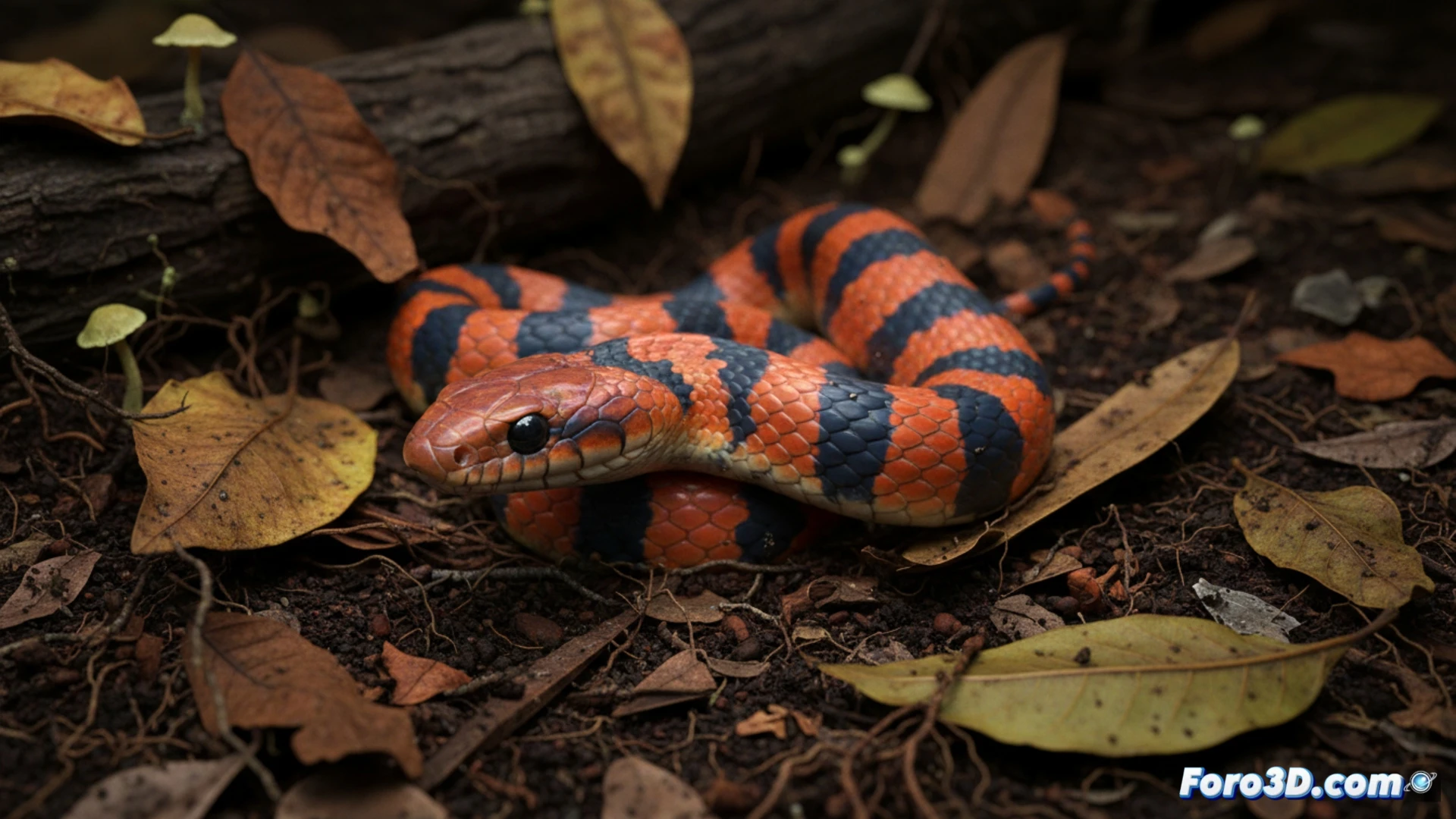
Anatomical reconstruction and photorealistic texturing 🐍
For the 3D model, we will start from reference scans of preserved specimens to ensure osteological accuracy. The polygonal mesh must capture the characteristic scalation of the genus, with smooth dorsal scales and a head indistinct from the neck, adapted to a fossorial lifestyle. Texturing will be critical: a dark dorsal gradient transitioning into a vibrant red and yellow ventral pattern, using displacement maps for the scales and physically based shading (PBR) that simulates the natural iridescence of the skin. The underlying musculature will be modeled to allow realistic serpentine locomotion animations.
Ecosystem visualization and burrowing behavior 🌿
The digital environment will replicate the microhabitat of the Siquijor rainforest. A volume of leaf litter will be generated with physics simulation for particles, where the snake moves using non-destructive rigging. Volumetric lighting should simulate the understory twilight, with rays of sunlight filtered through the tree canopy. This model will allow biologists and educators to observe how Calamaria uses its morphology to navigate the substrate, offering an interactive window into an ecosystem that is difficult to access for direct observation.
What texture mapping and translucency simulation techniques do you recommend to faithfully represent the vibrant coloration patterns of Calamaria sp. in a 3D model intended for scientific visualization?
(PS: here at Foro3D we know that even manta rays have better social connections than our polygons)